
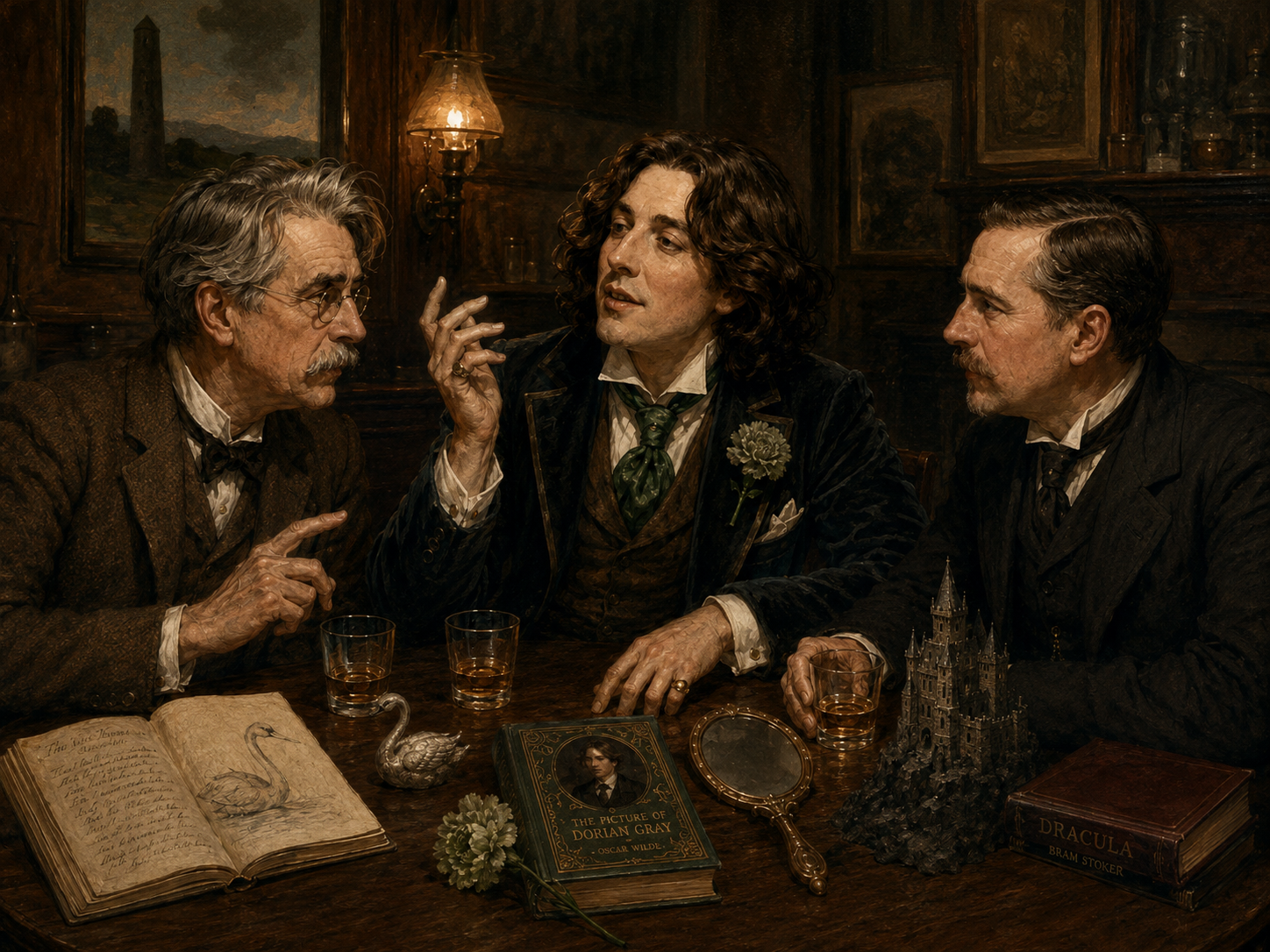
Picture Dublin at the turn of the last century.
Thomas Street smells like warm grain and hot copper, because George Roe’s distillery is running there and shipping two million gallons a year on its own. Add the Jamesons and John Powers and the city’s four big houses are pushing close to ten million gallons between them. Irish whiskey is the most popular spirit on earth. It’s better than 60 percent of every whiskey sold in America.
Now go around the corner into the pubs, because that’s where this story actually lives.
The rooms are full of people who’ll end up on university reading lists. Yeats, building a theatre and headed for a Nobel Prize in 1923. Joyce, a young man taking notes on a city he’ll spend his life describing from a safe distance. Lady Gregory. Bram Stoker. Bernard Shaw. Beckett shows up in 1906 and collects his own Nobel in 1969.
They keep terrible hours. They argue for sport. They do their best thinking with a glass in front of them.
And what’s in the glass is the whole reason I love this story. The fashionable pour of that era was a marriage of single pot still and single malt, no grain whiskey filling out the middle. Drinkers called it the champagne of Irish whiskey. It was rich, oily, a little fruity, and it was everywhere.
Then It Vanished
The whole thing came apart inside two generations.
Prohibition took America. The trade war of the 1930s closed off Britain and the Commonwealth. Bootleggers stuck “Irish whiskey” labels on whatever poison they could find, and a generation of drinkers learned to flinch at the words.
Ireland had at least 28 working distilleries in the 1890s. By 1966 there were two. Output fell from roughly twelve million cases a year to under half a million.
Twelve million to four hundred thousand. An entire industry going out like a candle. And that fashionable old blend, the pot still married to malt, died right along with the houses that made it. Nobody was making it anymore because there was almost nobody left to make anything.
A Man Making Coffee in the Alps
Ninety-odd years later, an Irishman named Bernard Walsh is working in Switzerland, making Irish coffees for guests at ski chalets. One of them is a woman named Rosemary. She marries him.
People keep asking for the drink. He gets tired of building them one at a time, all evening, so in 1999 the two of them bottle a mix and start selling it. That’s the whole origin story. No distillery, no inheritance, no family recipe going back six generations. A guy who got tired of stirring.
The coffee business taught him about whiskey, and the whiskey wouldn’t let him go. He signed a supply agreement with Irish distillers in 2006 and started blending.
He wasn’t reaching for something new. He went looking for that old Victorian pour, the pot still and malt marriage that had gone extinct, and he built it back. Ex-bourbon casks. Forty percent. Orchard fruit and vanilla up front, a soft grassy note from the malt, and that oily pot still weight underneath holding it all up.
By 2009 he had the whiskey. What he needed was a name.
Back to the Pubs
He had two loves, whiskey and books. So he went back to that Dublin, the one with the poets and the arguments and the ten million gallons, and he pulled out an old line people used to say about the men and women in those rooms.
They loved the stuff so much, the saying went, that when they wept, their tears were whiskey.
Bit much. Also unforgettable, which is rather the point.
Now pour one yourself and give the glass a slow turn. Watch the streaks run back down the inside. Most of us call those legs. Wine people have used another word for the same thing for a few hundred years, and it still sits in the spirits dictionaries right alongside: tears. The higher the alcohol, the more of them you get, which is why a good pot still whiskey puts on such a show.
Which meant there were two sets of tears sitting there waiting to be named after. The ones the poets were supposed to have wept, and the ones running down the glass in your hand.
He got both out of the same word.
Writers’ Tears.


