
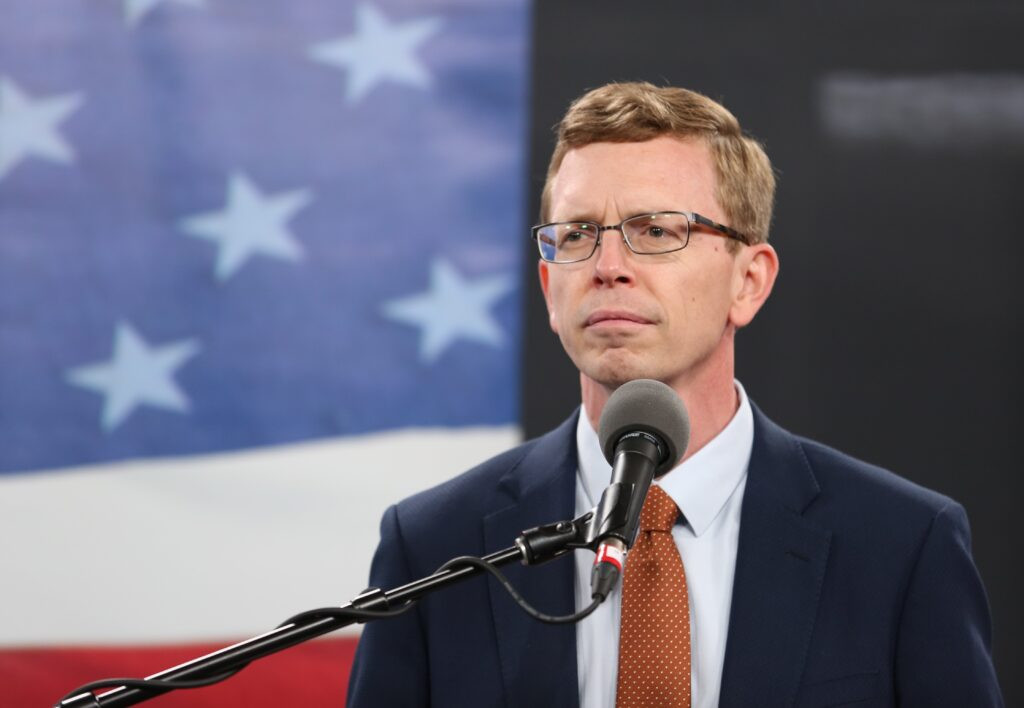
U.S. Rep. Dusty Johnson, R-South Dakota, participates in a debate on Oct. 15, 2024, in Sioux Falls. (Joshua Haiar/South Dakota Searchlight)
After lawmakers and Gov. Larry Rhoden put new restrictions on a controversial governor-controlled economic development fund, U.S. Rep. Dusty Johnson pledged Friday that if he’s elected governor, he will use $2 million from the fund to create a new local business startup program.
The Future Fund was created in 1987 at the request of then-Gov. George Mickelson, a Republican. South Dakota employers pay fees to the fund when they remit unemployment payroll taxes. The fund was placed under the governor’s exclusive control, enabling quick responses when economic opportunities arise.
Uses of the fund have periodically stirred controversy. Republican former Gov. Kristi Noem incited bipartisan backlash with her use of the fund, which included paying for a fireworks show at Mount Rushmore, a Rapid City-area shooting range that legislators refused to fund, a Sioux Falls rodeo, and a workforce recruitment campaign in which Noem starred.
Election 2026
News and commentary on statewide races and ballot questions.
During the annual legislative session that ended Thursday, state lawmakers narrowly rejected one bill that would have required the governor to seek approval of Future Fund awards from the state Board of Economic Development, and defeated another bill that would have made employer contributions to the fund voluntary rather than automatic.
Rhoden signed a bill into law Tuesday that makes reforms to the Future Fund, including the addition of definitions for acceptable uses, requiring more reporting to legislators about awards, stipulating information required of applicants, directing the Governor’s Office of Economic Development to formulate rules governing the fund’s use, and requiring the office to make recommendations to the governor about potential awards.
Johnson said his “Launch South Dakota” plan would expand proof-of-concept grants for early-stage companies, increase support for startups, bolster a local business-plan competition, and ensure the best use of federal small-business funding.
“Chasing huge companies like TikTok grabs headlines, but building South Dakota means investing in South Dakotans,” Johnson said in a press release.
Rhoden publicly backed Wyoming resident Reid Rasner’s failed effort to acquire TikTok and bring its operations to South Dakota last year. A South Dakota Searchlight investigation found little to support Rasner’s ability to bid for TikTok, and found that he was more than $1 million in debt due to a loan he received from a family trust.
Johnson and Rhoden are two of the candidates for the Republican nomination for governor in the June 2 primary election. Another candidate, state House Speaker Jon Hansen, has been critical of many state economic development efforts that he has described as “corporate welfare.” Businessman Toby Doeden has said the state is too focused on recruiting out-of-state companies and should focus more on helping homegrown entrepreneurs.
Johnson’s ‘Launch South Dakota’ plan
Key aspects of governor candidate Dusty Johnson’s plan to use $2 million from the Future Fund to help local business startups:
- Johnson said existing proof-of-concept programs assist a small number of early stage entrepreneurs in limited fields with $25,000 in funding. Johnson would increase the number and size of the awards, including the creation of a second, $25,000 follow-on grant once key milestones are met. He said the program would be expanded to better support software, technology and artificial intelligence startups.
- Johnson said his administration would expand support for venture development organizations that provide startup coaching and mentoring to South Dakota startups.
- South Dakota’s Giant Vision Business Plan Competition runs a “Shark Tank”-style competition in which finalists pitch their businesses for a chance to win $20,000 in startup funding. The plan would increase the prize pool and expand the event’s marketing.
- Johnson said South Dakota allocated its entire $60 million federal State Small Business Credit Initiative allocation to a loan program, missing an opportunity to provide high-growth startups with technical and capital assistance. He said most states used at least some of those dollars for venture development for founders, which is what his administration would do.


