
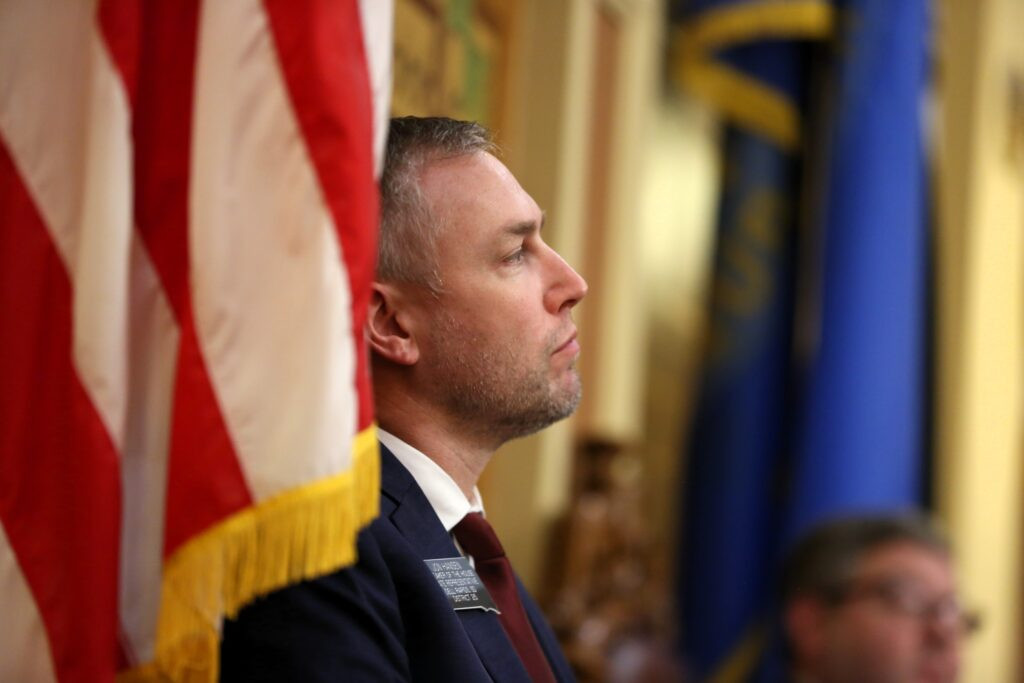
South Dakota Speaker of the House Jon Hansen, R-Dell Rapids, listens to Gov. Larry Rhoden’s State of the State address on Jan. 13, 2026, at the Capitol in Pierre. Hansen is the sponsor of a bill defining “man” and “woman.” (Photo by Meghan O’Brien/South Dakota Searchlight)
Differing ideas about a person’s sex and gender played out Friday at the South Dakota Capitol in Pierre as a legislative committee advanced a bill defining “man” and “woman.”
The Republican speaker of the state House of Representatives, Jon Hansen, said he introduced the bill to answer a question he thinks has a simple answer: “What is a woman?”
“This legislation simply establishes clear, consistent definitions for terms like man, woman, male, female,” Hansen said. “Definitions grounded in biological reality.”
Lawmakers on the House State Affairs Committee voted 10-2 to advance the bill to the full House. In addition to serving on the committee and as speaker of the House, Hansen, of Dell Rapids, is one of four announced candidates for the Republican nomination for governor in the June primary election.
Governor signs bills regulating transgender bathroom use and requiring obscenity appeal process
Under the definitions in the bill, “female” would be an individual who “naturally has, had, will have, or would have, but for a congenital anomaly or intentional or unintentional disruption, the reproductive system that produces, transports, and utilizes eggs for fertilization.”
“Male” would be defined similarly, but for producing sperm. The bill defines “sex” as an individual’s “biological sex, either male or female.”
“These are not new or novel ideas,” Hansen said. “The definitions in this bill reflect the biological reality that has existed since the beginning of humanity.”
The bill defines women and men as adult, human females and males, and girls and boys as minor females and males.
The American Psychological Association and the World Health Organization define gender as being socially constructed, while sex is biological. Bill supporters, like Cindy Meyer of Hartford, see them as one and the same.
“I just believe that we are created man and woman, male and female,” she said. “Just like the other animals that have been created male and female.”
The committee’s two Democratic members, Representatives Erin Healy of Sioux Falls and Eric Emery of Rosebud, cast the two no votes against the bill. Emery, a member of the Rosebud Sioux Tribe, said the tribe’s view of gender has long included language for people who do not fit into a man-woman binary. Those people are referred to as “two-spirited” today.
Matt Sharp, with Arizona-based Alliance Defending Freedom, said definitions tied to biology are necessary to protect the safety, fairness and equality of women and girls, particularly in intimate spaces and in sports. He said the bill accounts for “disorders of sex development” by treating anomalies as disruptions in development, not additional sexes.
Opponents focused on legal and administrative risk. They warned that imposing rigid definitions in the section of law governing terms used “throughout the code” would create complications that could lead to conflicts with civil rights law.
Bill adjusting bathroom law also advances
Separately, what the sponsor called a “cleanup bill” in response to South Dakota’s 2025 law prohibiting transgender people from using public restrooms or changing rooms aligned with their gender identity passed the committee 12-0.
Last year’s bill was driven by supporters’ concerns about privacy and safety in women’s and girls’ spaces and concerns about transgender women and girls accessing female-designated facilities.
The bill from Rep. David Kull, R-Brandon, would add targeted carveouts so spaces shared by firefighters, law enforcement personnel or theatrical performers of different sexes are not criminalized.
GET THE MORNING HEADLINES.


