
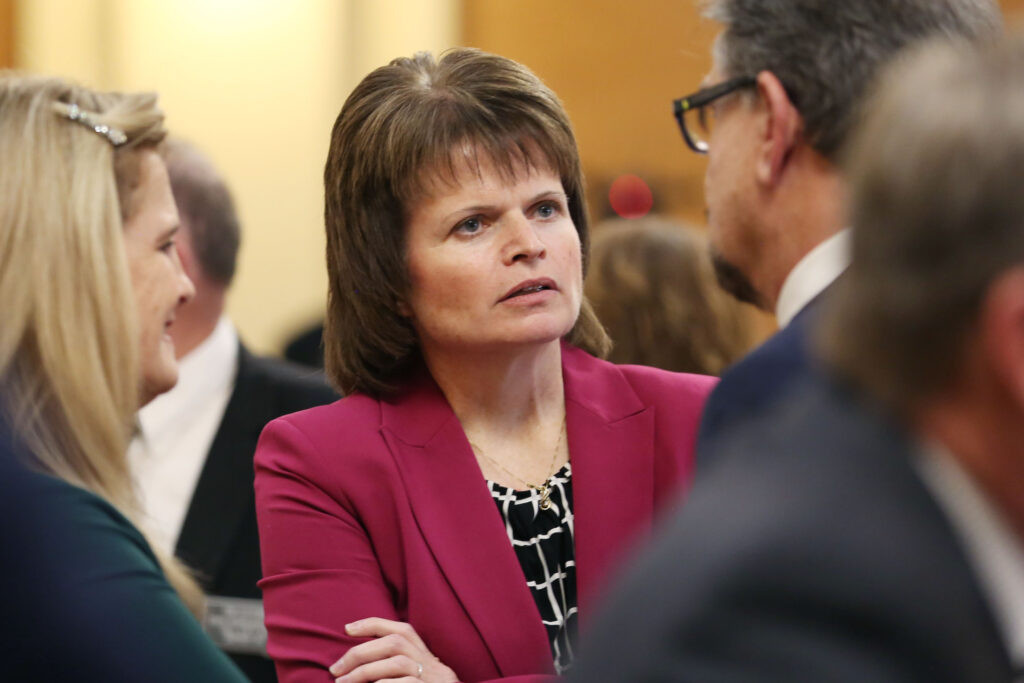
Sen. Lauren Nelson, R-Yankton, speaks with lawmakers on Dec. 3, 2024, at the South Dakota Capitol in Pierre. Nelson is the sponsor of a bill during the 2026 legislative session that would authorize charter schools. (Photo by Makenzie Huber/South Dakota Searchlight)
Lawmakers advanced a bill to allow charter schools in South Dakota on a 4-3 committee vote Tuesday, after debate over whether the proposal would expand opportunity or further strain public schools.
Charter schools are publicly funded, privately run, tuition-free schools that operate independently of the local school district and with some autonomy over scheduling and curricula. The schools receive public money based on the number of students they enroll.
A handful of states, including South Dakota, do not allow charter schools.
Sen. Lauren Nelson, R-Yankton, introduced the bill. It would authorize charter schools to operate with their own boards under contract with the state Department of Education. The schools would have autonomy over staffing and curriculum, but would have to comply with certain state standards and requirements, or risk closure. They would be funded via per-pupil dollars that would follow students from their current school district.
Searchlight Report podcast
Voices from South Dakota politics and policy. Listen >
Also available on Spotify, Apple Podcasts and YouTube.
Nelson and other supporters said charter schools provide families with more public-school options and support students with specialized needs. They emphasized that schools must demonstrate demand before opening.
Charlie Bufalino is the state advocacy director for the National Alliance for Public Charter Schools. He said that, on average, charter schools nationwide outperform traditional public schools.
“When public charter schools exist in a community, over time, it lifts the results of all public schools in that area,” he told lawmakers.
Supporters said charter schools could help students who struggle in traditional settings. Numerous examples of specialized programs that improve outcomes and help dropouts earn diplomas were cited.
Representatives of public school administrators, school boards and teachers urged lawmakers to reject the bill, warning it could create a “separate school system” and drain funding from traditional districts.
Rob Monson is the executive director of the School Administrators of South Dakota. He said South Dakota’s funding formula is based on enrollment counts. If students leave for charter schools, districts would lose funding while still paying fixed costs for buildings, buses and staff.
“If we start to siphon students off and send them to this charter school, it’s going to have an impact on all schools, but it’s certainly going to have an impact on rural schools more than larger schools,” he told lawmakers.
Opponents also said charter schools would be exempt from many state laws governing public schools and that the bill would require only 75% of teachers to be certified. They said the proposal could conflict with the state constitution’s requirement for a “uniform system of public schools.”
Additionally, opponents said districts already have tools to innovate without creating a new system. They said the state should fully fund existing schools before creating new ones.
The bill now moves to the full Senate for consideration.
Meanwhile, Gov. Larry Rhoden recently opted South Dakota into a federal program under President Donald Trump’s “One Big Beautiful Bill.” Under that program, South Dakotans who owe federal income taxes can either send up to $1,700 to the federal government, or they can donate that $1,700 to a government-recognized scholarship-granting organization benefiting public, private or homeschool entities in the state. The program starts next year.
South Dakota also has a program called Partners in Education that provides tax credits for insurance companies that fund scholarships for lower-income students to attend private school.


