
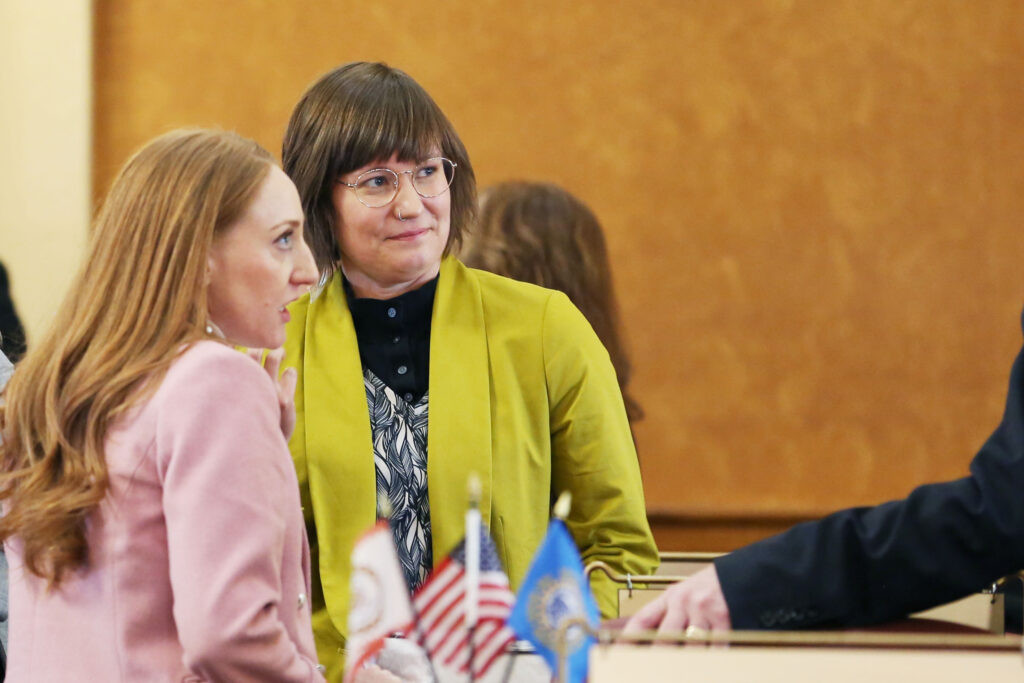
Rep. Nicole Uhre-Balk, D-Rapid City, speaks with Rep. Kadyn Wittman, D-Sioux Falls, left, in the South Dakota House of Representatives on Dec. 3, 2024, at the Capitol in Pierre. Uhre-Balk has a bill this legislative session to authorize biopools for small lodging establishments. (Photo by Makenzie Huber/South Dakota Searchlight)
PIERRE — Small lodges would be able to offer their guests a chlorine-free swimming experience under the terms of a bill approved Friday by the South Dakota House of Representatives.
House Bill 1299, sponsored by Rapid City Democrat Nicole Uhre-Balk, would allow establishments with 15 or fewer sleeping rooms to install biofilters for their pools. A biofilter is defined by the bill as a system that uses natural filtration processes to clean water, rather than chlorine.
Such systems use areas of plants, soil and rocks, physically separate from the pool, to clean water in a manner that mimics natural processes. Water flows through these regeneration zones, where microorganisms and beneficial bacteria in the soil leach out harmful contaminants, much like they do when water seeps through layers of soil on its way to aquifers.
The systems have caught on in other parts of the country and have grown popular in Europe, according to supporters who spoke in favor of the bill in the House Ag and Natural Resources Committee on Thursday. No one testified against the bill. The first natural pools opened in Europe in 1980 and in the United States in 2015.

Searchlight Report podcast
Listen to voices from South Dakota politics and policy.
Also available on Spotify, Apple Podcasts and YouTube.
One supporter owns a small vacation lodge in Spearfish, and told the committee he hopes to offer a natural pool amenity for his guests.
Under the bill, establishments like his that wish to use such systems could get an annual permit from the state Department of Health. The systems would need to be approved by the department, which would be required to promulgate rules on water quality testing standards, maintenance requirements and application procedures prior to issuing permits.
The filtration system would need to be inspected by the department once a year.
Uhre-Balk called it a “small step” to test the viability of a technology that reduces reliance on chemicals for commercial pools and offer chlorine-free options for the visitors who choose to stay in the small lodges scattered across the Black Hills.
Rep. Bobbi Andera, R-Sioux Falls, spoke in favor of the bill in the House by citing her own experience in a friend’s chlorine-free pool.
“It was amazing,” Andera said.
It passed 66-1. The lone no vote came from Rep. Spencer Gosch, R-Glenham. He also opposed the bill when it was presented in committee on Thursday. He did not speak in committee or on the House floor about why.
Via text message, he told South Dakota Searchlight he has concerns about efficiency and cleanliness, pointing to committee testimony about how it can take a day or two to clear out fecal accidents.
Uhre-Balk offered a nod to that issue in her testimony in the House. In committee, a biopool installer said shutdowns of a day or so are also normal for fecal emergencies in chlorinated pools.
All existing health and safety standards would need to be met for any non-chlorine pool, Uhre-Balk said, and the requirement to close a pool after such a situation until water quality returns would be the same.
“No filtration system, chemical or biological, changes the fact that kids will be kids,” Uhre-Balk said in the House.
The bill now moves to a state Senate committee.
GET THE MORNING HEADLINES.


