
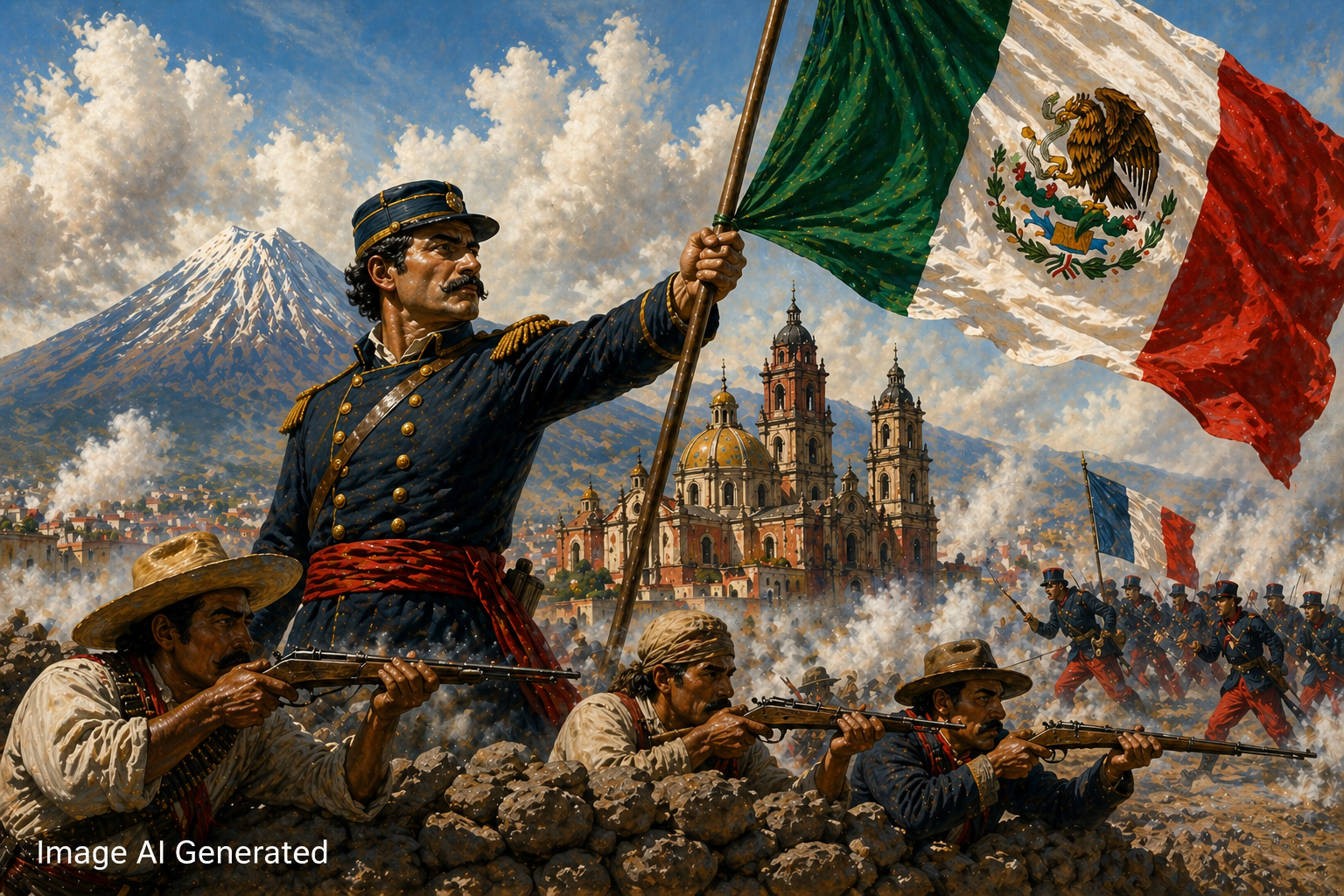
Every May 5th, millions of Americans crack open a beer, order a plate of nachos, and raise a glass to… something. A 2020 poll found that 41% of Americans believed Cinco de Mayo celebrated Mexican independence, and another 19% had no idea what it was. That’s 60% of the country celebrating a holiday they can’t explain.
Mexican Independence Day is September 16. Cinco de Mayo is something else entirely.
A Broke Country, a French Army, and One Unlikely Battle
By 1861, Mexico was in rough shape. Years of internal conflict had drained the country’s finances, and President Benito Juárez, a lawyer from the Zapotec people of Oaxaca, was forced to suspend payments on Mexico’s foreign debt. England, Spain, and France all sent troops to collect.
England and Spain negotiated and pulled out. Napoleon III kept his troops in place. He wanted to install a European monarch in Mexico, curb American influence in the region, and, according to some historians, potentially reintroduce slavery, which Mexico had abolished 30 years earlier.
On May 5, 1862, a French force of about 6,000 well-armed soldiers, who hadn’t lost a battle in nearly 50 years, marched on the city of Puebla. A Mexican army of roughly 4,000, many of them poorly equipped mestizo and Indigenous fighters under General Ignacio Zaragoza, held the city. Around 1,000 French troops were killed.
President Juárez declared May 5th a national holiday four days later. The first celebration was held on May 27, 1862, as news of the battle spread. The following year, people observed it on the actual date, and it stuck.
The Civil War Connection Most People Have Never Heard
The Battle of Puebla happened one year into the American Civil War. The Confederacy was pushing west, with ambitions to reach California. Napoleon III saw America’s distraction as his opening. A French-backed monarchy in Mexico could channel support to the Confederacy, extending slavery and tipping the war.
Historian Justo Sierra argued that had Mexico not stopped the French at Puebla, France would likely have aided the Confederate states. The Union might have lost. That’s a lot of weight to put on a single afternoon in a Mexican city, but the geopolitics were genuinely connected.
Mexican communities in California, Nevada, Oregon, and Texas started celebrating the Puebla victory the same year it happened, in 1862. Those communities were, at most, one generation removed from Mexican citizenship after the Mexican-American War had redrawn the border 15 years earlier.
How Cinco de Mayo Grew Bigger in America Than in Mexico
Walk up to someone in Mexico on May 5 and wish them a happy Cinco de Mayo, and you’ll probably get a polite but puzzled look. The holiday isn’t a federal holiday in Mexico, and outside of Puebla, it’s observed pretty quietly. The street festivals, the concerts, the sheer volume of guacamole consumed, that all developed north of the border.
UCLA professor David Hayes-Bautista, author of “El Cinco de Mayo: An American Tradition,” traces the holiday’s roots to Mexican American communities who saw the battle as part of their own story, tied to resistance and an identity that straddled two countries.
The Chicano Movement of the 1960s and 70s widened the celebration further. Activists used Cinco de Mayo to build Mexican American pride, connecting the battle’s anti-imperialist message to their own push for civil rights and political recognition.
Then beer companies arrived. In the 1980s, brands started targeting Spanish-speaking communities with Cinco de Mayo marketing campaigns, and the holiday’s commercial footprint expanded fast. By 2013, Americans were spending over $600 million on beer for Cinco de Mayo, outpacing both the Super Bowl and St. Patrick’s Day.
What the Battle Actually Did
The Puebla victory wasn’t a turning point in the war. France eventually took Mexico City in 1864 and installed Maximilian of Austria as emperor. Mexico didn’t fully expel French forces until 1867, when the U.S., finished with its own Civil War, started lending money and guns to Juárez’s liberals.
A 4,000-man force, poorly equipped, had turned back a French army that hadn’t been beaten in half a century. Juárez used the moment to keep resistance alive, rally civilians, and build a sense of shared purpose across a country that badly needed one. Los Angeles now holds a Cinco de Mayo celebration larger than the one in Puebla itself, which tells you something about how far the symbolism traveled.
The official dish is mole poblano, a Puebla specialty made with mole sauce, dark chocolate, and pepitas. Americans eat roughly 80 million pounds of avocados on May 5th. The margaritas are optional. The history, it turns out, is more interesting.


