
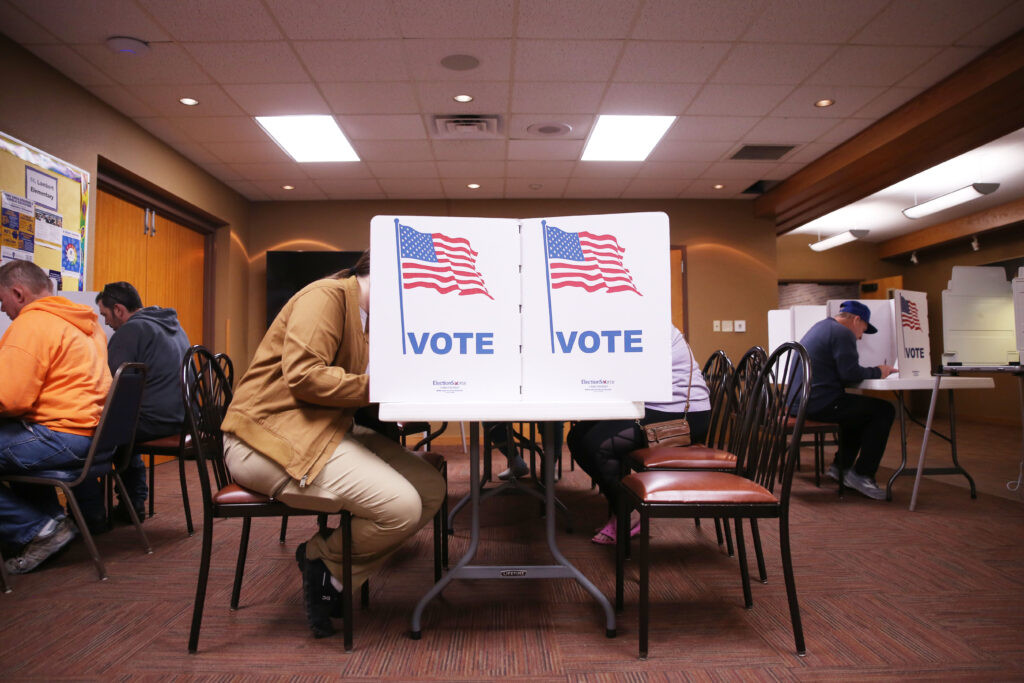
Sioux Falls residents vote in the general election on Nov. 5, 2024, at St. Lambert’s Catholic Church. (Photo by Makenzie Huber/South Dakota Searchlight)
South Dakotans hoping to run in the June primary election this year could have less time to circulate their nominating petitions, based on a bill making its way through the legislative process.
Rep. Rebecca Reimer, R-Chamberlain, introduced a bill that would change the nominating petition deadline to the third Tuesday in March, rather than various dates currently in statute, including March 31 for some candidates.
A nominating petition signed by registered voters is required for local and statewide South Dakota candidates to get on the ballot, with signature thresholds varying by position. Prospective candidates can begin circulating petitions in January.
“South Dakota gives petitioners more time to collect signatures than it allows the election workers to prepare for the election and create a ballot,” Reimer said.
More legislative news
See all of Searchlight’s coverage of the 2026 legislative session.
County auditors, under the current law, would have 17 days this year to prepare a ballot between the end of the petition deadline and the start of early voting for the June election. March ends on a Tuesday this year, and Easter further complicates the timing, election officials said.
The bill was originally heard by the House State Affairs Committee on Wednesday before being deferred to Monday.
Christine Lehrkamp, director of elections for the South Dakota Secretary of State’s Office, told lawmakers at the bill’s original committee hearing that it is an attempt to remedy “unintended consequences” from a law adopted last year that required local governments hold elections on the same day as the primary or general election.
Kathy Glines, Harding County auditor, told lawmakers at the original hearing that the tight turnaround between petition filing and ballot printing impacts candidates and the “constitutional right of our voters.”
“There’s a 99.99% chance we won’t meet the deadlines this year for the June election. That’s disturbing,” Glines said.
The bill would use an emergency clause to become law immediately, rather than becoming law on July 1, which is the usual effective date of legislation. The Secretary of State’s Office will inform candidates of the change via press release if the bill passes the Legislature, Lehrkamp said.
House Speaker Jon Hansen, R-Dell Rapids, voted against the bill. He said the calendar “crunch” this year won’t be as dramatic in the next few elections.
“I think that can open up a real unfairness and injustice to people if they tried submitting in that final week,” Hansen said on Monday.
Hansen said earlier in the session that the “real solution” would be to cut absentee voting from 45 to 30 days.
Lawmakers on the House State Affairs Committee approved the bill in a 7-5 vote. It’ll head to the House floor next.
GET THE MORNING HEADLINES.


