
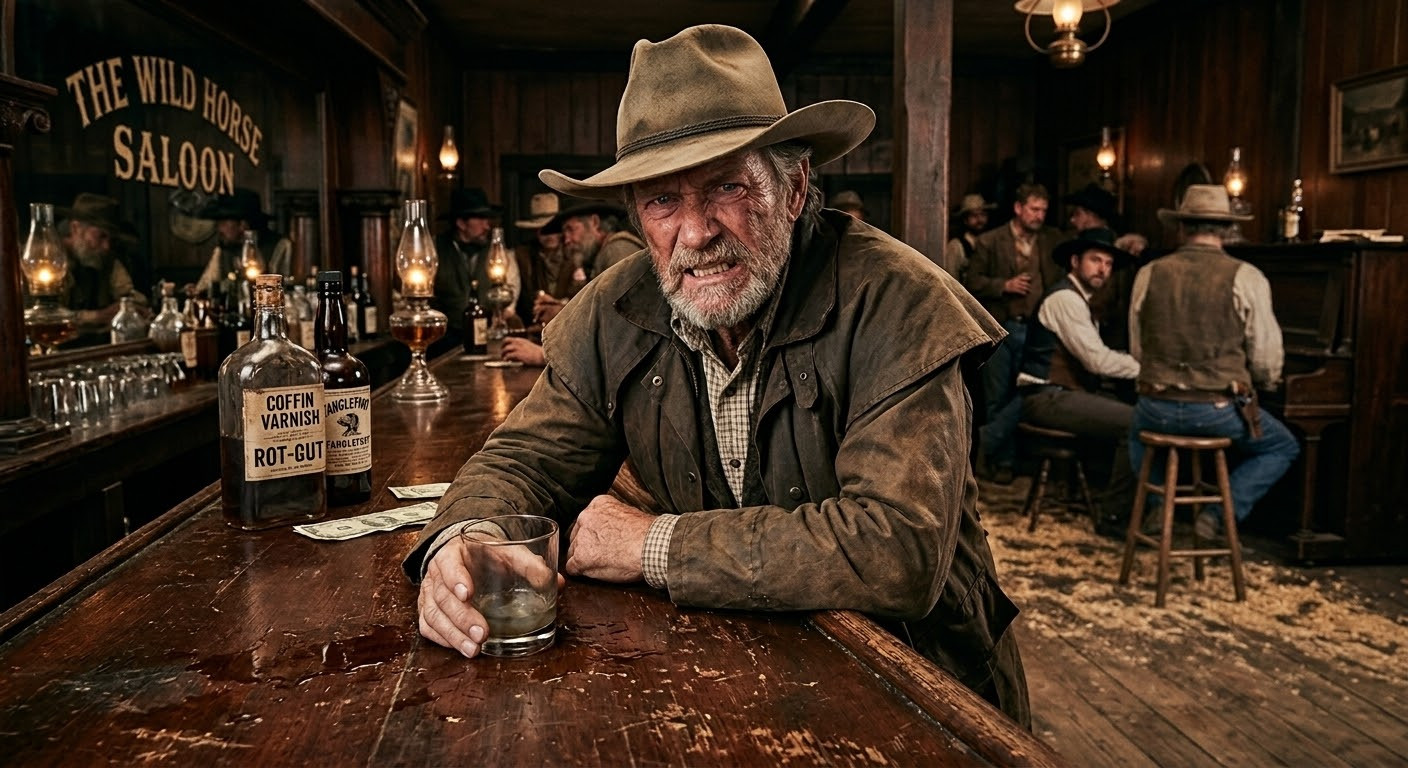
He pushes through the saloon doors like he’s done it a hundred times. Spurs clink. Hat tipped low. He leans on the bar and orders a whiskey.
The glass hits the counter. He lifts it, throws it back, and for half a second his soul leaves his body.
His eyes water. His jaw locks. He stares straight ahead, refusing to blink because blinking might admit weakness. Somewhere behind the mustache, there’s regret. If the piano player stops mid-song, it’s because he’s waiting to see if the cowboy survives.
Hollywood skips that part.
The truth is that Old West whiskey had a reputation, and not the good kind. Frontier drinkers called it mountain howitzer, coffin varnish, tanglefoot and rotgut. Some used the word strychnine. In certain towns, that label wasn’t entirely a joke.
In many western saloons, whiskey wasn’t aged and often wasn’t even fully whiskey. It could be raw grain alcohol diluted with water and darkened to resemble something mature. Blackstrap molasses, burnt sugar and prune juice were common tricks to fake barrel color. Plug chewing tobacco sometimes did the job. In worse cases, additives like turpentine, sulfuric acid or red pepper were mixed in to create burn and bite. The harsher it felt going down, the more convincing it seemed.
The real problem wasn’t just taste. It was the complete lack of rules.
For most of the 1800s, there were no federal production standards for distilled spirits. Anyone could distill, blend, dilute or relabel product. Barrels shipped west were frequently cut with extra water along the way. Spoilage could be covered up with sugar or flavorings. If it stretched profit, it stayed in the barrel.
By the late nineteenth century, legitimate distillers were battling “rectifiers,” businesses that bought neutral grain spirits, colored and flavored them, then sold them as straight whiskey. Consumers had almost no way to tell the difference. Labels meant very little. Trust across the market started to crumble.
One of the loudest voices pushing back was Colonel E. H. Taylor Jr., a Kentucky distiller who believed American whiskey needed protection, not just from bad actors but from confusion. He argued that without clear standards, both producers and drinkers would lose. His lobbying helped bring real change.
In 1897, Congress passed the Bottled in Bond Act, the first federal law focused specifically on distilled spirits quality. Its goal was simple: stop tampering and restore confidence in American whiskey.
To carry the Bottled in Bond designation, a whiskey had to meet strict requirements. It had to be produced by one distiller at one distillery. It had to come from a single distillation season, either January through June or July through December. It had to be aged at least four years in a federally bonded warehouse under government supervision. It had to be bottled at exactly 100 proof. And it had to clearly list where it was distilled and bottled.
The label became a federal promise. If it said Bottled in Bond, it met defined production and aging standards. No mystery ingredients. No backroom shortcuts. No chemistry experiments hiding behind a fancy label.
The reforms didn’t stop there. In 1906, President Theodore Roosevelt signed the Pure Food and Drug Act, targeting widespread food and beverage fraud across the country. Whiskey was a big part of that conversation. The federal government began defining what could legally be called straight whiskey versus blended or neutral spirits.
In 1909, President William Howard Taft followed up with what became known as the Taft Decision, formally recognizing straight whiskey as a distinct product made from grain, aged in wood, and not simply flavored neutral alcohol. It was a line in the sand that finally separated real distillers from clever relabelers.
Together, those changes reshaped American whiskey. What began as a loosely defined frontier commodity became a regulated product with legal identity and enforceable standards. Over time, those standards paved the way for modern bourbon regulations, including rules about mash bills, new charred oak barrels and labeling transparency.
The cowboy in the saloon didn’t have any of that. He had grit, pride and whatever was poured into the glass.
Modern whiskey drinkers have something better. When you pick up a bottle labeled Bottled in Bond or straight bourbon, you’re not just buying flavor. You’re buying accountability.
So yes, the burn might still be there. It’s whiskey, after all. But at least now, you know it’s supposed to be.
For more stories that uncover the history, culture and odd twists behind whiskey and the drinks built around it, listen to Rob and Mark on Whiskey@Work.


