
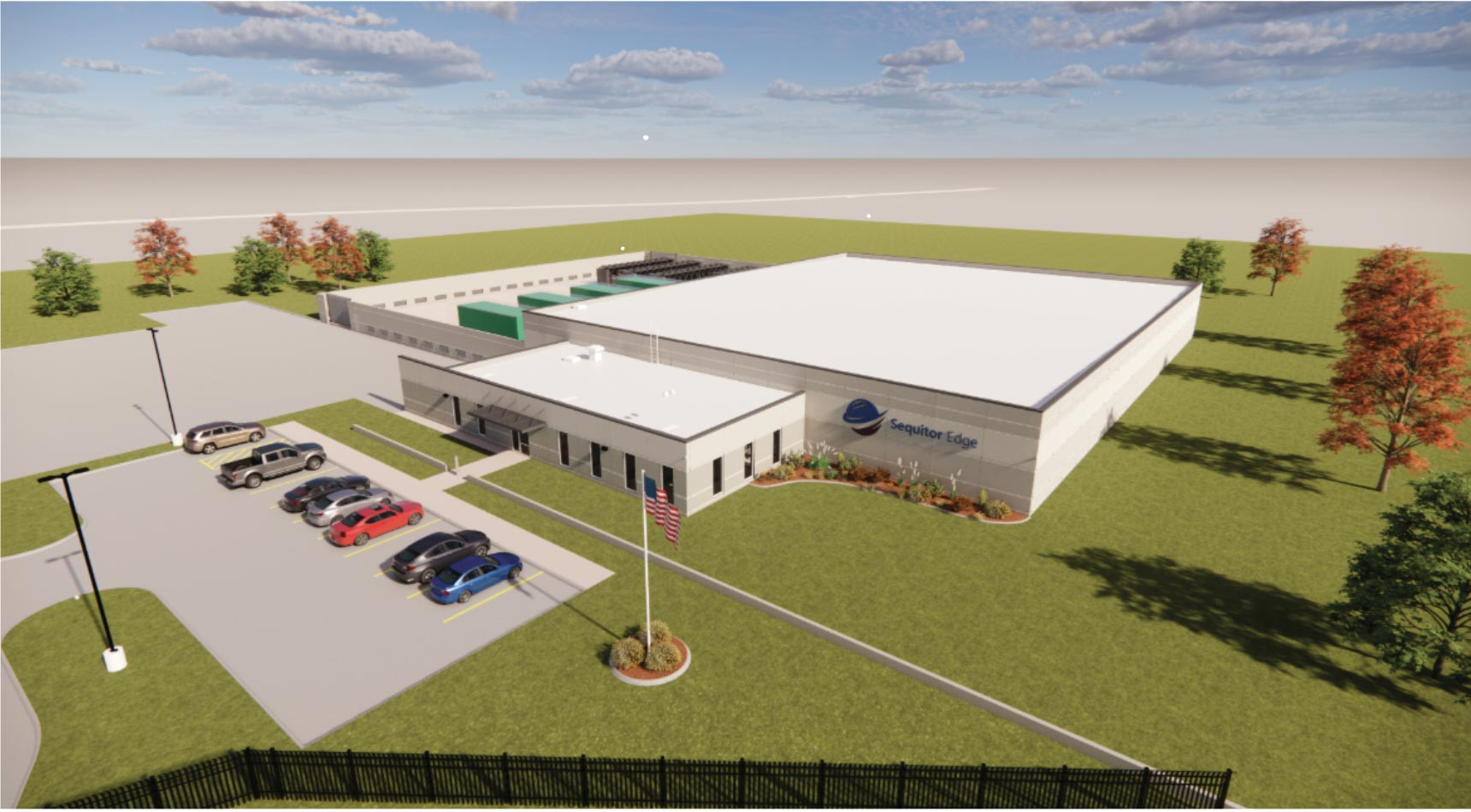
RAPID CITY, S.D. – A new edge computing data center is planned for Rapid City’s Black Hills Industrial Center, a project that company leaders say will focus on serving local and regional businesses while using significantly less power and water than traditional large-scale facilities.

Victoria Blatchford, vice president of business development for Sequitor Edge’s Great Plains region, said the facility will operate as a Tier III colocation data center designed to provide high levels of uptime, security and performance for area businesses.
“It serves our local businesses. I can’t emphasize that enough,” Blatchford said in a phone interview.
The approximately 30,000-square-foot building will sit on a 10-acre site in the Black Hills Industrial Center near South Highway 79 and Old Folsom Road. Blatchford said the initial buildout will include one data hall with about 240 cabinets and require up to 2 megawatts of power, scaling up to a maximum of 10 megawatts if five data halls are eventually constructed.
By comparison, hyperscale data centers typically built for single, global users such as artificial intelligence or blockchain processing often start at 100 megawatts and can reach 500 megawatts, she said.
“We’re 30,000 square feet, two megawatt powers up to a max capacity of 10 megawatts,” Blatchford said. “Significant difference.”
Unlike hyperscale facilities, which are generally built for a single company’s use, Sequitor Edge’s model allows multiple businesses to lease cabinet space inside the facility. Companies can colocate their own servers, connect to high-speed fiber providers in a shared “meet-me room,” and choose their preferred telecommunications carrier.
Blatchford described the facility as infrastructure that brings computing power closer to the end user.
“Think of it like a lift station,” she said. “It pushes and pulls the data faster and more secure if you have an edge computing center right near the end user.”
She said the facility will allow businesses to lease time on high-performance Nvidia chip processors for artificial intelligence pilots and other advanced computing needs, rather than investing millions of dollars upfront in their own hardware.
“How do you scale when you’re a good-sized business but yet even for a good-sized business or small business to scale with technology, it’s just cost prohibitive?” Blatchford said. “If we don’t give the tools to the businesses or have the tools to attract the right kind of businesses to the Rapid City regional area it’s really hindering the economic development of that area.”
The center will be built in an area already zoned for light industrial use. Blatchford said noise concerns are often overstated.
“It’s no different than light industrial,” she said, noting that backup generators are tested monthly for a few hours.
The project is expected to create three to five full-time, high-tech positions with average wages around $100,000, according to Blatchford. Additional indirect economic impact could come from local IT service providers and businesses that colocate equipment at the site.
Sequitor Edge plans to use a closed-loop cooling system that requires a one-time fill of approximately 19,000 to 20,000 gallons of water for the initial data hall. Additional water would only be added if new data halls are constructed.
“To fill the cooled system, that’s a closed loop, it’s going to be anywhere between 19 and 20,000 gallons, which is the same amount of filling a residential pool,” Blatchford said. “It is one-time fill to a closed loop system.”
She contrasted that with some larger facilities that use significantly more water on an ongoing basis.
The Rapid City project was hosted and supported by Elevate Rapid City, which Blatchford said has been “very instrumental” in helping bring the development to the area.
Blatchford said Sequitor Edge is intentionally targeting rural and mid-sized markets rather than major metropolitan areas, citing population shifts away from large cities and the growing need for distributed computing infrastructure.
“Industrial revolution demanded we must have roads and infrastructure,” she said. “That’s what this is. Literally, it’s infrastructure.”
A data center is a secure facility that houses computer servers and networking equipment used to store, process and transmit digital information. Tier III facilities are designed for high reliability, typically targeting about 99.98% uptime, with redundant power and cooling systems to minimize service interruptions. In a colocation model, businesses rent space within the facility to operate their own servers while relying on the center’s power, cooling and physical security.
Blatchford said the Rapid City facility will primarily serve financial institutions, health care providers, government entities, smart agriculture, smart manufacturing and other organizations that handle sensitive consumer information.
“We’re really excited to come to Rapid City and serve the regional area,” she said. “Rapid City is really showing that they want to be a place of innovation and proactive, and this is going to help set up for that.”


