
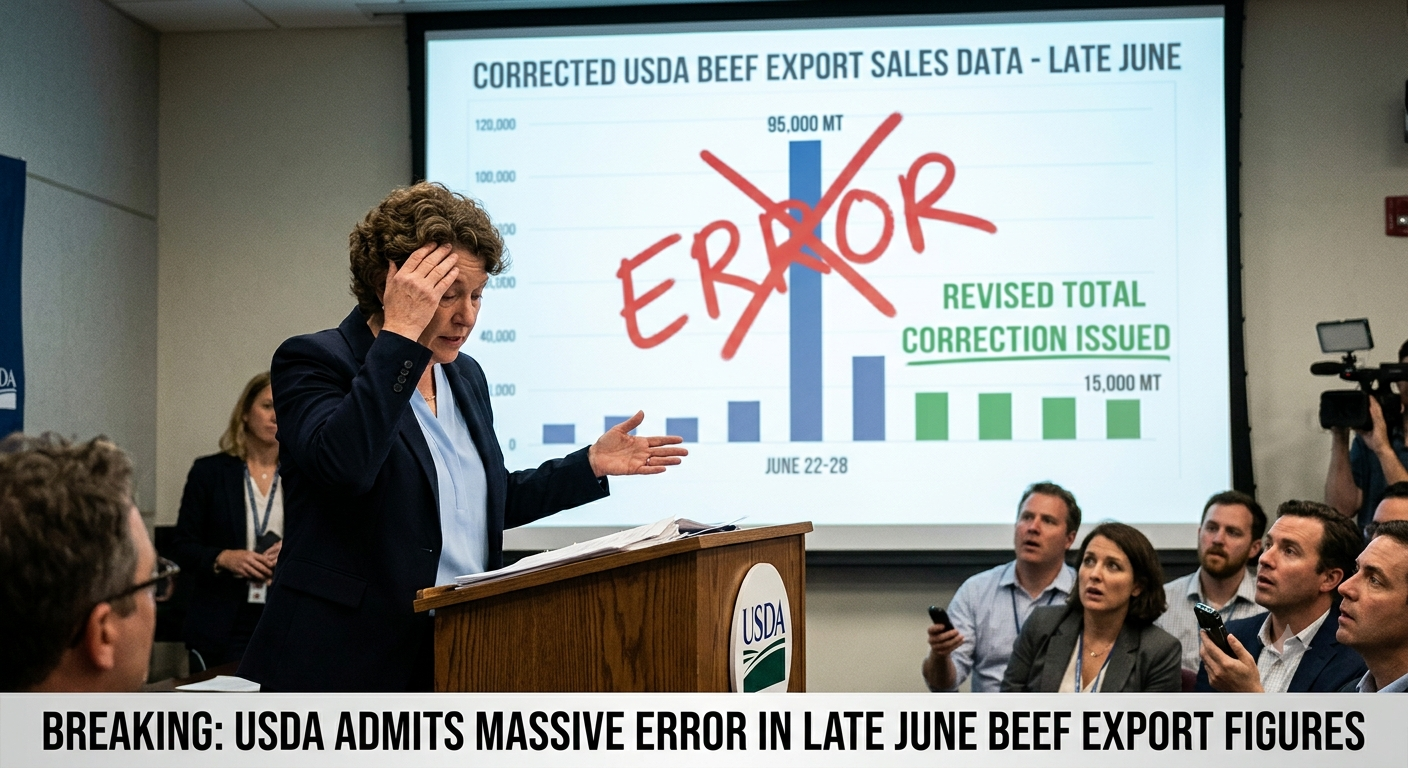
USDA officials initially defended the data, publicly stating they had contacted the exporting company and “confirmed” the massive totals
CHICAGO, ILL – Traditionally, many in the cattle business don’t fully trust the numbers reported by USDA. The recent misreporting by the agency hasn’t helped that.
A massive administrative blunder by the U.S. Department of Agriculture (USDA) has sent shockwaves through the American livestock sector. In a stunning turnabout, the agency quietly slashed its previously reported beef export sales for late June by 90%, converting what was initially hailed as a “record-shattering” week into a historical dud.
The drastic correction has ignited a firestorm of criticism from cattle ranchers, market analysts, and traders who rely on USDA data to make multi-million-dollar marketing decisions.
The Blunder by the Numbers
On July 2, the USDA published a weekly export report that left the industry rubbing its eyes. It claimed that for the week ending June 25, U.S. beef export sales skyrocketed by nearly 500% to a historic 126,062 metric tons. The numbers were anchored by eye-popping purchases from countries like Chile (38,434 MT) and Italy (32,274 MT)—volumes that eclipsed what those nations typically buy in an entire year.
Just one week later, on July 9, the USDA admitted the figures were published in error. The revised net sales plunged to just 12,064 metric tons.
- Chile’s real purchase: Revised down to 367 metric tons.
- Italy’s real purchase: Revised down to 350 metric tons.
- Other affected nations: Export data for 14 additional countries had to be significantly walked back.
What Ranchers and Analysts Are Saying
For America’s livestock producers, this isn’t just a simple math mistake—it’s a threat to their livelihood. Ranchers use these data points to gauge global demand, time their cattle sales, and negotiate prices in a market already under severe stress from prolonged droughts and record-high production costs.
The reaction from the ground has been a mix of fury, dark humor, and a profound erosion of trust.
“At this point, it’s getting hard to believe anything coming out of Washington,” said one Iowa cattle producer reflecting on the sudden drop. “We are operating in an incredibly tight market with cattle inventories at multi-decade lows. We need accurate data to survive, not fairytale numbers that get wiped out a week later.”
Many in the industry are pointing to systemic issues within the agency. The USDA’s Foreign Agricultural Service (FAS), which handles these reports, recently suffered a 21% loss in personnel due to aggressive federal restructuring.
Ranchers and agricultural commentators on industry forums noted that while they understand the agency is running on a skeleton crew, the financial consequences fall squarely on the producers. “Sure, ‘mistakes’ happen when you gut an agency, but this completely skews commodity pricing,” shared an independent cattleman.
Market analysts also called out the USDA for failing to spot the anomaly before publishing. Austin Schroeder, a commodity analyst at Brugler Marketing & Management, noted, “Should the USDA have caught it? Probably. They may have just overlooked it.” Analysts argued the initial numbers made zero economic sense given that record-high U.S. beef prices have effectively priced the country out of major global export surges.
A Growing Crisis of Confidence
Compounding the frustration is how the USDA handled the incident. When the initial “record” report came out, traders immediately flagged it as highly suspicious. Yet, USDA officials initially defended the data, publicly stating they had contacted the exporting company and “confirmed” the massive totals.
The sudden 90% rollback without a detailed explanation of how the error bypassed internal quality controls has left a bitter taste in the mouths of agricultural producers. This follows previous agency missteps, including heavily criticized miscalculations of corn acreage and delays in crucial trade deficit reports.
As the U.S. cattle industry heads into the peak of the summer grilling season under the pressure of tight supplies, ranchers are left with record-high beef prices—but zero faith in the metrics meant to guide them
Ultimately, the error didn’t crash the cattle market, but it served as a stark reminder of the market’s heavy reliance on government statistics—and the chaos that can ensue when the math doesn’t add up.


