
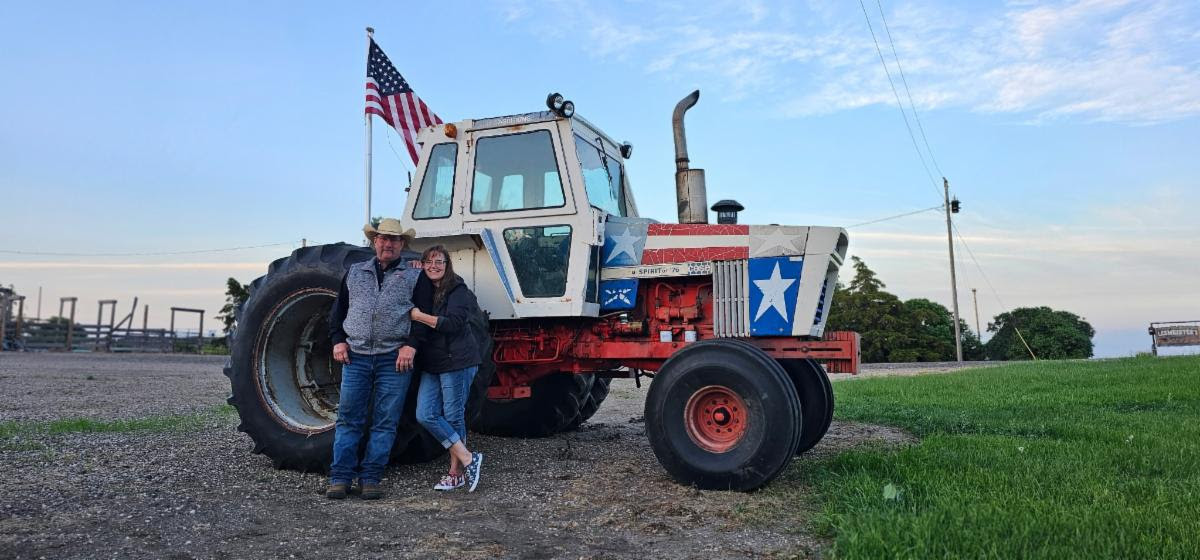
EAGLE BUTTE, S.D. – This Spirit of ’76 is one of little more than 200 manufactured by CASE in 1976 to celebrate America’s bicentennial. Parade rancher Oren Lesmeister remembers the day his dad, Louie, purchased it.
“We were sitting in the Nauman Implement sales office in Gettysburg, South Dakota, and from the office window we saw when the tractor arrived on the lot,” Oren said. “Dad asked about it. And after several hours of negotiations – Dad was hard-headed as hell – he bought the tractor with duals, front end weights and a small loader.”
Oren was 10 at the time. Reflecting on the tractor 50 years later, he becomes nostalgic.
“I grew up in it – literally. From the time I was 10 years old on I have lived in that tractor,” said Oren, explaining how the tractor has been a part of his farm/ranch story.
“It was the tractor I drove the first 10 years I helped Dad farm. Even after that, when we bought the place from Mom and Dad, I still used it and farmed with it. It is one of the first tractors Tracy drove when she moved here after we married,” said the fourth-generation Dewey County farmer/rancher.
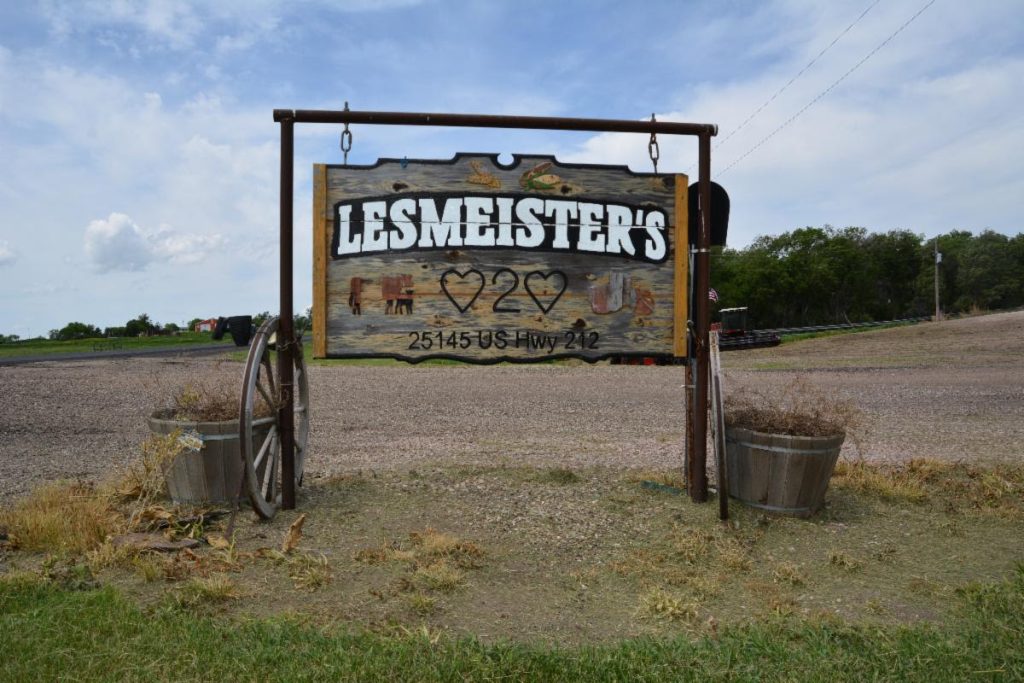
And today, even though Oren and Tracy lease their farmground out and focus all their efforts on the ranch’s cow/calf herd, the Spirit of ’76 continues to play an important role on the ranch. “Today, its main job is hauling hay for livestock … just to keep it active.”
With America’s 250th birthday on the horizon, Oren and Tracy park the beloved tractor prominently on their ranch just nine miles east of Eagle Butte to showcase their patriotism.
“America is built on the backs of its farmers and ranchers,” Tracy said. “This tractor is a way to show our respect for the flag and the people who fought for our freedoms. It’s a symbol of our freedoms. And you know, it’s the last piece of equipment still working on the place that Oren’s dad bought, so it’s symbolic of our ranch too.”
Nothing Like The Smell Of Freshly Tilled Dirt
The Spirit of ’76 has also been a part of Tracy’s farm/ranch story. Growing up in Ft. Pierre, the daughter of a school superintendent and a secretary, Tracy yearned to be out in the country.
“I always wanted to be a farmer or rancher’s wife and work in the fields and raise cattle. It’s just a peaceful way of life,” Tracy explained.
Tracy and Oren met their first week of college. Tracy was a Black Hills State University student, and Oren was attending Western Dakota Technical College.
“We met because I could dance,” Oren said. “We still dance to this day.”
The couple married in 1986. Although Oren always wanted to return to his family’s farm/ranch when Louie suffered a major heart attack, he and Tracy were forced to transition to full-time farming and ranching sooner than they planned.
“It was the ’80s Farm Crisis and the interest rates were forcing a lot of family farms and ranches into foreclosure. The hospital was looking for money from Mom and Dad, so we took out a loan to buy the place, and this is how we got started,” Oren explained.
It was by no means the easy way to get started. Oren was 22. Tracy was 22. Thankfully, Tracy had an off-ranch career.
“Tracy having an off-farm job in the ’80s and the ’90s was really everything,” Oren explained. “It is what bought the groceries and paid the light bill. With the farming economy what it was, and interest rates what they were, the farm/ranch income what it was, you hoped you could break even, but sometimes you did not.”
Early on in their marriage, Tracy worked in the extension office. Then, when she was expecting their third child and daycare costs looked to be more than her income, she opened her own daycare.
Her desire to be involved in the farm/ranch remained strong, so in the evenings after work, Tracy helped Oren with the farming or cattle.
In 1995, when their two older children were in elementary school, Tracy applied for a job in sales and delivery for PepsiCo and Frito-Lay. It turns out her affinity for farmwork helped her get the job delivering products to convenience stores and grocery stores across the region.
“I always did summer fallow and I loved it. I know there are better farming practices now, and farmers no longer do summer fallow, but there is nothing like the smell of freshly tilled dirt,” Tracy said. “The tractor did not have air conditioning, so the doors were always open as I tilled the field. The guy hiring for the position was staying at the Super 8 for just a few days, and we were leaving on a trip the next day. So, I got done at dark and drove to town. I was literally covered in dirt when I did the interview because the doors of the cab had been open and it was already so late, I could not take the time to get cleaned up. My boss actually told me later that had I been all dressed up, I might not have gotten the job. But because he knew I had worked all day and worked all evening, he said he knew I was a worker and could do this job – it’s not an easy job.”
In August, Tracy will celebrate 31 one years in the position. This June she was recognized during an awards ceremony in New York City with PepsiCo and Frito-Lay’s highest award.
Tracy is one of only 13 employees worldwide to receive the distinguished award for her sales, service and safety performance. Tracy placed first in her region and ninth in the U.S.
It’s Our Heritage
While managing full-time farm/ranch work, Oren also worked several off-farm/ranch jobs. He worked for the local cooperative, taught agriculture education classes and was the Eagle Butte FFA adviser. He also served in the South Dakota National Guard as a combat engineer with the 211th Engineer Company out of Lemmon and Mobridge, advancing to communications chief for the 109th Eng. Battalion in Sturgis.
In 2012 he opened Fox Ridge Ranch Supply and Feed Store on the ranch. “We had a motto, if we are home, we are open. There have been a lot of ranchers dropping in at 2 a.m. during calving season because they ran out of vet supplies or calf starter.”
Like Tracy’s career, Oren said he took on the extra work to keep the family farm/ranch legacy alive.
“It’s just what you do. It was our responsibility. This farm/ranch is our heritage,” Oren said.
Lesmeister farm/ranch heritage began in Dewey County around 1898 when Oren’s great-grandpa, Adam, left Strausburg, North Dakota, and discovered this area’s landscape of rolling grassland hills, springs and wetlands. Immigrants from Germany, Adam, together with his son, Frank, traveled to the land office to get an official deed to the land in 1909.
Growing up the youngest of three, Oren took immense pride in helping his parents, Louie and Marla, on the diversified operation.
“Like everyone else back then, we were diversified. We raised registered Black Angus cows, Thoroughbred horses, hogs, we milked cows, had some sheep and farmed,” Oren recalled.
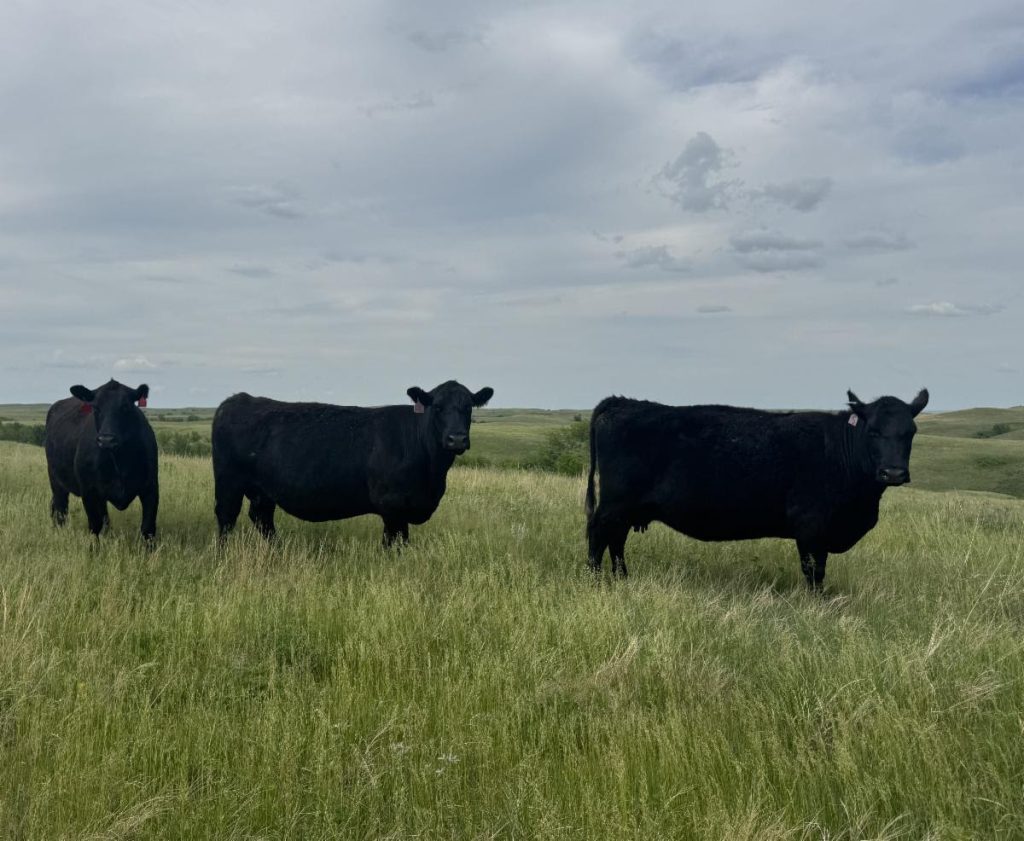
Today, he and Tracy raise a herd of commercial Black Angus cattle that they manage on a rotation to maximize grassland health and access to fresh water. The landscape of rolling hills is not ideal for farming, but their cattle thrive among the native grasses and wildlife.
White-tailed deer, prairie chickens, grouse, pheasants and various other bird species are spotted nearly every time they head out to check cattle.
“We check cattle together every evening after work,” Tracy said. “It’s my goal to make it home from work in time to go with Oren and he most often will wait for me. We hop in the side-by-side and drive through the hills checking cattle. It’s our time together – no phones – we just get to enjoy each other’s company.”
Advocating For Agriculture
In 2017, Oren was asked to run for the South Dakota State Legislature. He served four terms representing District 28-A in the State House. Oren said he made the time to serve because of his agriculture roots.
“Today, even in South Dakota, our state is becoming more urban. It’s not a bad thing, but it is the reason we need to protect our way of life,” explained the former State Minority Leader. “There are more and more senators and representatives coming out of areas who do not understand what true farming and ranching life is like.”
Tracy said she was proud of Oren’s efforts. “He never did anything in Pierre for himself. He wanted to do what was best and made the most sense for South Dakota overall.”
Today, Oren serves on the state board of directors for South Dakota Farmers Union, so the couple are able to advocate for agriculture together participating in the organization’s D.C. Fly-In.
“With fewer and fewer farm families, we need to make sure our voice is heard,” Tracy said. “People just can’t afford to farm and ranch. I always wanted to be a farmer’s/rancher’s wife – but to be honest, the only way I could be one was to work in town. The only way a farm or ranch can be successful is to have a wife that has a good town job.”
As the couple look to the future, they are unsure if one of their three children will return to the farm/ranch full time. In their early ’60s, they are still young enough to do the work, but they are beginning to have conversations with their children, Colten, Colby Blakesly and Chelsy Norman.
“The future is unknown,” Oren said. “Right now, we are going to keep moving forward.”
To view videos and more photos of the Lesmeister family, visit www.sdfu.org.


