
By the late 1800s, buying a bottle of whiskey in America was a gamble.
There were no real standards. No reliable labels. No guarantees about what was actually inside the bottle. Some whiskey was excellent. Some was dangerous. Much of it was something in between, altered just enough to sell.
And the people winning the whiskey business weren’t always the distillers.
They were called rectifiers.
Rectifiers didn’t distill whiskey themselves. Instead, they bought neutral grain spirits and altered them with coloring, sweeteners, and flavorings to mimic aged whiskey. Burnt sugar was common. Fruit extracts too. The end result was legal, consistent, and cheaper to produce than traditionally aged whiskey. In crowded urban markets, it sold well.
From a business standpoint, rectifiers were efficient.
From Edmund Haynes Taylor Jr.’s perspective, they were everything wrong with the industry.
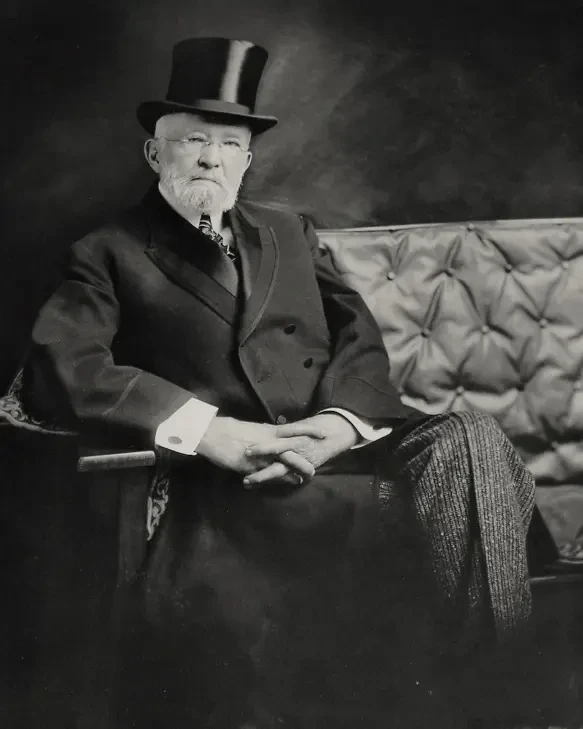
Taylor, born in Virginia in 1830 and later based in Kentucky, entered the whiskey business during this chaotic period. He was not a legacy distiller and not a particularly diplomatic man. What he was, however, was deeply moral about whiskey. He believed consumers deserved to know what they were drinking, and that honest distillers shouldn’t be forced to compete with imitation.
At a time when many distilleries resembled barns, Taylor invested in infrastructure that bordered on excessive. He introduced steam heating to reduce fire risk. He replaced wooden fermentation vessels with iron tanks. Cleanliness and consistency became obsessions. His distilleries were large, imposing, and intentionally designed to look permanent.
The castle-like architecture he favored wasn’t about ego. Taylor believed whiskey had a credibility problem. If bourbon looked official, he reasoned, maybe it would be treated that way.
But bricks and steel weren’t enough.
Taylor took his fight into the political arena, serving as mayor of Frankfort and later as a member of Kentucky’s legislature and senate. He wasn’t a smooth politician. He was a crusader. He pushed relentlessly for transparency in spirits, arguing that consumers should know who made their whiskey, where it came from, and how it was produced.
This stance was controversial. Many distillers resisted oversight. Rectifiers saw regulation as a threat to their business model. Even Taylor’s peers found him exhausting. He was stubborn, argumentative, and unwilling to compromise.
That stubbornness came at a cost.
Taylor overbuilt. He overspent. He struggled financially later in life and lost control of some of his distillery holdings. While others adapted quickly to market changes, Taylor remained fixed on principle. He was better at winning arguments than balancing books.
Yet his ideas outlived his setbacks.
Pressure from distillers like Taylor eventually helped force transparency onto the whiskey industry. Clearer labeling standards emerged. Accountability improved. The rectifiers, once dominant, gradually lost their advantage as consumers gained the ability to tell real whiskey from imitation.
Taylor died in 1923, just as Prohibition was reshaping American drinking culture. Many of his physical achievements were erased. His influence was not.
Today, bottles bearing his name serve as reminders of a man who refused to accept a broken system. Not because it was unprofitable, but because it was dishonest.
Edmund Haynes Taylor Jr. was not the most successful figure in American whiskey history. He was not the richest. He was not easy to work with.
But American whiskey is safer, clearer, and more trustworthy because he would not stop arguing.
And sometimes, that’s exactly the kind of person history remembers.
This story is explored in more depth on the Whiskey@Work podcast, where hosts dig into E.H. Taylor Jr.’s life, his war with rectifiers, and why his stubbornness still matters every time you see his name on a bottle.
The episode is available now wherever you get your podcasts, with a filmed version also available online.


