
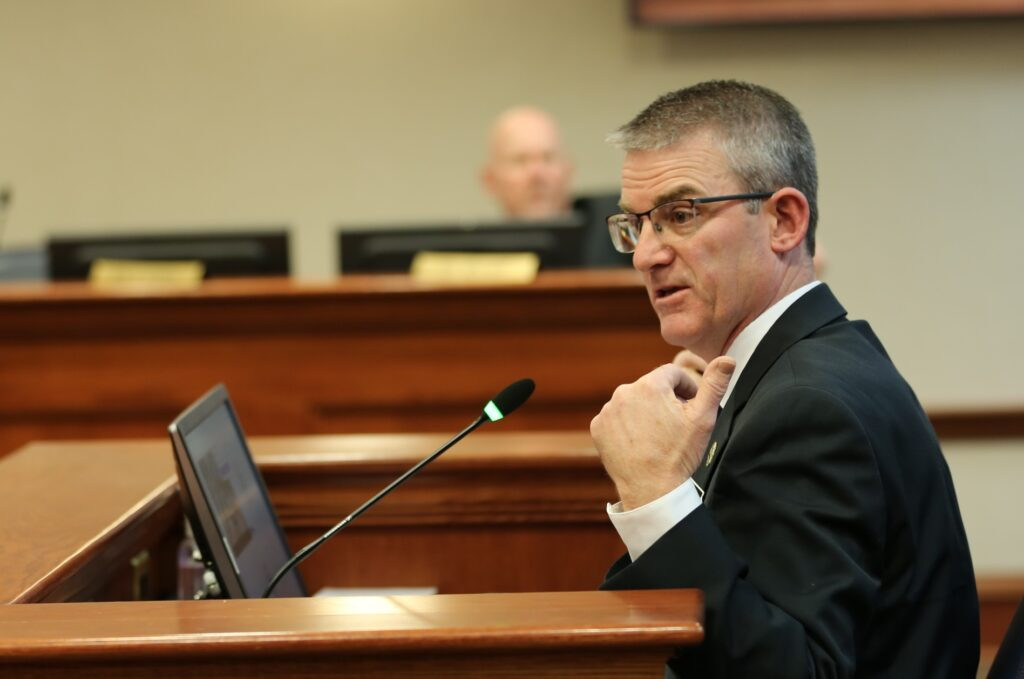
Sen. Steve Kolbeck, R-Brandon, testifies on Jan. 27, 2026, to the Senate Commerce and Energy Committee at the South Dakota Capitol in Pierre. (Photo by Joshua Haiar/South Dakota Searchlight)
PIERRE — South Dakota lawmakers advanced a bill Tuesday at the Capitol that would give utilities legal protections if a wildfire is blamed on them, in exchange for filing a wildfire mitigation plan.
The Senate Commerce and Energy Committee voted 6-3 to send the bill to the full Senate.
Under the bill, private utilities could submit mitigation plans to the Public Utilities Commission, while electric cooperatives and municipal utilities could submit plans to their boards or city councils. The utilities that do so would have to file annual compliance reports.
The bill includes required elements for plans, such as identifying higher-risk areas, inspection and operating standards, vegetation management strategies, and coordination with the appropriate wildfire agencies.
Liability changes
The bill’s most debated section would change the legal playing field after a wildfire. It would bar courts from applying “strict liability” to qualified utilities in wildfire-damage lawsuits. That is a legal standard that makes entities responsible for harm they cause, regardless of whether they were negligent or intended to cause it.
The bill would make the new law a plaintiff’s “sole remedy” against a qualified utility for wildfire losses.
State prepares to get ‘punched in the nose’ as utility plans shut-offs to mitigate wildfire risk
The bill is sponsored by Sen. Steve Kolbeck, R-Brandon, who works as a director of business affairs at Xcel Energy, an investor-owned utility with over 100,000 customers in the state.
“We want to make people whole. We just don’t want to make them rich,” Kolbeck told fellow members of the committee.
The bill says plaintiffs would be able to recover losses only by proving that the utility failed to “substantially comply” with an “essential element” of the plan, and “that failure was the actual and proximate cause of the damages to the plaintiff.”
Plaintiffs would have three years to file a lawsuit from the date of ignition.
The bill would also limit noneconomic damages awarded in lawsuits to cases involving death or “visible bodily injury in the form of a burn,” and restrict punitive damages to situations proven by clear and convincing evidence of malice or criminal intent.
Property damages would be capped at the lesser of restoration cost or the change in fair market value before and after the wildfire.
Supporters and opponents
Some utility groups, firefighters, business groups and the state Public Utilities Commission argued the bill would reduce both wildfire risk and utilities’ financial exposure before a catastrophic event, especially in high-risk areas like the Black Hills.
Supporters also said wildfire-related insurance is becoming harder to obtain and more expensive for utilities, and the threat of massive wildfire liability can drive up costs that ultimately land on customers.
In opposition, insurance industry representatives and trial lawyers argued the bill would give utilities special legal protections not available to other businesses or individuals and shift the cost of wildfire losses from utilities onto property owners and their insurers.
We want to make people whole. We just don’t want to make them rich.
– Sen. Steve Kolbeck, R-Brandon, the sponsor of a bill that would limit electrical providers’ wildfire liability
Opponents said the bill effectively replaces a stricter liability standard with a negligence-based framework with additional protections for utilities, and that victims could be left undercompensated due to limits on noneconomic damages, restrictions on punitive damages, and the cap on property recovery. They also raised concerns that the mitigation plan standards are too general and enforcement is too weak.
“Fire victims may not recover non-economic damages unless the plaintiff suffers death or visible body injury in the form of a burn,” said Steve Siegel, representing the South Dakota Trial Lawyers Association. “No smoke inhalation, burned lungs. I’d like to know, what is the definition of ‘visible bodily injury’? Is that with the naked eye? Does that include an MRI scan or a CT scan?”
Siegel said the threat of having to pay damages in lawsuits helps incentivize utilities to mitigate the risk of a fire.
Power line-related incidents are sources of ignition in the Black Hills. In 2017, the Legion Lake Fire, a wind-driven wildfire that started in Custer State Park, grew rapidly and burned a mix of over 50,000 public and private acres, prompting evacuations and park closures. Investigators concluded the fire was sparked when a tree fell and broke a power line.
Get updates to stories like this: Sign up for our free newsletter.


