
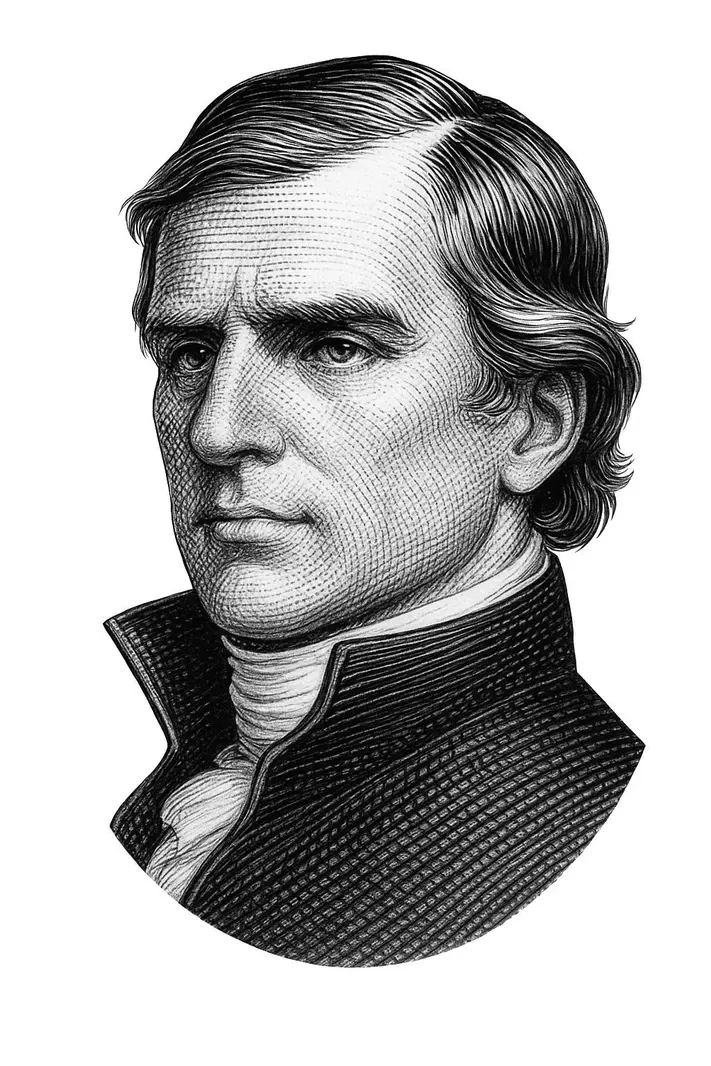
Long before bourbon became a billion-dollar badge of American pride, a Baptist preacher in Kentucky was building churches, operating mills and, according to legend, accidentally changing the way whiskey would taste forever.
That preacher was Elijah Craig.
Born in 1738 in Orange County, Virginia, Craig was ordained as a Baptist minister during a time when preaching without a license could land you in jail. In fact, he was briefly imprisoned in Virginia for unauthorized preaching, part of the larger religious tension that eventually helped shape early American views on religious freedom. He was not just a man of faith. He was a man comfortable pushing against authority.
In the 1780s, Craig moved west to Kentucky, then still the frontier. Land was cheap. Infrastructure was scarce. Whiskey was often more reliable than currency. Grain did not travel well over rough roads, but distilled into whiskey, it became portable, valuable and shelf stable. On the frontier, distilling was not indulgence. It was strategy.
Craig settled in what is now Georgetown, Kentucky. There, he became a true community builder. He founded one of the area’s first Baptist churches and established the Rittenhouse Academy, one of the earliest classical schools west of the Allegheny Mountains. He operated gristmills and fulling mills, manufactured rope and cloth, and held significant land. At one point, he was among the largest landowners in the region.
And yes, he distilled whiskey.
The most famous story attached to Craig is that he was the first to age whiskey in charred oak barrels, effectively creating bourbon as we know it today. The legend says a fire scorched the inside of his barrels. Rather than discard them, Craig filled the blackened casks with whiskey. When he opened them later, the spirit had transformed. It was darker. Smoother. Sweeter. The charred wood had changed everything.
It is a fantastic story.
It also lacks hard evidence.
There is no surviving document proving Craig intentionally pioneered charred barrel aging. Charred barrels were already used in other industries, particularly for shipping goods like fish and rum, where sterilization mattered. It is entirely possible that multiple distillers were experimenting with barrel treatment at the same time. Bourbon, like most American innovations, likely evolved through gradual improvement rather than a single eureka moment.
There are other legends woven into early bourbon history as well. Some credit Jacob Spears, another early Kentucky distiller, with being among the first to label his product “bourbon” after Bourbon County. Others point to the influence of French settlers who brought knowledge of aging spirits in oak. The truth is probably a blend of all of it. Frontier experimentation. European technique. American necessity.
Still, Craig’s name stuck.
Part of that may be because he was more than just a distiller. He was visible. He was respected. He was a preacher who also understood business. That combination made him memorable. Over time, memory becomes myth. Myth becomes marketing.
Today, his name lives on through Heaven Hill Distillery in Bardstown, Kentucky, which produces Elijah Craig Bourbon and refers to him as the “Father of Bourbon.” The brand openly acknowledges the debate while embracing the legend. And the whiskey itself has earned real credibility. In 2017, Elijah Craig Barrel Proof was named Whisky of the Year by Whisky Advocate, a modern accolade layered on top of a two-century-old story.
The irony is hard to ignore. A frontier preacher who once rode horseback through Kentucky, preaching sermons and building mills, now anchors one of the most recognizable labels in American whiskey.
Craig died in 1808, long before bourbon became legally defined. It was not until 1964 that Congress declared bourbon a “distinctive product of the United States.” By then, the mythology around Elijah Craig had already settled into the culture.
Whether or not he truly invented charred barrel aging, Craig represents something larger. He stands at the intersection of faith, grit and early American enterprise. He reflects a time when ministers built businesses, entrepreneurs preached sermons and whiskey was as much survival as it was pleasure.
Bourbon history is filled with legends. Some are airtight. Others are better understood as stories that capture the spirit of a place and time.
Elijah Craig may not have single-handedly created bourbon. But he helped build the world bourbon grew up in. And in whiskey, sometimes that is enough.
Because in the end, bourbon is not just about barrels and proof. It is about people. And few early names loom larger than Elijah Craig.
For more stories about the giants of whiskey, follow Whiskey@Work with Rob and Mark wherever you get your podcasts!


