
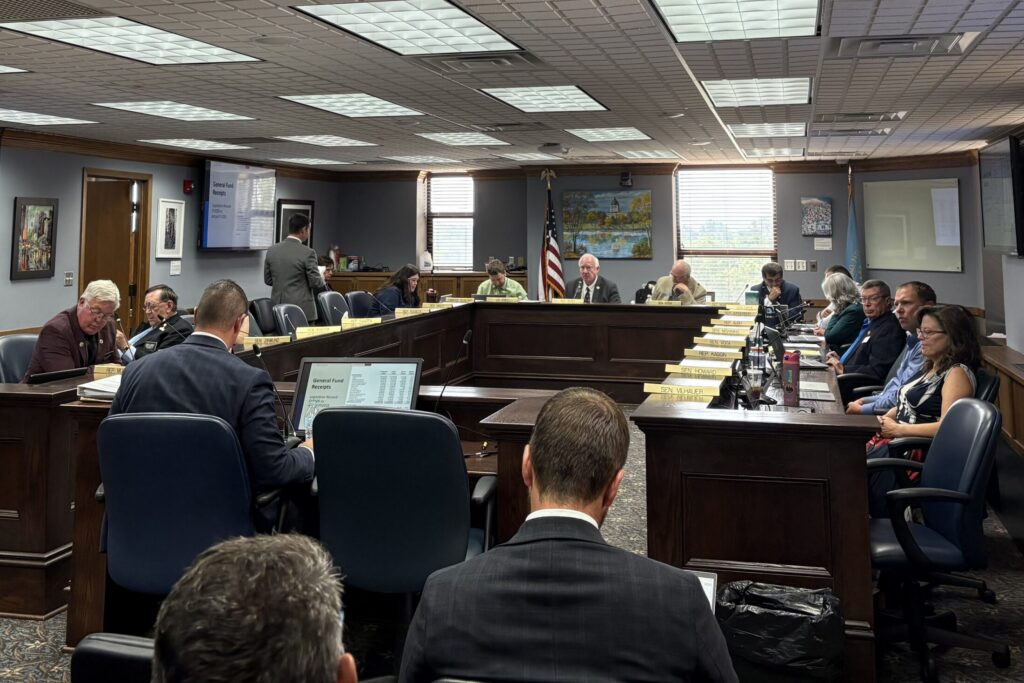
The Interim Committee on Appropriations meets at the South Dakota State Capitol in Pierre on July 20, 2026. (Photo by Meghan O’Brien/South Dakota Searchlight)
PIERRE — South Dakota’s top state budget official offered further explanations Monday for the $39 million that state departments left unspent during the recently completed fiscal year, eliciting both praise and concerns from lawmakers.
The fiscal year ended June 30. The Department of Social Services had the biggest budget reversion, returning $32 million.
Jim Terwilliger, commissioner of the state’s Bureau of Finance and Management, told a committee of state lawmakers that the size of the department’s reversion shouldn’t be “a surprise, because it’s the one area in the state budget that is a lot less predictable.”
“There’s only two sides of the coin,” he said. “That you have enough funds to get you through, or you’re going to be short.”
Unused funds from state departments made up more than half of the $69 million budget surplus that Gov. Larry Rhoden announced last week. The state also collected $30 million more than its budgeted revenue, $17 million of which came from higher-than-projected sales tax revenue. The surplus went into the state’s reserve funds and “will be available for one-time investments in future budget years,” the governor said.
Department of Social Services reversions
The Department of Social Services’ $32 million of reversions came from a $1.8 billion departmental budget. The department manages programs such as Medicaid, the Supplemental Nutrition Assistance Program and Temporary Assistance for Needy Families, among others. About $654 million of its budget was from state funding sources, with most of the remainder coming from the federal government.
Governor celebrates surplus as Democratic lawmaker says state missed opportunities to help people
The department’s largest category of unspent funds was in medical services, which includes Medicaid, the joint federal-state program that helps pay for healthcare for low-income people of any age. There were $12.5 million of medical services reversions.
“We’re trying to predict how many people come to the hospital with various acute conditions and so on and so forth,” Terwilliger said. “So, it’s not something that’s easy to predict going forward.”
Medicaid enrollment declined by 968 people, from 143,743 at the start of the fiscal year last July to 142,775 last month.
Lower use of substance use disorder programming and mental health treatment services resulted partially from fewer staff to provide treatment, Terwilliger said. In particular, the Human Services Center, a facility in Yankton dedicated to providing treatment for substance use disorder and mental health, has struggled to hire personnel.
Terwilliger also credited the department’s launch of a program called BEES — the Beneficiary Eligibility and Enrollment System — in 2024, which screens applicants for their eligibility for medical eligibility programs.
Some lawmakers were pleased with the returned funds, including Sen. Taffy Howard, R-Rapid City.
“These are all welfare services, so lower utilization should be cause to celebrate,” she said. “And I hope we aren’t looking for ways to increase utilization just because we happen to have some reversions.”
Sen. Red Dawn Foster, D-Pine Ridge, said she agreed with Howard’s comments, “but I think that the services that we do provide, we want to make sure that there’s a pathway to self-sufficiency and not just attrition.”
Foster also asked if the launch of BEES is causing people to be eliminated from programs. Terwilliger did not provide further information but said “it’s something we can certainly look at.”
Current-year revenue
Legislators received varying predictions Monday about how revenue will fare during the current fiscal year, which began July 1.
Derek Johnson, state economist with the bureau, estimated revenue will be 0.34% higher than originally estimated, resulting in $8.7 million more than lawmakers planned for when they approved the budget in March. Johnson works for the governor in the executive branch.
The state collected $17 million more in sales and use tax during the recently ended fiscal year than predicted, and collections were 6.6% higher than the previous fiscal year. Johnson is projecting continued growth.
Jeff Mehlhaff, who works for lawmakers as interim director of the Legislative Research Council, is also considering last year’s sales tax growth. But he views it as a reason to be conservative.
“I just didn’t expect that much growth, which leads me to pause a little bit,” he said. “Typically when you have a high growth year like that, where you exceed your expectations, the next year usually produces a below average return.”
Mehlhaff predicted this fiscal year’s revenues will be 0.5% lower than estimated, resulting in $13.3 million less than planned.


