
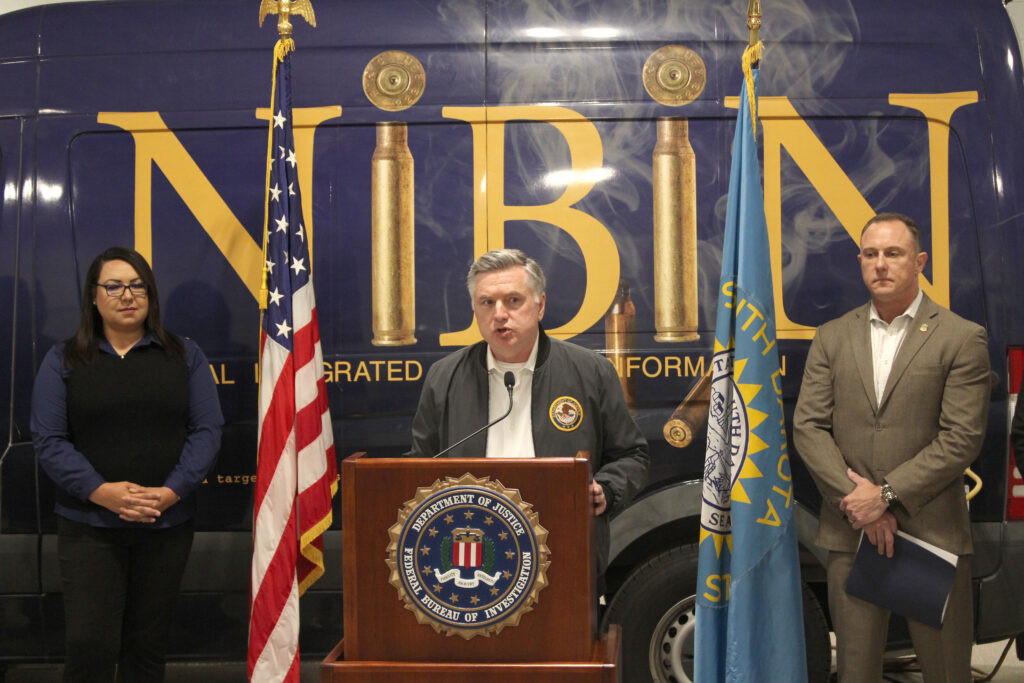
Ron Parsons, center, U.S. attorney for the District of South Dakota, speaks on June 16, 2026, in Rapid City, South Dakota, with Jessica Four Bear, left, attorney general for the Oglala Sioux Tribe, and Christopher Dotson, special agent in charge for the Minneapolis field office of the FBI. (Photo by John Hult/South Dakota Searchlight)
RAPID CITY — Federal law enforcement agencies and the Oglala Sioux Tribe have partnered to add the ammunition casing signatures of more than 500 firearms seized in criminal investigations on the Pine Ridge Reservation into a federal weapons database.
In clearing the backlog of untested firearms, the U.S. Attorney’s Office for the District of South Dakota hopes to find clues in unsolved cases on the reservation.
Every entry in the database could help move investigations toward closure for families who’ve lost loved ones, according to Ron Parsons, U.S. attorney for South Dakota.

The FBI investigates felony-level crimes that occur on tribal land; U.S. attorney’s offices prosecute the cases. Parsons spoke of the high number of missing and murdered Indigenous people cases in South Dakota, and said the ballistics testing will help the FBI and his office meet their obligation to attend to them.
“The full weight of federal forensic capability is being brought to bear on cases that have waited far too long for answers,” Parsons said on Tuesday.
Parsons’ comments at a federal law enforcement facility in Rapid City came one day after agents with the FBI began to fire off hundreds of rounds of ammunition on the Pine Ridge Reservation, work that will continue for the next few weeks. The casings were given to a mobile Bureau of Alcohol, Tobacco, Firearms and Explosives lab for entry into that agency’s National Integrated Ballistic Information Network.
The network has resulted in more than a million investigative leads on unresolved gun crimes, according to a press release from the FBI.
The initiative, dubbed “Operation Ballistic Backlog,” is part of a larger-scale expansion of federal policing resources in tribal areas called “Operation Steadfast Promise.” Among other efforts, the latter put 70 FBI agents into rotation for temporary detail in tribal areas across the U.S. and stepped up efforts to prosecute fraud involving tribal dollars.
Ballistics like a fingerprint
Firearms leave the equivalent of fingerprints on spent ammunition casings, according to Spence Burnett, assistant special agent in charge for the St. Paul field office of the ATF.
The microscopic marks left when guns are fired can be used to match casings to firearms seized by law enforcement and cataloged by the ATF’s National Tracing Center, and can then serve as evidence in criminal trials.
“No two firearms are the same,” Burnett said.
The network was launched in 1999, but Burnett said after the press conference that not every seized firearm logged in the National Tracing Center database is linked to a shell casing signature in the network.
There’s no cost to enter 3D images of casing signatures into the network’s database, or for law enforcement agencies to access the information. But for signatures to be logged, agencies first need to fire the weapons, collect the casings and send them in for inclusion. That can be a logistical challenge for any agency, he said, particularly ones with heavy caseloads.

The initiative brought ATF agents to the reservation, as well as FBI agents to fire the weapons, and the federal agencies provided the ammunition.
The Oglala Sioux Tribe has filed multiple lawsuits against the federal government over policing, alleging that the U.S. has failed to uphold its treaty obligations to provide public safety by underfunding law enforcement.
The litigation was not addressed at the press conference. Parsons did, however, acknowledge that local police have been taxed by high crime.
“For years, a great many firearms and other ballistic evidence, potentially tied to serious crimes on the reservation, have sat unexamined, not for any lack of will, but because caseloads have been overwhelming, and laboratory testing capacity has been stretched thin,” Parsons said.
Jason Lone Hill, the Oglala Sioux Tribe Department of Public Safety’s chief of police, and Jessica Four Bear, the tribe’s attorney general, were present for the press conference. They did not speak, but both were quoted in a press release sent shortly before the event.
“Working with our federal partners strengthens our ability to protect the community with our limited resources,” Lone Hill said in the release.
Tribal consultation led to backlog-clearing efforts
The idea to step up ballistics testing came through consultations with the tribe, according to Christopher Dotson, special agent in charge for the Minneapolis field office of the FBI.
“Getting out to the lands, meeting with the tribal councils, the chiefs, the police departments, is a priority, not only in South Dakota, but in other states in the nation who have Indian Country in their jurisdiction,” said Dotson, whose office oversees the agents operating at the Rapid City regional FBI facility.

Last week, the FBI announced a reward of $50,000 for information leading to an arrest in the 2022 murder of 6-year-old Logan Warrior Goings, killed in his home in a drive-by shooting in the community of Oglala. Shell casings recovered from the scene were linked through the database to a weapon recovered in another part of the state.
Dotson told reporters gathered for the press conference on the ballistics testing that the database was used to help prosecute the men who killed Vincent Von Brewer III outside Pine Ridge’s SuAnne Big Crow Boys and Girls Club in 2016. A pair of men from Denver were convicted of that murder in 2021.
Dotson said the collection of ballistics evidence, folded into unsolved criminal cases, is meant to show that the agency is committed to addressing the high number of unsolved violent crimes in places like Pine Ridge.
“We will never stop seeking justice for victims of gun violence,” Dotson said. “We are committed to solving every murder, every assault, and bringing violent criminals to justice, no matter how long it takes.”


