
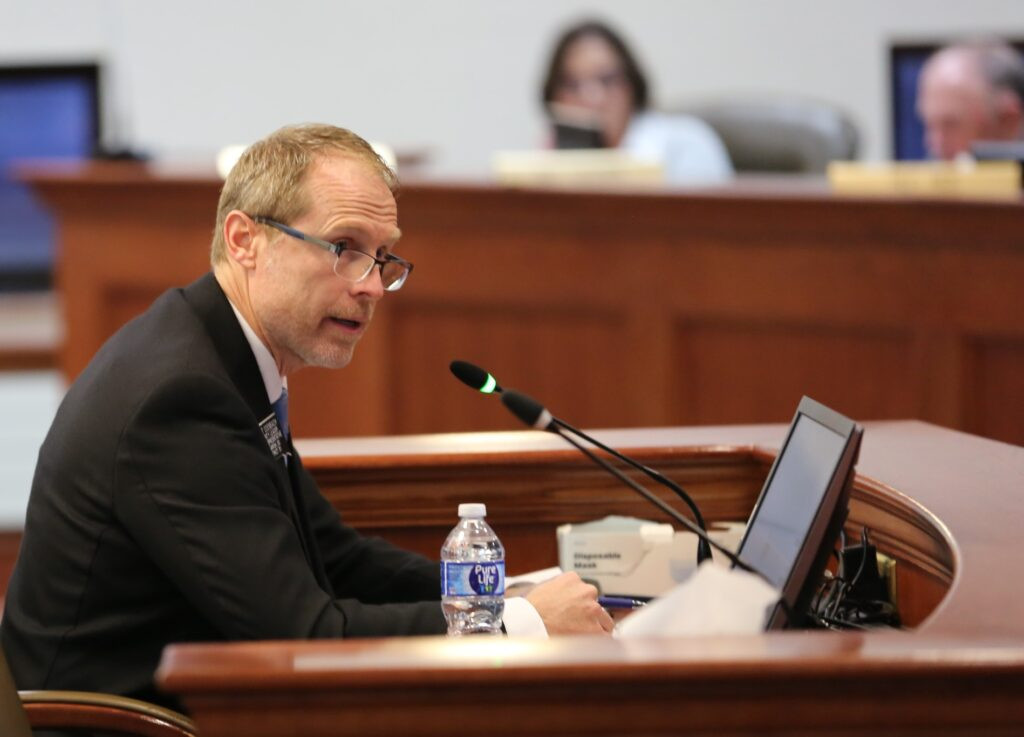
Rep. Scott Odenbach, R-Spearfish, testifies in favor of a bill before the House Agriculture and Natural Resources Committee at the South Dakota Capitol in Pierre on Jan. 29, 2026. (Photo by Joshua Haiar/South Dakota Searchlight)
PIERRE — A committee of South Dakota lawmakers advanced a bill Thursday that would tighten state limits on groundwater withdrawals by eliminating an exception for some deep aquifers used by public water systems.
The bill, sponsored by Rep. Scott Odenbach, R-Spearfish, would require that annual withdrawals from any groundwater source could not exceed the source’s estimated recharge rate. It would do so by striking language in state law that allows an exception when pumping from lower than the Greenhorn formation, a layer of limestone found across the state.
Supporters framed the change as “common sense” long-term planning to prevent “water mining,” particularly in the drier areas of western South Dakota.
Odenbach said applying the same recharge standard across aquifers would protect water for future generations and for long-term economic prospects.
“We balance our budget every year. We’re proud of that,” he said. “We need to begin to balance our water budget.”
Jay Gilbertson, manager of the East Dakota Water Development District, told lawmakers the state already conducts hydrologic balance analyses even when the exception could apply; therefore, there would be no additional requirements on the state if the bill passed.
GET THE MORNING HEADLINES.
Opponents included state water officials, rural water groups, municipalities and business advocates. They warned the bill could create practical and financial problems for public water providers that depend on deep aquifers where the recharge is harder to estimate with precision.
Mark Mayer, with the state Department of Agriculture and Natural Resources, said the current Greenhorn exception is discretionary and exists to help regulators navigate uncertainty in recharge calculations for deep, expansive aquifers.
“The statute says ‘may’ approve, not ‘shall,’” Mayer said. “There’s no automatic approval.”
He said removing the exception could restrict water distribution systems that deliver drinking water.
State Geologist Tim Cowman told the House Agriculture and Natural Resources Committee that calculating better recharge estimates for deep aquifers would require additional observation wells and more extensive study and modeling. Opponents of the legislation said those costs would show up in the public’s water bills and in the costs of digging a well.
The committee approved the bill 9-4 and sent it to the full House of Representatives.


