
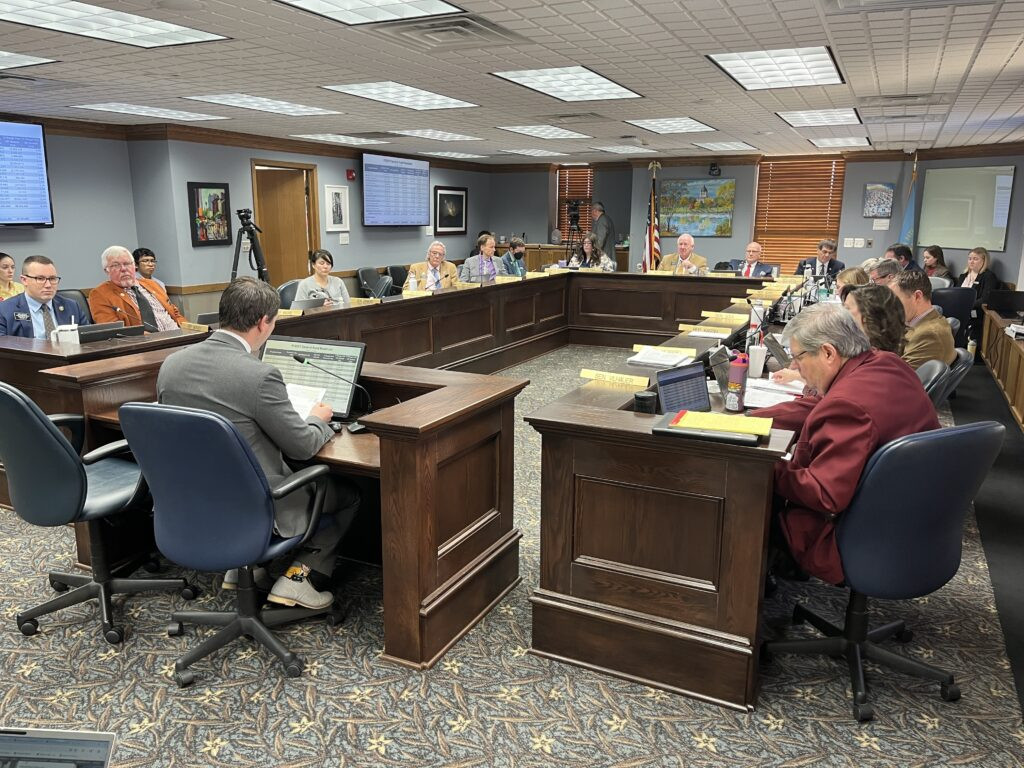
Jeff Mehlhaff, deputy director and chief fiscal analyst for the Legislative Research Council, presents fiscal year 2026 and 2027 revenue projections to the legislative Joint Appropriations Committee on Feb. 11, 2026, at the South Dakota Capitol in Pierre. (Photo by Makenzie Huber/South Dakota Searchlight)
PIERRE — There will be enough money on hand to give teachers, state employees and Medicaid providers more funding next fiscal year, lawmakers on South Dakota’s budget committee expect.
It’s just a matter of how much of an increase lawmakers choose to provide.
The legislative Joint Appropriations Committee adopted a general fund revenue projection of $2.5 billion for fiscal year 2027 on Thursday at the Capitol. That’s nearly $30 million more than what Gov. Larry Rhoden estimated in his December budget address, when he recommended flat funding for the “Big Three.”
More legislative news
See all of Searchlight’s coverage of the 2026 legislative session.
A 1% increase in funding for teachers, state employees and Medicaid providers would cost $24.8 million. A 1.25% increase would cost $30.9 million, according to the Legislative Research Council.
Democratic and Republican legislative leaders told members of the press on Thursday that there is an appetite for some level of increase. Rhoden said he is advocating for a 1% increase.
Lawmakers in the House will start to discuss what level of increase they should provide now that they have revenue estimates in hand, said House Assistant Majority Leader Marty Overweg, R-New Holland.
“I think there’s an appetite to talk,” Overweg said.
State government’s day-to-day operations are funded by “ongoing” revenue, such as sales taxes, while money from federal stimulus programs and other “one-time” sources are typically used for one-time needs such as construction projects.

The Joint Appropriations Committee also adopted a revised total general fund revenue estimate of $2.65 billion for the current fiscal year. The fiscal year 2026 revenue estimate includes one-time and ongoing revenue, while the fiscal year 2027 estimate includes only ongoing revenue.
The fiscal year 2026 estimate adopted by the committee is $9.7 million more than the committee’s adopted projection from last winter and $16.8 million more than Rhoden proposed in December. The increase was driven primarily by higher projected sales tax revenue.
With those projections in hand, lawmakers will start to more seriously vet a laundry list of ideas on how to spend millions in ongoing and one-time dollars.
The revenue projections are roughly the averages between projections provided by the Legislative Research Council, which works for the Legislature, and the state Bureau of Finance and Management, which is under the governor in the executive branch.

The lead co-chair of the Joint Appropriations Committee, Rep. Mike Derby, R-Rapid City, said the two projections are “guardrails” for lawmakers to set the budget. The fiscal year 2027 projections differed by about $22 million – less than 1% of the budget.
“We could have gone higher, probably about $11 million higher,” Derby said. “But I think this is a very thoughtful and conservative budget going forward.”
Rep. Eric Muckey, D-Sioux Falls, a member of Joint Appropriations, said the projections are a “good step forward” that displays confidence in South Dakota’s economy.
“It’s a good thing to see South Dakota trending in the right direction economically,” Muckey said.
The state’s 2026 fiscal year ends in June, and the 2027 fiscal year starts in July.
Economic conditions impact sales tax revenue and state budget
Jeff Mehlhaff, with the Legislative Research Council, told lawmakers on Wednesday that his projections were “optimistically conservative.”
Mehlhaff and Derek Johnson, with the Bureau of Finance and Management, said their projections are impacted by continued high inflation and interest rates, which can stress businesses and consumers, and dragging farm income — all leading to sluggish sales tax revenue, the biggest source of revenue for state government’s general fund.

Inflation is expected to remain above 2.5% for the next couple of years, Johnson said.
Despite that, both Mehlhaff and Johnson’s fiscal year 2027 revenue projections were higher than previous projections, buoyed largely by higher-than-anticipated sales tax revenue.
Federal tax refunds this year due to the One Big Beautiful Bill Act will put roughly $305 million in South Dakotans’ pockets this spring, Mehlhaff told lawmakers. That could lead to about $10 million in state sales tax revenue throughout the rest of the year.
South Dakota also reported a 10.9% year-over-year increase in January sales tax collections, according to the Bureau of Finance and Management.
The legislative committee adopted a fiscal year 2027 general fund revenue projection that sets sales tax revenue, nearly 61% of ongoing general fund revenue in the state, at $1.58 billion – an increase of nearly $20 million from the governor’s December forecast.
The other three largest revenue sources for South Dakota’s general fund are lottery, contractor’s excise tax and insurance company tax. Lottery and contractor’s excise tax revenue will stay relatively flat, the committee expects, while insurance company tax revenue is expected to increase by $2.6 million, or 1.63%.
The source is a tax on insurance premiums, so it’s a sign of rising costs to consumers and businesses, said Rep. Al Novstrup, R-Aberdeen.
“Growth is bad in this situation,” Novstrup said.
The state’s main revenue sources flow into the general fund, which is one part of a broader state budget totaling around $7 billion. About 40% of the total budget is funded by the federal government.


