
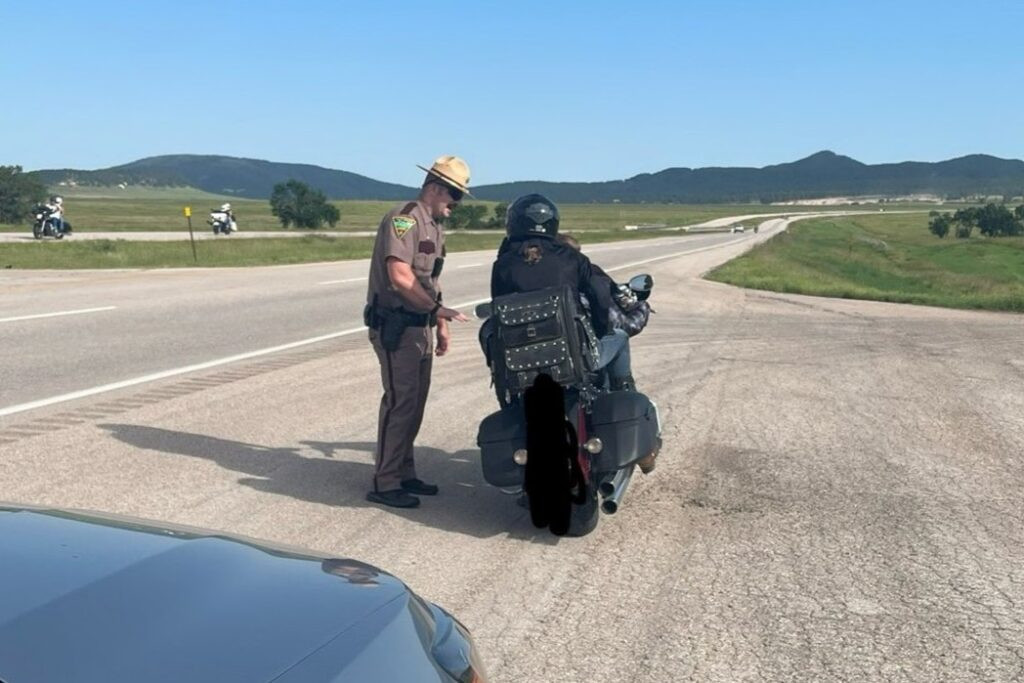
A South Dakota Highway Patrol trooper makes a traffic stop during the 2025 Sturgis Motorcycle Rally. (Courtesy of South Dakota Highway Patrol)
At the start of Tuesday’s House Transportation Committee meeting in Pierre, a legislative page introduced himself at the urging of the committee’s chairman.
He’s a senior at Rapid City Stevens High School, he said, and intends to pursue a career in law enforcement after graduation.
About 15 minutes later, Department of Public Safety Secretary Bob Perry told the committee “we’d like to talk to him when we’re done.”
The state Highway Patrol has struggled mightily to maintain staffing levels in recent years, Perry said during his informational briefing to the committee. And the agency’s 23 openings are weighted heavily in the rural enclaves of “West River,” the part of South Dakota west of the Missouri River. The state patrol is authorized to employ 210 troopers.
The state added a squad of troopers to the Sioux Falls area last year, and Perry said all nine of those positions were easily filled.
Positions stationed in places like Faith, a town of 350, tend to go unfilled for months or years.
Growth in Sioux Falls prompts governor to add Highway Patrol troopers
With West River recruitment efforts, Perry said, “we’re at wrestling tournaments, we’re at basketball tournaments. We’re anywhere we can get the word out.”
“These are high school level events, but we’re targeting older brothers, older sisters, mothers, fathers,” Perry said. “It’s not that we’re there to target the high school kids, although we do want to get it in their mind.”
As of 2025, the patrol began recruiting two classes a year instead of one. That’s put 11 more recruits into the pipeline in the monthslong process of hiring and training.
The imbalance in recruiting success between the eastern and western sides of South Dakota is a measure of high demand for law enforcement officers in and out of South Dakota. Decades ago, when Perry signed on to be a state trooper, trainers would post a list of openings around week eight in the training.
“They’d walk out of the room, and everyone had to figure it out,” he said.
The state can’t do that anymore, he said. Now, recruits know where they’ll go the day they’re hired.
“If you tell someone who wants to go to Sioux Falls that they’re going to go to Faith, they’re going to say no, and they’re going to pursue opportunities,” Perry said.
The next hiring cycle begins in March, Perry said. Despite the struggles in the west, he told the committee, the department has been pleased with its recruitment efforts in terms of sheer numbers. The last three classes of recruits have each had more than 10 members, he said, which hadn’t happened since 2020.
GET THE MORNING HEADLINES.


