
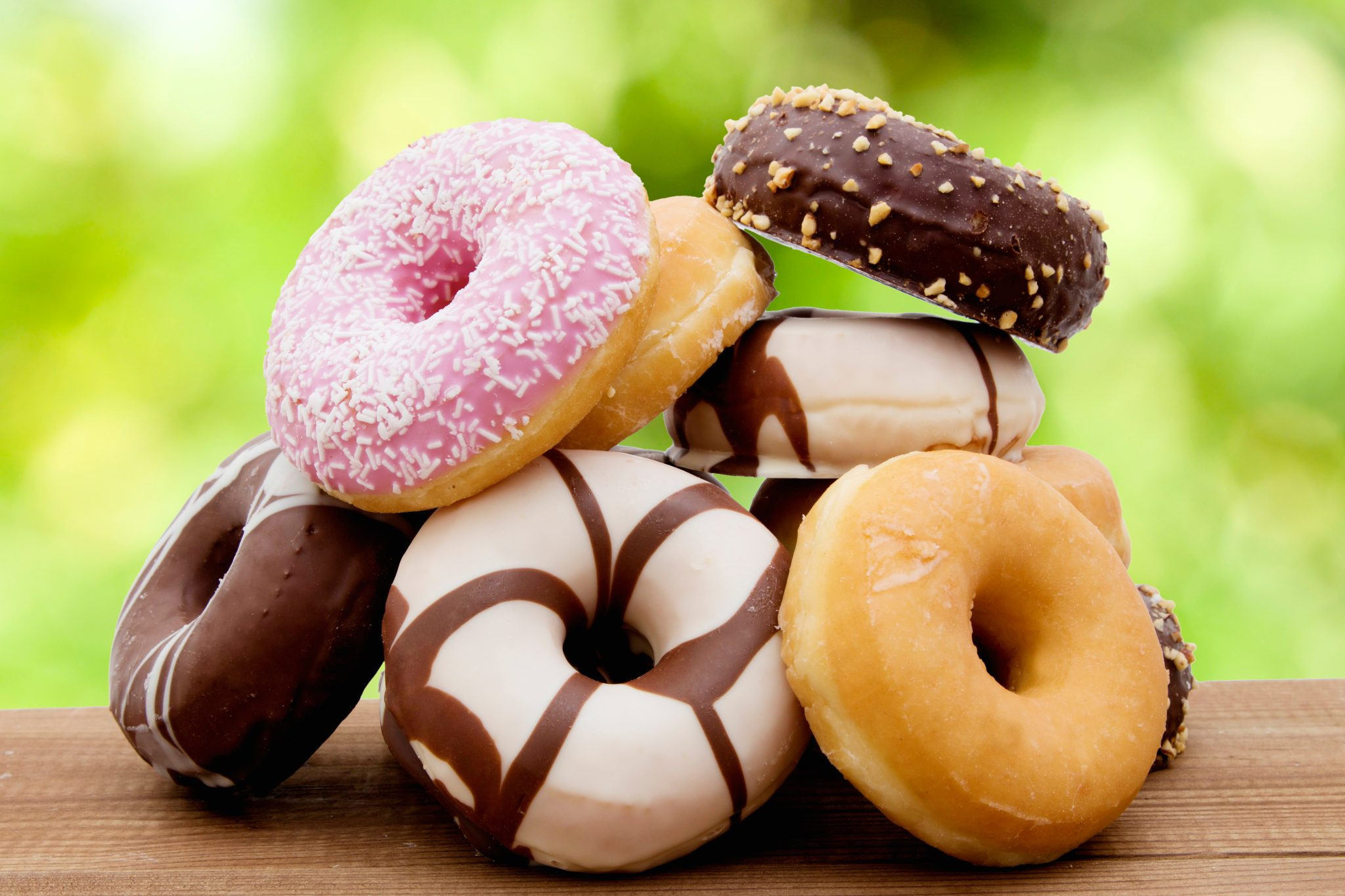
Most articles about donuts hit the same five paragraphs in a different order. Dutch settlers, a kid named Hanson Gregory, a war, a machine, Krispy Kreme. The history of donuts gets more interesting when you follow the people who actually built the thing, because almost none of them were born here.
It started with oily cakes nobody wanted to claim
Dutch settlers in what’s now New York were frying dough balls called olykoeks in the 17th century. The word translates to “oily cakes.” They were dense, lard-fried, and prone to coming out raw in the middle. Cooks started stuffing the centers with nuts, apples, or dried fruit to help the inside catch up with the outside.
Washington Irving wrote about them in his 1809 History of New York, describing “balls of sweetened dough, fried in hog’s fat, and called doughnuts, or olykoeks.” That’s the first time anyone in print used the word doughnut. The Dutch families in his book treated them as a household tradition. Everyone else mostly ignored them for another forty years.
A teenager from Maine, a hole, and a story that grew with age
The hole in the middle gets credited to Hanson Gregory, who was 15 or 16 in 1847, working as crew on a lime-trading schooner out of Rockport, Maine. By the time the Washington Post interviewed him in 1916, he was 85 years old, retired, and happy to talk about the night he punched the centers out of his mother’s fried cakes so they’d cook all the way through.
The details shifted depending on who he was talking to. One version has him using the lid of a tin pepper box. Another has him grabbing a fork. The most theatrical version puts him in a storm at sea, impaling the dough on a spoke of the ship’s wheel to free up his hands. His descendants have said the real story was probably less dramatic, a teenager standing in his mother’s kitchen, annoyed at the soggy middles.
His gravestone in Quincy, Massachusetts, calls him the inventor of the doughnut. There’s a plaque in Rockport that says the same thing. Most of the embellishment came from Hanson himself in his old age.
The Doughnut Lassies brought them back from war
The donut didn’t become a national obsession until World War I. In 1917, the Salvation Army sent about 250 volunteers to set up huts near the front lines in France. They handed out clothes, writing supplies, stamps, and emotional support to American soldiers, most of them between 18 and 23.
Two of those volunteers, Ensign Margaret Sheldon and Adjutant Helen Purviance, started frying donuts in soldiers’ helmets because they didn’t have proper kitchens. They made 150 the first day. Within weeks they were making 9,000 a day, sometimes carrying them into the trenches.
The soldiers called themselves doughboys. When they came home, they craved the donuts that had tasted like home in the middle of hell. The Salvation Army created National Donut Day in Chicago in 1938, partly to honor the Lassies and partly as a Depression-era fundraiser. It’s still held on the first Friday in June.
A Russian refugee built the machine that made donuts mainstream
Adolph Levitt was born Adolph Yudalevich in czarist Russia and arrived in America in 1883, age 8, with a family fleeing anti-Semitic violence. He was almost 50 before he found his lane.
Levitt was running a bakery in Harlem after WWI, watching theater crowds line up for donuts faster than he could fry them. In 1920 he built what he called the Wonderful Almost Human Automatic Doughnut Machine. You’ve probably seen one, it dropped rings of dough into oil, flipped them, and pushed them out finished. The thing could turn out 1,000 donuts an hour. People stopped on the sidewalk to watch it work.
By the mid-1930s, Levitt’s Doughnut Corporation of America was bringing in around $25 million a year, mostly from selling machines and mix to bakeries across the country. At the 1934 Chicago World’s Fair, donuts were billed as “the food hit of the Century of Progress.” Levitt is also the reason most signs say “donut” instead of “doughnut.” He shortened the spelling for his company, and it stuck.
Cambodian refugees turned the donut shop into a way out
In 1975, Ted Ngoy escaped Cambodia on the last passenger plane out before the Khmer Rouge took power. He landed at Camp Pendleton with his family and worked three jobs, one of them at a gas station attached to a donut shop. A coworker handed him a donut one night. He took one bite and went and asked to buy the shop.
They laughed at him. They told him to apply at Winchell’s. He did, became their first Southeast Asian manager trainee, and bought his own place, Christy’s, in 1979 in La Habra. By 1980 he owned 20 shops. Over the next decade, Ngoy sponsored hundreds of visas for fellow refugees, leased them his shops, and taught them the business.
By the 1990s, roughly 80% of California’s independent donut shops were Cambodian-owned. The bright pink box that became the LA donut shop’s calling card came out of the same scrappy economics. Cambodian shop owners asked their supplier, Westco, for something cheaper than the standard white box. Westco had leftover pink cardboard stock sitting around. The pink box cost about 10 cents less per dozen. The savings added up fast at thousands of boxes a week.
Ngoy himself lost most of what he built to a gambling addiction in the early 1990s. The empire kept running without him. His great-niece Mayly Tao runs Donut Princess LA today, one of a wave of second-generation shops carrying the story forward.
A footnote about cops and donuts
The stereotype isn’t really about laziness. In the 1940s and 50s, donut shops were among the few places open through the night, because bakers had to start before dawn to be ready for the morning rush. Officers on graveyard shift needed a warm spot to fill out paperwork, drink coffee, and eat something cheap. Dunkin’ founder William Rosenberg wrote in his autobiography that the police relationship was central to the company’s early success. Shop owners liked having cruisers parked outside. It kept robbers away.
What gets left out of the usual telling
The donut story usually ends with Dunkin’ and Krispy Kreme and whether sourdough is the best (it is). The longer version runs through Dutch farmers, a Russian Jewish kid who watched his machine become a World’s Fair attraction, women who fried dough in helmets while artillery shook the ground around them, and refugees who landed in California with nothing and ended up running an industry. The donut is American the way the country is American. Built mostly by people who weren’t from here.


