
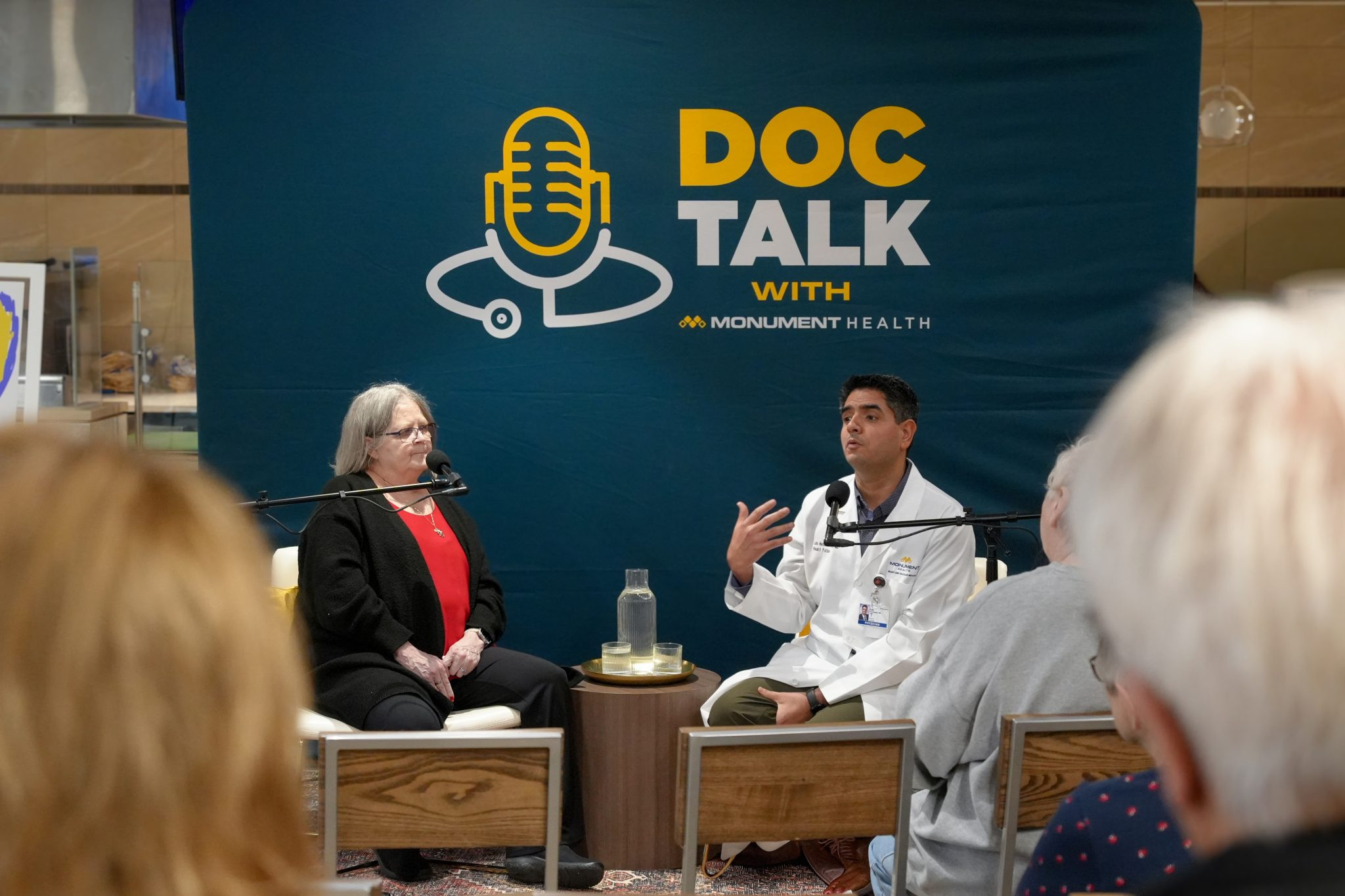
During Heart Failure Awareness Week in Rapid City, a conversation about medicine became something far more personal. Doctors, nurses, patients, and families gathered to talk about the realities of advanced heart disease and what happens when treatment reaches its final options. At the center of that discussion was Dr. Luis Hernandez of the Monument Health Heart and Vascular Institute and one of his patients, Renea, whose experience with heart failure and transplant care offered a rare look at the journey behind the headlines.
Dr. Hernandez, who serves as medical director of the Advanced Heart Failure Program, opened the event by recognizing the team behind the work.
“Everything that we have done is thank you to my team,” Hernandez told the audience, asking staff members to raise their hands. “We couldn’t have accomplished what we accomplished without them.”
The focus soon shifted to Renea, whose story stretches back more than two decades. Her heart issues began in 2000 when doctors implanted a defibrillator pacemaker, a device designed to regulate dangerous heart rhythms. For years the device and medication kept her condition stable while physicians carefully managed the progression of heart failure.
“I came in here and I had a defibrillator pacemaker put in,” Renea explained. “We did pretty good with that for quite a while. We worked on different things, different medicine management and stuff like that.”
Eventually her condition worsened. A hospital visit in January of last year changed the direction of her treatment and introduced a possibility she had not expected to hear.
“The first time I met him, he came in the room and goes, ‘I think we’re going to have to do a heart transplant,’” she said. “And I went, I looked at my kids. I go, ‘What did you say?’”
The months that followed involved testing, procedures, and difficult conversations with her family about where the transplant process should happen. She initially traveled to Minneapolis for evaluation. Soon afterward her children suggested Denver instead, since her daughter lives nearby in Colorado Springs. The decision meant shorter travel times for follow-up care and stronger family support during recovery.
That choice soon proved important. In early July Renea traveled to Denver for testing and evaluation, where doctors discovered that her kidneys were also failing. The transplant team determined she qualified for both a heart and kidney transplant.
“I qualified on the seventh of July for a heart and a kidney,” she said.
Events accelerated quickly after that point. By July 18 her defibrillator began firing repeatedly, a sign her heart rhythm had become dangerously unstable. Eight days later surgeons performed the transplant.
“By the twenty sixth of July, I had a transplant,” she said.
Even months later the moment still feels difficult for her to fully process.
“Every now and then it just… I don’t know,” Renea told the audience. “You just get this weird feeling, like, ‘Is this real? Is this real life?’ It’s like one of those pinch yourself moments.”
For Hernandez, stories like hers help correct common misconceptions about heart transplants. Many people believe patients must be at the point of death before doctors begin discussing transplant options. In reality, physicians try to intervene earlier while patients are still strong enough to withstand surgery and recovery.
“People always think that you have to be dying to get a transplant,” Hernandez said. “Ideally we want to send people before you’re dying. We don’t want to send you when you’re too sick.”
Age is another misunderstanding that surfaces frequently during consultations. Renea said she repeatedly heard comments suggesting she might be too old to qualify.
“One of the things too that I had in my corner that I heard about a lot is ‘You’re old. You’re old. I don’t know if we should be doing this,’” she said.
Hernandez told the audience that transplant eligibility depends on many factors, including overall health, lifestyle, and the strength of a patient’s support system. Age alone rarely determines eligibility.
“People think that if you are sixty five or sixty one, you’re too old,” he said. “Most programs will do seventy. Minneapolis does seventy two, for example.”
Family support often becomes one of the most important parts of the process. Renea’s children helped coordinate travel, recovery, and housing during the long weeks she spent near the transplant hospital. After surgery she remained hospitalized for nine days and then stayed nearby at Brent’s Place, a patient housing facility similar to a Ronald McDonald House, where transplant patients can recover close to the hospital during the early stages of healing.
Her daily routine changed dramatically after surgery. The long list of medications she once took for heart failure disappeared, replaced by another group designed to protect the new organs from rejection.
“I went from a whole lot of heart meds to a whole lot of immunosuppression drugs,” she said.
Many of those medications will continue for the rest of her life. Still, she views them as part of the second chance she received.
During the discussion she shared a moment that stayed with her during recovery. Her twelve year old grandson visited her in Denver and struggled to understand why she could not come home yet.
“He says to me, ‘Nana, when are you coming home?’” she recalled. “And I said, ‘I don’t know when I’m going to get to come home.’”
The boy thought about it for a moment before asking a question that made the room laugh.
“Well then why did you get an apartment?”
To a child, the weeks felt endless. For Renea, that time represented something entirely different. It was time she might not have had without the transplant.
Today she says the surgery gave her something she values more than anything else.
“I’ve totally enjoyed the extra time now,” she said. “And hope to have a bunch more with my grandkids.”
For patients living with heart failure, that hope often becomes the reason behind every appointment, every medication, and every difficult decision. The conversation in Rapid City served as a reminder that behind every transplant statistic is a family hoping for the same outcome.
More time together.


