
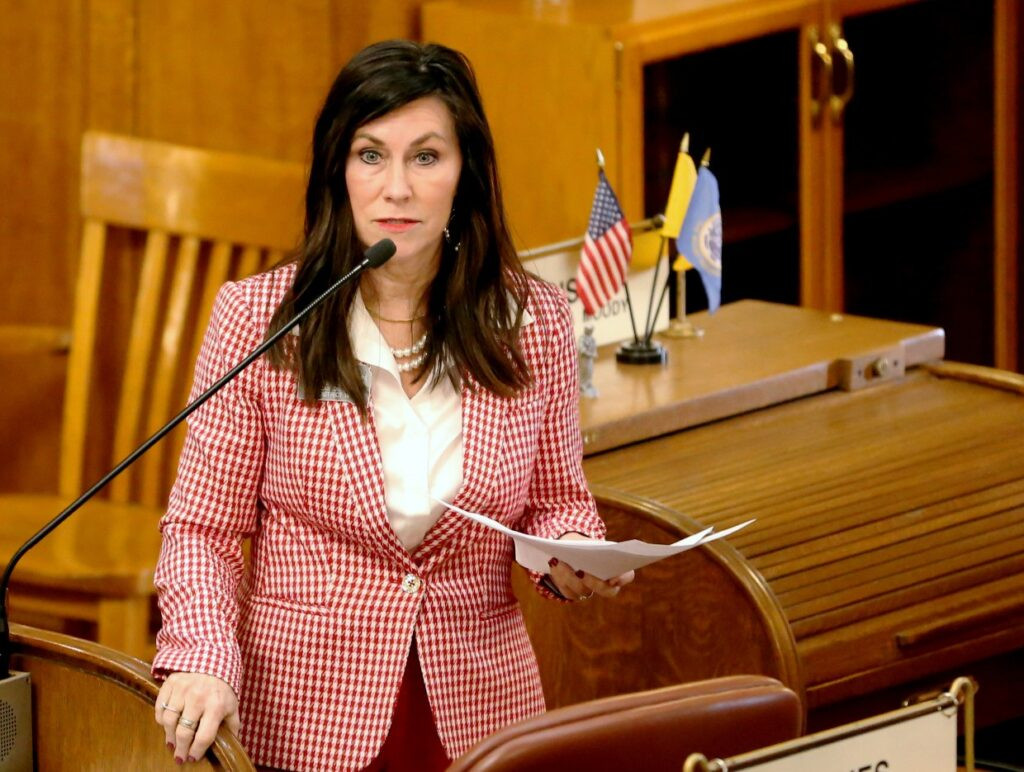
Rep. Karla Lems, R-Canton, speaks on the floor of the South Dakota House of Representatives on Feb. 19, 2026, at the Capitol in Pierre. She is the sponsor of bills that would reform aspects of state-funded economic development. (Photo by John Hult/South Dakota Searchlight)
A lawmaker got split results Thursday with two attempts to reform aspects of state economic development.
A bill from Canton Republican Rep. Karla Lems to tighten conflict-of-interest restrictions on members of the state Board of Economic Development failed in the state House, but her bill relieving employers of their obligation to pay into the governor-controlled Future Fund for economic development advanced.
The House vote on the Board of Economic Development bill was 29-36. It would have barred board members from holding a direct ownership interest or serving on the board of any entity that receives public funds approved by the board. The governor-appointed board approves an array of loan, grant, bond and tax rebate programs administered by the Governor’s Office of Economic Development.
SD economic development chair has multiple ties to food company receiving millions in state aid
Lems said the bill was meant to “shore up” public trust after recent scrutiny of state economic development operations. She cited South Dakota Searchlight reporting that the board’s longtime chairman, Jeff Erickson, also serves on the corporate board of CJ Schwan’s and is part of a corporation that rents office space to the company. The company has benefited from $69 million in state tax rebates, grants and loans in the past several years for the construction of a food production plant in Sioux Falls, though Erickson abstained from related discussions and votes.
Lems said when taxpayer dollars are involved, state officials should avoid not only conflicts but even the appearance of them.
“We cannot make informed decisions with public funds if it is clouded by undisclosed conflicts after decisions are made. Legislative reform is necessary now,” Lems said, reading a quote from Rep. Eric Muckey, D-Sioux Falls, in Searchlight’s reporting about Erickson. She handed out printed copies of that story prior to the House debate.
Muckey, an opponent of Lems’ bill, said that having his quote used on the House floor “in the name of a bill I wasn’t asked to support is frankly unprofessional.”
Muckey said the state already has a detailed conflict-of-interest section of law that governs when officials must disclose conflicts and recuse themselves. He said the real issue, and what his quote was about, is that disclosures are not consistently clear or timely. That’s something he had hoped to address in a bill he ultimately withdrew due to time constraints.
Future Fund bill
Lems’ Board of Economic Development bill had reached the House floor after it passed the House State Affairs Committee. Separately on Thursday, that same committee sent another bill introduced by Lems to the full House. That proposal would change how the state collects the “employer’s investment in South Dakota’s future fee.” The fee funds the governor-controlled Future Fund.
The fund was created in 1987 at the request of then-Gov. George Mickelson. It was placed under the governor’s exclusive control, enabling quick responses when economic opportunities arise.
Republican former Gov. Kristi Noem incited bipartisan backlash with her uses of the fund, which included paying for a fireworks show at Mount Rushmore, a Rapid City-area shooting range that legislators refused to fund, a Sioux Falls rodeo, and a workforce recruitment campaign in which Noem starred.
South Dakota employers contribute fees to the Future Fund when they remit payroll taxes for unemployment benefits.
The bill would shift the fee from automatic collection to a voluntary system by requiring employers to opt in. Employers who do not opt in would be treated as having opted out and would not have to pay the fee. It would also require the Department of Labor and Regulation to create an opt-in/opt-out form and post it online.
GET THE MORNING HEADLINES.
Lems told lawmakers the bill is about choice and transparency. She said some small employers don’t realize they’re paying the fee with their unemployment remittances.
“Employers should knowingly choose where their dollars will go,” Lems said. “If a program is valuable, employers will support it voluntarily, and if participation must be compelled to sustain it, that is something we should all examine honestly.”
Opponents warned the change could reduce funding for economic development and various programs supported by the Future Fund, such as the Build Dakota Scholarship Fund. That was created for scholars entering high-demand programs at technical colleges in the state.
Department of Labor and Regulation Secretary Marcia Hultman said the department collects the fee using an outdated computer system, and tracking opt-in/opt-out status for more than 35,000 employers would require costly programming work.
The Governor’s Office of Economic Development, the South Dakota Economic Development Professionals Association, the South Dakota Chamber of Commerce and Industry, and other business and development organizations also opposed the bill.
The Governor’s Office of Economic Development told South Dakota Searchlight that 1,691 grants have been awarded from the Future Fund since its inception in 1987. The grants include awards made across the state and 318 awards allocated to entities or projects serving the entire state. Opponents said supporters are focused on a few anecdotes and are ignoring the bigger picture.
The bill now heads to the House floor for consideration.
Another reform bill pending
Another bill inspired by Searchlight reporting would make state officials involved in a big contract with a company wait longer before accepting a job with that company.
The bill comes in response to the situation of former state economic development commissioner Steve Westra. As reported by Searchlight, Westra took a job with CJ Schwan’s a year after he left state government. While working for the state, Westra had signed the first pledge of state aid benefiting the construction of the company’s $550 million, 650-employee food production plant in northern Sioux Falls.
Under current law, state officers and employees involved in awarding or overseeing a contract with a company must wait one year after leaving government before taking a job with the company. The bill would extend the waiting period to two years for contracts worth more than $5 million.
That bill has passed the Senate and awaits action by a House committee.
YOU MAKE OUR WORK POSSIBLE.


