
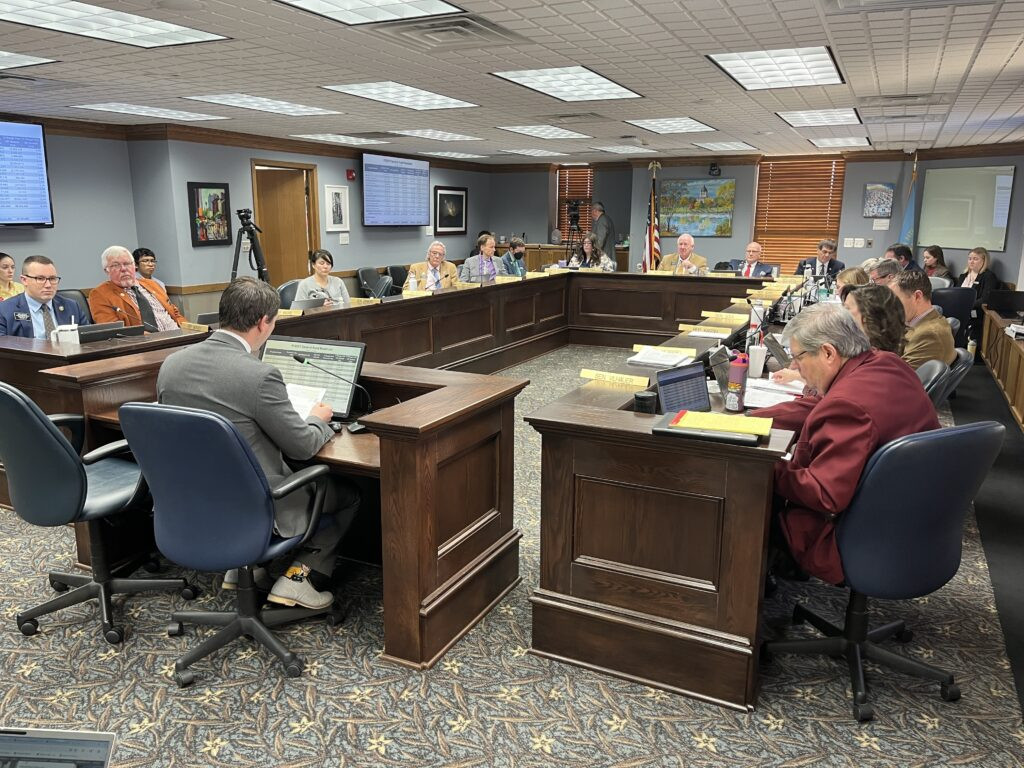
The legislative Joint Appropriations Committee meets on Feb. 11, 2026, at the South Dakota Capitol in Pierre. The committee voted Wednesday to restore some funding for Temporary Assistance for Needy Families. (Photo by Makenzie Huber/South Dakota Searchlight)
PIERRE — The South Dakota Legislature’s main budget committee voted Wednesday to partially restore cuts made to a federal-state program that provides needs-based financial support for families.
The same committee voted last year, due to lower-than-anticipated state revenues, to cut state funding for Temporary Assistance for Needy Families by 30% while authorizing the state Department of Social Services to use excess federal funds carried over from prior years. The change decreased state funding to the minimum amount required to receive federal funding, also called the “maintenance of effort.”
TANF is a federal-state program used in South Dakota to provide assistance to families with children who need financial support because of the death of a parent, an absent parent, or the unemployment or physical or mental incapacity of a parent. Caregiver participants are required to work, search or train for a job.
Protesters display paper dolls at SD Capitol to challenge benefit reduction for needy families
Instead of replacing the decrease in state funds entirely with carryover federal funds last year, the state Department of Social Services cut TANF benefits by 10%. The move saved the state about $1.5 million, department Secretary Matt Althoff said at the time, and was expected to reduce benefits for the average household by $51 per month.
The program distributed $15.3 million in benefits in fiscal year 2024, and the average monthly benefit per household was $518.06. Nearly 5,000 people in the state, most of them children, benefit from the program.
Althoff said last year that the department would gradually cut benefits until it reached a 30% reduction.
That decision set off a monthslong tug-of-war between the department and Rep. Erik Muckey, D-Sioux Falls, who serves on the budget committee, about whether the committee truly understood the department’s plan when the committee approved it last year.
Wednesday’s decision to partially restore funding for benefits passed with an 11-7 vote. Two members of the committee, including Muckey, are Democrats, while the rest are Republicans. The decision incorporates the funding into the broader annual budget legislation that will be considered by the full Legislature on Thursday, which is the last day of the annual legislative session except for a day March 30 to consider vetoes.

“Caring for those in poverty is not a partisan issue,” Muckey told South Dakota Searchlight after the meeting, “and today demonstrated that the Legislature is indeed focused on caring for the vulnerable, managing our financial obligations responsibly and not putting folks in deep poverty on the chopping block to do so.”
The decision includes a $427,000 increase in state funding coupled with another $427,000 increase in the department’s authority to spend carryover federal funds. Together, that’s a 5% increase in TANF benefits — restoring half of the benefit cut the state Department of Social Services implemented last year.
Muckey said he hopes the Legislature works with the department to define the future of the program, better understand how the funds are spent and avoid future cuts.
“This clarifies the intent of the Legislature more than anything else,” Muckey said, adding, “we have to figure out how, going forward, we’re going to sustain those benefits while also understanding that the reserves are finite.”
Sen. Taffy Howard, R-Rapid City, said she was concerned increasing the funds was premature and would lead to future increases. She added that some TANF recipients receive benefits from other state and federal programs.
“When we voted last year to get this down to the maintenance of effort,” Howard said, “we do not now — one year later — need to undo that.”


