
There’s a moment on the drive up to Mesa Verde National Park where you stop thinking about where you’re going and start focusing on staying alive. The road coils up the side of the mesa in tight switchbacks that will test your nerve regardless of how confident you felt at the bottom. If you’ve driven Going-to-the-Sun Road in Glacier or crawled up Pikes Peak with your knuckles white on the wheel, you know the feeling. One part exhilarating, most parts terrifying. And that’s before you’ve even seen anything.
I came in from the east, through the Rocky Mountains, which is not exactly a gentle warm-up act. By the time you’ve spent a few days surrounded by that kind of grandeur, you figure you’ve got a sense of what the land out here can do to you. Mesa Verde recalibrates that assumption.
The Quiet Gets There First
Step away from the tour groups for a minute. Find a spot where the voices fade out. What’s left is a silence that surprises you. I’m a pretty grounded guy who didn’t really start traveling until his mid-forties, and I’m telling you, Mesa Verde gets quiet in a way you have never really felt.
I’ve felt that same quality of silence in a few other places. Stonehenge at the right hour. The caverns beneath Budapest where Vlad the Impaler was reportedly held captive. The grounds at Dachau. None of those places are anything alike historically, but they share something in the air, some frequency that seems to say, “Something happened here, and you’ll respect it.” Mesa Verde carries the same signal. I don’t believe in the supernatural, and I want to be clear about that. I do believe some places on earth have been lived in so deeply, so completely, that the living left something behind that isn’t quite gone.
The Tewa people, whose ancestors built these dwellings, would tell you the place is still inhabited by the souls of those who came before. Whether you share that belief or carry your own framework or none at all, it changes how you move through the space. You get a little more careful with your footsteps. You start to feel like a guest.
What They Actually Built
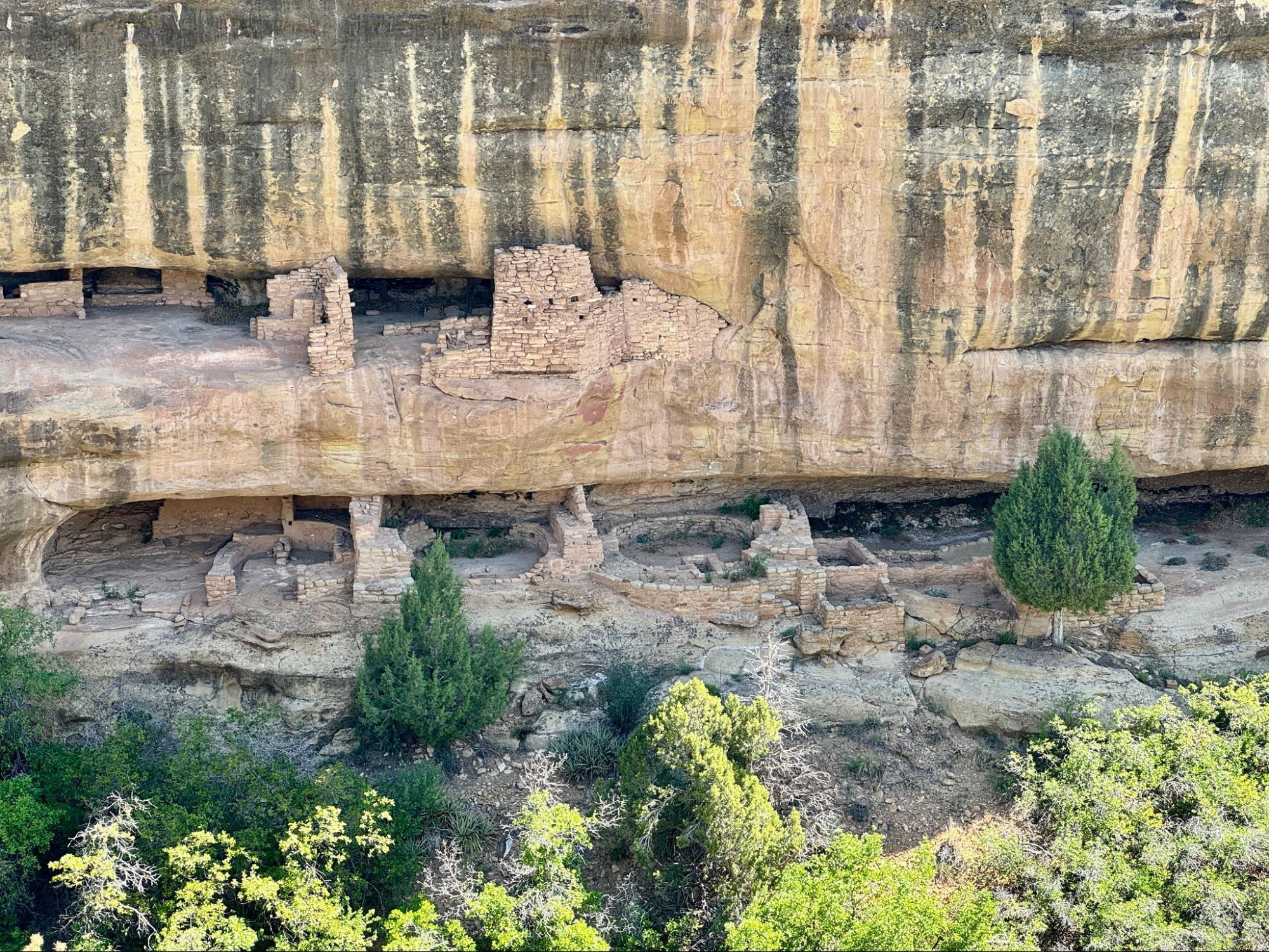
The Ancestral Pueblo people settled the Mesa Verde region around 550 CE, farming the mesa tops and building pit houses that gradually evolved into something extraordinary. By around 1190 CE they began constructing stone dwellings directly into the cliff faces, hundreds of feet above the canyon floor. Cliff Palace alone has more than 150 rooms and 23 kivas, the circular ceremonial chambers that anchored community life. It housed around 150 people. They built it by hand, with sandstone blocks, adobe mortar, and wooden beams hauled up from the valley below.
Stand in front of it and really look. No cranes. No power tools. No architectural renderings. No OSHA. These people built a multi-story city into the side of a cliff, maintained it, expanded it, and farmed the mesa top above it, all at the same time. We’ve got machinery and processing power and more capital than any civilization in history, and most of what we build is forgettable inside of a generation. These walls have been standing for 800 years and they’re still solid.
When you’re standing inside a room that was built before the printing press existed, the noise in your head goes down a few notches. You start paying attention to what hands can do when that’s all you’ve got.
They Left on Purpose
By around 1300 CE, the Ancestral Pueblo people were gone. They migrated south toward what’s now New Mexico and Arizona, and their descendants, including the Hopi, Zuni, and other Pueblo communities, are still there today. The reasons for leaving aren’t fully settled. Extended drought, resource scarcity, violence, political pressure, probably some combination of all of it. Some villages show signs of being burned as a final act before departure, a closing of the door on the way out.
What gets me about Mesa Verde is the feeling of standing inside a home that someone chose to leave. A place that was carefully built, carefully lived in, and then carefully walked away from. You can still see handprints in the plaster. Painted murals on the walls. The layout of rooms that reflect decisions somebody made about how they wanted to live, where they wanted the light to come in, how they wanted to move through a space carved into the side of a cliff.
It’s All Connected
Coming through the Rockies and arriving at Mesa Verde does something to your sense of scale. The mountains give you geology, raw and enormous and indifferent to your presence. Mesa Verde gives you people, real ones, who figured out how to live inside all of that on their own terms. The landscape and the communities that grew out of it have always been part of the same story.
Mesa Verde National Park sits in the Four Corners region of southwestern Colorado, about 35 miles west of Durango. Tours of Cliff Palace and Balcony House run from late spring through fall and require advance tickets. Balcony House involves a 32-foot ladder climb and a crawl through a narrow tunnel. The drive to the top of the mesa is roughly 45 minutes from the park entrance and earns every bit of the anxiety it causes.
I grew up in North Dakota. Flat, wide, sky in every direction. I didn’t start seeing much of the world until I was well into adulthood, which means when something genuinely stops me, it actually stops me. Mesa Verde stopped me. It made me feel small in the specific way that happens when you’re standing somewhere that was already ancient when your country was not even an idea. There’s humility in that, and it’s not a bad thing to carry home.


