
Mines Student Gains Real-World Wildfire Forecasting Experience Through Summer Internship
RAPID CITY, SD Detailed weather forecasting is integral to successful wildland firefighting operations. Wind shifts, humidity, temperature and precipitation all influence how fires behave and how crews respond.
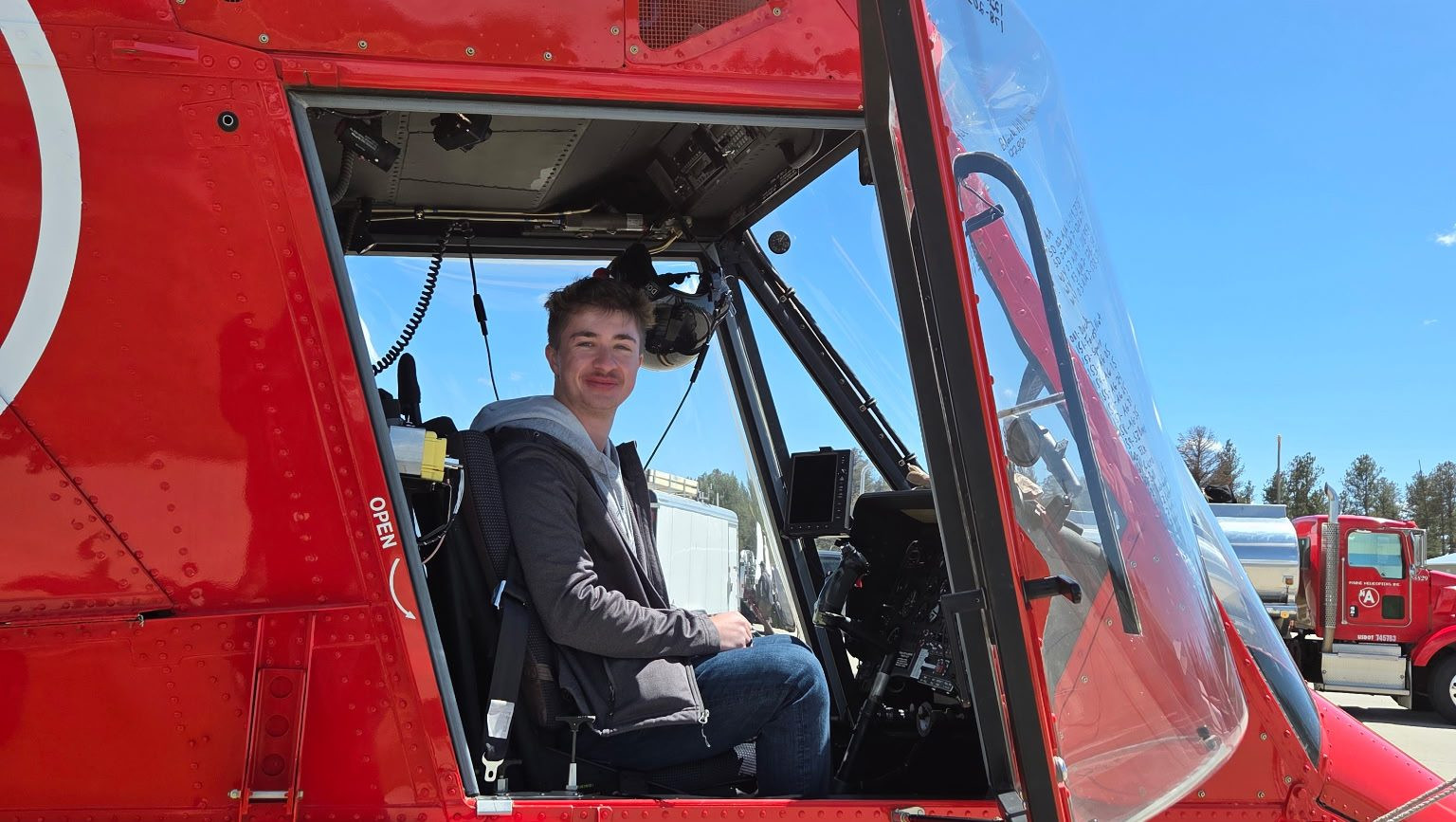
Gavin Bird, a South Dakota Mines atmospheric and environmental sciences student, is spending his summer interning with South Dakota Wildland Fire, where he is learning how weather forecasting supports wildfire operations across the Black Hills.
Based in the Weather Lab on campus, he works alongside Darren Clabo, Ph.D., associate professor of practice and state fire meteorologist, gaining firsthand experience in the science behind wildfire prediction and response.
Bird has spent much of his summer shadowing Clabo, learning how weather information is used to support firefighting operations. His internship has also taken him to wildfire offices across the Black Hills, where he has met firefighters, observed morning operational briefings and learned how weather forecasts influence decisions made on the fire line.
While Bird’s internship mainly involves fighting fires “behind the scenes”, he is, in fact, a certified wildland firefighter. As part of his training, he completed online instruction and participated in a live-fire exercise in Custer State Park.
“I got to tie in with a couple of hand crews down there, dig some (fire) line and play with live fire,” he said. “That was a lot of fun.”
The experience has given Bird a better understanding of the challenges firefighters face and the weather information they rely on.
“That’s part of what I’ve gotten as well when I’ve toured the different districts,” he said. “I go through their morning briefing, and I see what kind of weather they focus on, so I know what’s most important to them, and how I can best help.”
In addition to operational forecasting, Bird is researching long-term snow-depth trends and how changing winter conditions could affect future wildfire management practices.
Historical data show declining snow depth across the region, a trend that can shorten opportunities for prescribed burning and slash pile reduction during the winter months. Bird’s research explores whether weather conditions such as rainfall and saturated ground could safely provide additional opportunities for burning when snow cover is limited.
“In the last 50-plus years, with our changing climate, it’s definitely been declining in how much snow we get, which is crucial for firefighting operations,” he said.
The internship has also provided Bird with an opportunity to combine three longtime interests – weather, wildfire and aviation.
One of the highlights came in June when he visited the Rapid City Airtanker Base as crews supported suppression efforts on the South Fork Fire in northern Nebraska.
“We were cranking through the retardant out of our airtanker base,” he said. “Getting to hang out there was awesome. That was my highlight.”
After graduation, Bird hopes to pursue a career in aviation meteorology, where he can continue applying weather science in operational settings.
“Whether that’s working for the National Weather Service or for a private airline or something, that would be great,” he said. “In a broader sense, I just want to do anything in operations, making forecasts, working with partners, anything like that.”
Fort Pierre Couple’s Decades of Giving Inspires Next Generation of STEM Leaders

experiences and interactive demonstrations that introduce them to a variety of science
and engineering fields.

Expedition camp.
For Gary and Connie Grittner, investing in young people has always been about creating opportunities that can change the course of a life.
Gary knows this firsthand. As a young teen, he attended a summer medical camp that sparked his own interest in science. That experience led him to pursue a career as a chemist and reinforced his belief that exposing students to STEM at an early age can shape their futures.
For more than a decade, the Fort Pierre couple has quietly helped hundreds of high school students discover the excitement of STEM through South Dakota Mines summer camps, such as the STEM Exploration camp, as well as other student scholarships. This year, the university recognized that enduring commitment by renaming STEM Exploration, the Grittner STEM Expedition camp.
“For years, Connie and Gary Grittner have been the driving force behind making this experience possible,” said Alyssa Shipper, director of summer camps. “Their generosity is rooted in their own experiences and their belief that continuing education, curiosity, and hands-on exploration can change lives.”
The name reflects not only the Grittners’ generosity, but also their vision that early exposure to STEM can inspire the innovators, problem-solvers and leaders of tomorrow.
“For over a decade, Gary and Connie Grittner have shown up for our summer camp students with scholarships and equipment, year after year,” said Molly Moore, associate vice president for enrollment management. “Because of them, hundreds of young people have discovered a love of STEM they might never have found otherwise. We are deeply grateful for their generosity.”
This summer alone, the Grittners provided 25 scholarships for students across the nation to attend the immersive camp, continuing a tradition that has made STEM experiences accessible to young people who may not otherwise have had the opportunity.
“This has always been close to our hearts,” said Gary, who spent nearly 30 years serving in the U.S. Navy, both active duty and reserves.
Although neither Gary nor Connie attended Mines, the couple forged a lasting connection with the university after relocating to South Dakota in the early 2000s. Inspired to create opportunities for gifted youth across the state, they met with then-Secretary of Education Melody Schopp, who introduced them to then-Mines President Heather Wilson. That connection laid the foundation for a partnership that has helped inspire hundreds of young people to pursue STEM fields.
During the STEM camp, students participate in hands-on activities, laboratory experiences, and interactive demonstrations that introduce them to a variety of science and engineering disciplines. Campers also work alongside Mines faculty and researchers as they explore how STEM fields address real-world challenges.
In addition to their ongoing contributions to the STEM camp, the Grittners also donated nearly $40,000 to purchase a state-of-the-art particle image velocimetry (PIV) system, giving students access to the same advanced technology used by researchers and engineers to study fluid flow.
The PIV system provides detailed visualizations and precise measurements of airflow, allowing students to observe velocity and pressure fields within a wind tunnel in real time. Joseph John Thalakkottor, Ph.D., assistant professor in the Leslie A. Rose Department of Mechanical Engineering, will incorporate the equipment into the Grittner STEM Expedition, giving campers a hands-on introduction to aerospace engineering concepts. The system will also enhance instruction and research opportunities in the university’s aerospace engineering courses throughout the academic year.
For the Grittners, the impact of their support isn’t measured by the number of scholarships or the equipment donated, but by the students who leave camp seeing new possibilities for their future.
“If we can give students an opportunity to discover a passion for STEM and help them realize what they’re capable of, then we’ve accomplished what we set out to do,” Gary said.
Upcoming Events:
- Public Science Talk: The Invisible Universe – Ghost Particles and Dark Matter, by Anil Thapa, Ph.D., a theoretical particle physicist, from 6 – 7 p.m. Tuesday, July 14, in Room 104E of the Classroom Building, South Dakota Mines.
- Go to Mines, open house event for prospective students, from 8 a.m. – 1 p.m. Saturday, July 25, at Surbeck Center, South Dakota Mines.


