
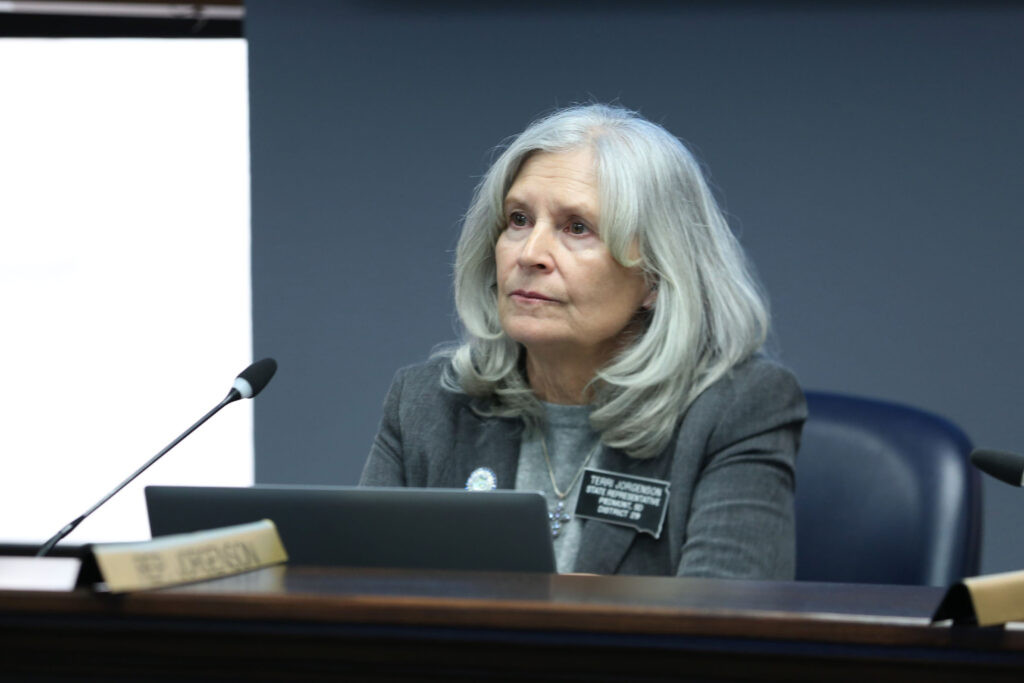
Rep. Terri Jorgenson, R-Piedmont, listens to a speaker during a legislative Joint Committee on Appropriations meeting on Jan. 20, 2026, at the Capitol in Pierre. (Photo by Makenzie Huber/South Dakota Searchlight)
Responding to concerns from residents near a controversial mine on the edge of the Black Hills, a committee of South Dakota lawmakers advanced legislation Thursday at the Capitol in Pierre that would subject mining explosives to tighter regulation.
Residents near Piedmont are concerned about blasting at a planned 300-acre limestone quarry. The mine plans to begin operations in August.
The House Agriculture and Natural Resources Committee approved a bill from Rep. Terri Jorgensen, R-Piedmont, who said dozens of residents have raised concerns about property values, noise, dust, groundwater and the cumulative effect of repeated blasting.
The bill would shift any mining that uses explosives to South Dakota’s more stringent mining-permit process, rather than the simpler annual mining license system used for the extraction of materials such as sand, gravel, construction rock, and limestone. It would phase existing explosive-use operators onto those permits over five years. The bill would also require operators to report explosives use 90 days in advance.
More legislative news
See all of Searchlight’s coverage of the 2026 legislative session.
Opponents, including the South Dakota Mineral Industries Association, Associated General Contractors of South Dakota, and the state Department of Agriculture and Natural Resources, said the bill creates unnecessary regulation and imposes a statewide mandate to address a local issue.
They said blasting is already regulated at the federal level and that counties with zoning authority can address setbacks, noise and other concerns locally. State officials said the state does not directly regulate blasting under its mine permits and warned the bill would require additional staff and hearings without providing funding.
Supporters said 22 South Dakota counties — including Meade County, which includes Piedmont — lack comprehensive zoning, and that federal regulations prioritize worker safety over community impacts beyond the mine fence line.
Rep. Kadyn Wittman, D-Sioux Falls, said she planned to oppose this year’s legislative effort. But then she learned the bill “doesn’t ban blasting. It doesn’t shut down aggregate production. It just says that when explosives are used, which we know increases impact and risk, the operation should have to meet more comprehensive permitting standards.”
“If there are implementation concerns or transition questions, I think those can be addressed,” she said.
Wittman made those comments as fellow lawmakers considered a motion to defeat the bill. She resisted that motion, arguing a rejection of the bill “stops this conversation completely, and I’m tired of hearing this come every single year, and us not doing anything about mining operations in the state.”
GET THE MORNING HEADLINES.
Some in the crowd clapped and cheered in response to those comments, causing the committee chair to pound his gavel and call for order in the room. Many who were in attendance live near Piedmont, where the controversial quarry plan includes blasting.
Minutes later, the committee deadlocked 5-5 on a motion to defeat the bill, then voted 7-3 to advance the measure.
Wittman later told South Dakota Searchlight that her comments were about various mining issues: “whether bonding is sufficient, whether acreage thresholds are appropriate, and whether taxpayers are protected from long-term liability.”
Other Piedmont-inspired bill fails
Separately, the Senate Commerce and Energy Committee also took up a bill Thursday that was motivated by the controversial Piedmont mine.
The bill, from Piedmont Republican Sen. John Carley, would require mining companies to send a notice to nearby neighbors, conservation districts, counties and cities at least two weeks prior to the commencement of mining activity for smaller operations, and 90 days in advance for operations at larger mines.
Companies would also be required to post a notice of expected mining activity for those larger operations at least three times in the area’s newspaper of record, the first of which would need to appear 180 days before mining begins.
Carley and some neighbors to the Piedmont mine testified in support, saying they had insufficient notice of the controversial mine. Mining company representatives, economic development lobbyists and the state Department of Agriculture and Natural Resources spoke against the bill, saying the notice requirements would be onerous and would unfairly burden all miners based on pushback against the Piedmont mine.
The bill was defeated 7-1.
Broader mining bill rejected
The House Agriculture and Natural Resources Committee also rejected a bill 9-2 on Thursday that would tighten and restructure South Dakota’s mining laws, revise permitting and operational requirements, and change fees.
Opponents, including mining officials, the Department of Agriculture and Natural Resources, and the state Chamber of Commerce, said the bill wrongly treats aggregate pits like large-scale mining, adds delays and costs, strains state staffing, and could repeal useful provisions.
Supporters, including bill sponsor Rep. Nicole Uhre-Balk, D-Rapid City, Dakota Rural Action, and the Black Hills Clean Water Alliance, said current laws allow mining with little notice and weak protections, and the bill would close gaps to protect water, sensitive sites and communities.
YOU MAKE OUR WORK POSSIBLE.


