
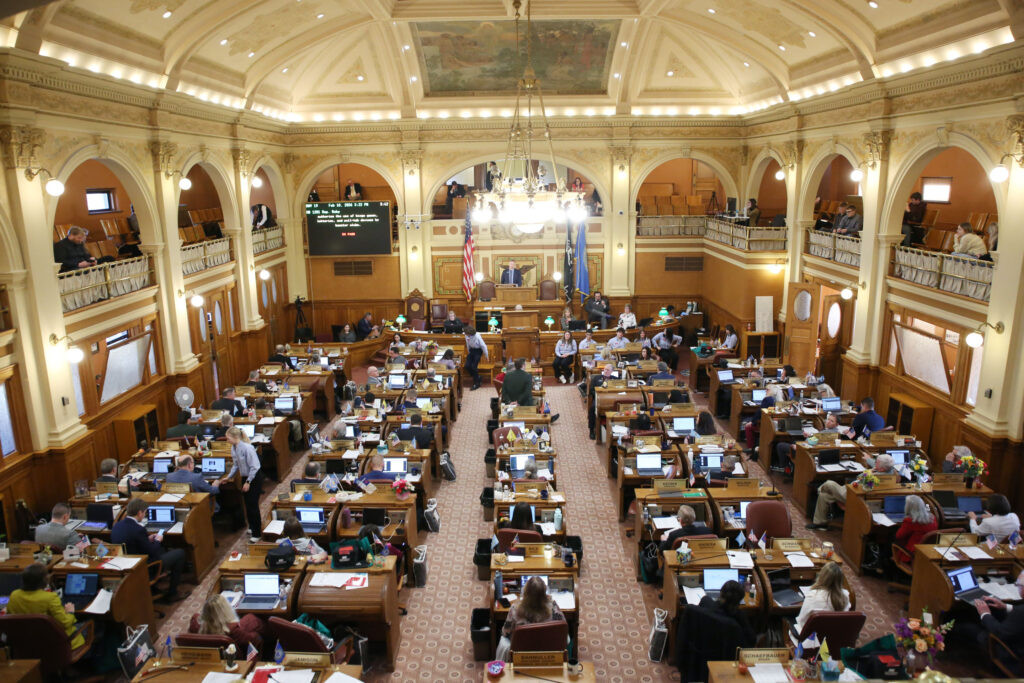
The South Dakota House of Representatives on Feb. 10, 2026. (Photo by Makenzie Huber/South Dakota Searchlight)
On Tuesday morning, smoke shop lobbyist Jordan Mason told a committee of South Dakota lawmakers that nicotine vaping products are “the number one method worldwide to help people quit smoking.”
Rapid City smoke shop owner Caleb Rose told them fruity, candy-flavored vape varieties are the ones his ex-smoker customers seek out most often and were, for many, the flavors that got them to stop lighting up.
Both men then asked the lawmakers to back a bill that would essentially restrict the sale of those flavors in South Dakota to smoke shops.
A regulatory framework like that, Mason said, would “preserve the lives of people that are addicted to tobacco, while also keeping it out of the hands of youth.”
Their comments came during a lengthy, two-part dialogue on how to best regulate the nicotine vape pens and other tobacco-free products like nicotine pouches that populate shelves on counters and behind cash registers at gas stations, grocery stores and pharmacy chains all across South Dakota.
The House Health and Human Services Committee ultimately kept both bills alive, but only one earned the “do pass” recommendation that ensures a floor vote in the House of Representatives.
That bill, House Bill 1220, would require wholesalers and distributors of nicotine products to be licensed and abide by a set of product guidelines.
Popularity of nicotine replacement
The bill Rose and Mason support, House Bill 1240, was sent to the House without a recommendation, which means it will need a motion supported by a majority of the House to be placed on the calendar for debate. The bill would regulate the sale of vape products in South Dakota more tightly than tobacco, which can be sold to people older than 21 by businesses with a sales tax license.
South Dakota is one of the nine states that doesn’t require a license to sell tobacco.
Bill to ban sale of pot-like Delta-9 to minors is on path to easy passage
Nicotine is addictive and vapes in particular carry risks of lung problems, but the scientific consensus is that both nicotine vapes and nicotine pouches carry a fraction of the health risks of tobacco products. Tobacco use is the number one cause of preventable deaths in the U.S., according to the Centers for Disease Control and Prevention.
Concerns about the health risks of vaping have risen as more young people have taken to the practice. E-cigarettes have been teens’ top choice for nicotine delivery since 2014, and just under 8% of teens had used them in the last 30 days, according to a 2024 report from the CDC. Fewer than 2% had smoked a cigarette in the previous month.
Angela Kennecke, founder of the nonprofit Emily’s Hope, told the committee her organization found five stores selling vape products within a quarter-mile of schools in Sioux Falls. Six such stores are located within a quarter-mile of schools in Rapid City.
In the House of Representatives on Tuesday, lawmakers voted 58-8 to approve House Concurrent Resolution 6011, which encourages the Legislature’s Executive Board to create a “Neurohealth Safety Committee” to study safety and regulatory issues surrounding vapor products, which would be inclusive of products with nicotine or marijuana-like intoxicants.
Smoke shop bill
In addition to restricting the sale of fruity flavored vapes to businesses that get at least 25% of their money from nicotine product sales, HB 1240 would require a $250 license to sell the products, curtail advertising and signage and require businesses to have a point-of-sale digital age verification scanner to check a customer’s age.
“We don’t want products in the hands of kids, and this takes a structured and workable approach to that goal,” Rose said. “It creates a clear licensing system for retailers, and that matters. If we want to curb youth vaping and eliminate bad actors, retailers need to be held to higher standards.”
Both men also mentioned that their industry coalesced around the ideas in the bill in response to previous attempts to regulate vape products, and in response to what Rose described as an unfair conflation of smoke shops with cannabis products.
The bill is sponsored by Rapid City Republican Rep. Tim Goodwin.
Lobbyists for retailers, convenience stores, the American Heart Association, Department of Revenue and Department of Health opposed the bill.
Jennifer Stalley, of the American Heart Association, said the bill has “technical flaws” that make it “unworkable.” Bill Van Camp, of the South Dakota Retailers Association, said it was “more than unworkable”
“Now they’re going to take certain types of products and move those into vape shops only, and we don’t think that that’s fair — if it’s legal,” Van Camp said.
Businesses that get less than 25% of their revenue would only be allowed to sell nicotine vapes with tobacco, mint or menthol flavors.
Licenses for wholesalers
The other vape regulation bill, HB 1220, got support from several of the smoke shop bill’s opponents.
As originally written, HB 1220 would have required any business selling vape products in South Dakota to first pay for a license. The bill’s sponsor, Sioux Falls Republican Rep. Brian Mulder, asked the committee to amend it to license only wholesalers and distributors.
The license would cost $1,000, and businesses with more than one location would need a license for each.
More legislative news
See all of Searchlight’s coverage of the 2026 legislative session.
Retailers wouldn’t need a license, but would need to stock their shelves with products from South Dakota-licensed wholesalers.
“We need to take steps moving forward to get our arms around this really rapidly growing retail operation,” said Mulder, who said the amendment was a compromise built through conversations with the various stakeholders.
Mulder’s bill earned a do pass recommendation 11-2.
Just under an hour later, Mulder said he couldn’t support the bill backed by smoke shops, in part because it didn’t have consensus support across the various interest groups.
But Mason, Rose and Rep. Goodwin all said “yes” when asked if they’d be willing to amend their bill to remove its more controversial provisions.
That should be enough to keep the proposal alive, argued Rep. Dylan Jordan, R-Clear Lake.
“I think we should, at a minimum, respect the compromise and that they want to regulate the bad actors in their field,” Jordan said.
Jordan moved to send the bill to the full House with a do pass recommendation, but that motion failed 6-7. A motion to defeat the bill failed by the same margin, with Sioux Falls Republican Rep. Taylor Rehfeldt switching her vote.
The committee ultimately voted 9-4 to advance the bill with no recommendation.
GET THE MORNING HEADLINES.


