
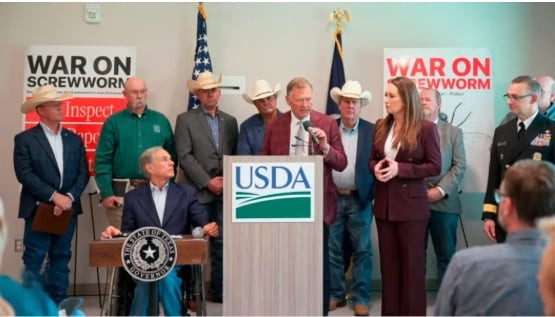
The parasite can hitch a ride north on a family pet or migrating wildlife as well as through movement of livestock
WASHINGTON, D.C. – On Tuesday, the U.S. Department of Agriculture (USDA) confirmed the fifth and sixth cases of active New World screwworm, detected in a goat and cattle and in La Salle County, Texas. Three other cases of infested cattle in Texas have been reported since June 3. A case of an infested dog in New Mexico was reported on Sunday.
Following the initial June 3 discovery of New World screwworm (Cochliomyia hominivorax) in a three-week-old calf in Zavala County, Texas, USDA and state officials have confirmed that the parasitic pest has expanded. Detections have now been verified across multiple Texas counties—including La Salle, Gillespie, and Andrews—as well as an isolated case in Lea County, New Mexico.
The flesh-eating parasite, which hasn’t had a confirmed domestic case since its eradication in 1966, has spent the last year marching northward through Central America and Mexico. Its arrival in the American Southwest has mobilized a massive, unified federal and state response.
The response from trading partners has been swift, aiming to wall off the infested regions before the fly can spread further into uninfected livestock populations.
- Canada: The Canadian Food Inspection Agency (CFIA) implemented emergency import restrictions. Livestock and horses that originate from or have been present in Texas within 21 days of reaching the border will be denied entry.
- Mexico Cross-Border Halts: In a reciprocal effort to freeze regional transit, the USDA Animal and Plant Health Inspection Service (APHIS) halted the exportation of U.S. cattle, wild ruminants, and equines to Mexico. Concurrently, strict 5-day veterinary certifications are being enforced on dogs entering the U.S. from Mexico after a dog in Andrews County tested positive.
Fearing a wider domestic outbreak, several major agricultural states have tightened their borders against Texas livestock. State animal health officials have established heightened veterinary inspection and permit requirements for incoming animals in:
- Florida
- Georgia
- Tennessee
- Montana
State agencies and livestock organizations are balancing public reassurance with urgent appeals to producers. Officials emphasize that the food supply remains entirely safe, as the parasite impacts living animal tissue rather than processed meat. However, the operational and economic strain on ranches is severe.
Dr. Matt Hille, an assistant professor and diagnostic pathologist at the University of Nebraska-Lincoln’s Nebraska Veterinary Diagnostic Center, said the veterinary profession has used the past two years of escalating threat to prepare for a pest most practicing vets had never encountered.
“A lot of veterinarians probably weren’t near as up to date on their screwworm knowledge,” he said. “But seeing the threat become more and more real has given us time, as a profession, to become collectively more educated and prepared.”
Still, he questions production of the United States’ main defense to the pest.
Sterile flies, when released into the wild, mate with normal flies but produce no offspring — gradually collapsing the population. A Texas facility currently under construction will produce sterile flies at scale, but it is not yet operational. Hille says with no fully functioning facility in the United States, the best the country can do right now is buy producers some time.
“The issue we have right now is our capacity to produce enough sterile flies,” Hille said. “The unfortunate thing is it just simply takes time to get these extra facilities up and running. We need to bide our time until we get enough of those flies.”
He said that shortage helps explain why the parasite has been able to push northward at all.
“The reason it’s continued to go northward is we haven’t had enough flies to even stop it where it was, let alone slow the progression,” Hille said. “There is going to be a little bit of a gap — and all the more reason for folks to just be diligent.”
In Texas, where a 20-kilometer “infested zone” and joint Incident Command Team have been established, the focus is entirely on localized containment.
For a broader approach, emergency coordinator John Bellinger has been appointed by USDA. “John’s roots in Texas where New World screwworm is at ground zero, and his private sector experience will help the administration advance our response and protect U.S. livestock,” noted U.S. Agriculture Secretary Brooke Rollins, following the emergency appointment Bellinger as Senior Advisor for New World Screwworm Preparedness to coordinate with state partners.
In states implementing import blocks, agricultural officials are emphasizing aggressive defense. Representatives from the restricted states note that keeping the fly out of their local boundaries is a matter of immediate economic survival for their cattlemen.
“While our colder climate is not hospitable for the long-term establishment of the fly in Canada, they can survive shorter periods of time in the summer months,” the Canadian Food Inspection Agency said in an official statement detailing their Texas restrictions. “Taking this action now is an appropriate risk mitigation measure to prevent its introduction and protect animal health.”
The primary tool for defeating the outbreak is the Sterile Insect Technique (SIT). Because female screwworm flies only mate once in their lifetime, releasing millions of laboratory-sterilized male flies causes the wild population to rapidly collapse.
[Wild Female Fly]  x  [Artificially Sterilized Male]
                              │
                              ▼
                     [Infertile Eggs]
                              │
                              ▼
                 [Population Suppression]
The USDA is currently scaling up production infrastructure with a goal of releasing 500 million sterile flies per week—the same historic threshold used to eradicate the pest decades ago. Additionally, the federal government has launched a “$100 million Grand Challenge” to fund innovative response strategies.
For producers on the ground in the Southwest, officials say the immediate directive is simple: inspect herds daily. Any unhealed, draining wounds or foul-smelling sores on livestock must be reported to state veterinarians immediately to prevent a localized outbreak from becoming a nationwide crisis


