
PIERRE, S.D. – We’ve just come through a period of unusually warm weather. But what’s coming next?
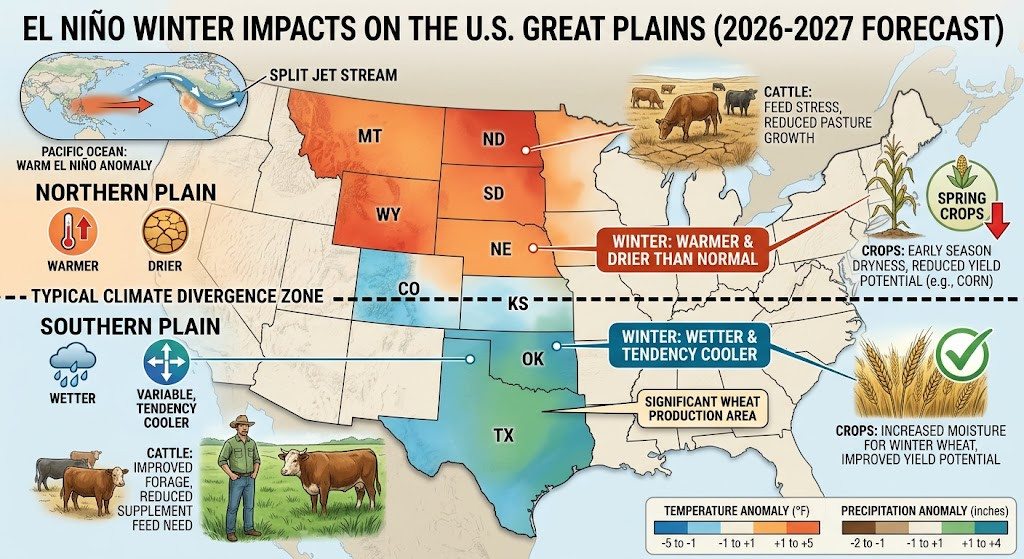
A rapidly developing El Nino in the Pacific Ocean will have an impact on weather across North America this winter and into next spring, according to weather officials.
State Climatologist Laura Edwards says one of the strongest El Nino patterns ever measured is expected to bring a warmer winter than normal but there will still be snow and periods of very cold weather.
El Niño is a climate pattern that brings warmer-than-average ocean temperatures to the central and eastern tropical Pacific Ocean.
Edwards says most of the local impacts will be to temperatures.
This El Nino is predicted to be one of the strongest ever measured. Edwards says she doesn’t expect more snow this winter. “We don’t seem much of an impact on precipitation. We’ve seen El Nino years of both wetter or drier conditions. It can go either way.
Edwards says there could be noticeable changes. When we looks at the combination of precipitation with the warmer temperatures were expecting I think it’s more likely we will see snowpack that doesn’t stick around when it does snow. Maybe more rain than snow potentially, a shorter cold season in general.
Past strong El Niño winters uniformly brought exceptionally mild weather to the Northern Plains, ranking among some of the warmest winter seasons on record for Montana, North Dakota, and South Dakota
The primary historical benchmarks for “strong to very strong” events include 1982-1983, 1997-1998, 2015-2016, and 2023-2024.
The “Warm” Guarantee: While El Niño weather patterns can occasionally be unpredictable in other regions, its signal in the Northern Plains is one of the most reliable in meteorology. A strong event historically guarantees fewer sub-zero days.
The Snow Wildcard: “Drier” does not mean “no snow.” Even during the historically dry 1997-1998 event, individual fast-moving Alberta Clipper systems or sudden spring systems still triggered localized heavy snow totals, despite the lack of a sustained winter snowpack.
With an El Nino hold on the region, with less snow and warmer temperatures, Edwards says there will still be snow and periods of very cold weather through the winter.


