

The views and opinions of this article may not reflect the views of The Rapid City Post, its affiliates, or advertisers.
By Emmett Reistroffer, Republican Candidate for State House in District 35
South Dakota is currently preparing to undertake what will likely become the single largest capital expenditure in state history: the construction of a massive new prison complex at a price tag around a minimum of a half-billion dollars.
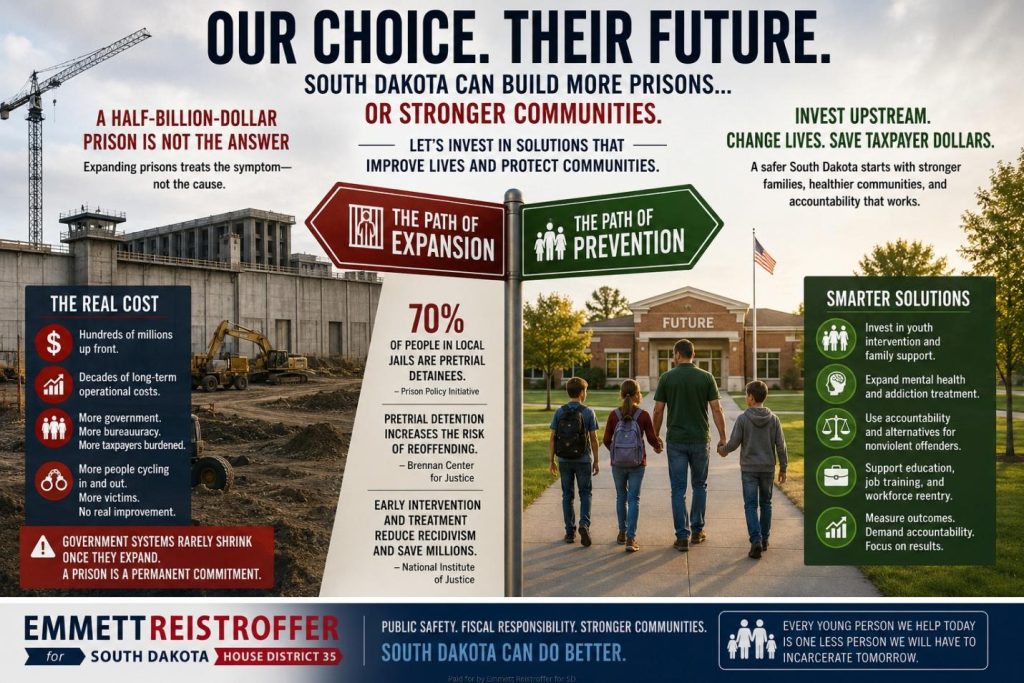
At a time when families across Rapid City and Box Elder are struggling with rising property taxes, housing costs, infrastructure strain, and growing concerns about government spending, it is worth asking a difficult but necessary question: how did we arrive at a point where one of the largest government projects ever proposed in South Dakota is not related to education, healthcare or infrastructure, — but a prison?
This conversation did not emerge overnight. For nearly two decades, South Dakota leaders have repeatedly acknowledged growing structural problems within the criminal justice system. I followed many of these discussions closely, including attending criminal justice reform meetings and policy discussions during the Daugaard administration when lawmakers, judges, prosecutors, law enforcement officials, treatment providers, and community stakeholders openly discussed the need for reform-oriented solutions designed to reduce recidivism and improve long-term public safety outcomes.
More recently, South Dakota’s prison task force was formed to study the growing pressures facing the correctional system, including overcrowding, aging infrastructure, staffing shortages, inmate population trends, and future capacity needs. Many of the concerns identified by that task force were serious and legitimate. But the broader danger is that policymakers may ultimately treat prison expansion itself as the solution rather than confronting the deeper systemic failures driving the need for expansion in the first place.
As political leaders recently gathered to celebrate the prison project and discuss construction timelines, I found myself increasingly uncomfortable with the tone of these conversations. I largely bit my tongue publicly at the time but ultimately decided somebody needs to be willing to say what many South Dakotans are already thinking: there is nothing normal about one of the largest government projects in state history being a prison. That is not simply an infrastructure story. It reflects years of unresolved systemic failure that policymakers can no longer afford to avoid confronting honestly.
Governor Larry Rhoden has also announced plans for a new recidivism-focused task force, which is an important and necessary step. Frankly, discussions surrounding recidivism should have been central to this conversation from the beginning. If South Dakota is preparing to commit taxpayers to one of the largest government expenditures in state history, then reducing repeat offending, improving treatment outcomes, strengthening accountability systems, and lowering long-term incarceration rates should be treated as core priorities — not secondary conversations occurring after the fact.
Because at its core, the prison debate is not simply about buildings or bed space. It is about whether South Dakota is prepared to honestly evaluate why so many individuals continue cycling repeatedly through the system despite decades of growing expenditures and reform discussions.
This is not a criticism of the hardworking men and women serving on the front lines. Law enforcement officers, sheriff deputies, dispatchers, correctional officers, parole staff, prosecutors, public defenders, and treatment providers throughout western South Dakota work under increasingly difficult conditions. They routinely encounter repeat offenders cycling through the system, untreated addiction, mental health crises, staffing shortages, and fragmented bureaucracies that too often operate without coordination or consistent accountability.
The problem is not a lack of dedication from the people inside the system. The problem is that the system itself has increasingly become reactive, expensive, and disconnected from measurable outcomes. Conservatives should not ignore that reality simply because the subject involves criminal justice.
In fact, conservatives above all others should be asking hard questions when government systems continue expanding while outcomes are deteriorating. South Dakota taxpayers are now being asked to support hundreds of millions of dollars in prison construction costs, with long-term obligations likely extending far beyond the initial price tag once staffing, maintenance, healthcare, transportation, pensions, and operational growth are fully included. Government systems rarely shrink once they expand. A prison is not merely a building project. It is a permanent commitment to larger government operations for decades to come.
The new prison should concern anyone who believes in limited government and fiscal responsibility.
At the same time, many South Dakotans understandably feel frustrated watching repeat offenders cycle endlessly through the system while communities continue dealing with crime, addiction, disorder, and growing pressures on law enforcement. Victims deserve better. Communities deserve better. Taxpayers deserve better than simply being asked to fund systems that appear increasingly incapable of producing long-term improvement.
One of the most overlooked drivers of these pressures is pretrial detention.
Look at the inmate list on any given day, and you will see the vast majority of individuals housed in our local jail pretrial detainees who have not yet been convicted of crimes. Many remain incarcerated not because they represent major threats to public safety, but because they cannot afford bail, are waiting on competency evaluations, lack access to treatment programs, or are trapped in delayed court processes.
The consequences are profound. Research from the Brennan Center for Justice and the National Institute of Justice shows that prolonged pretrial detention often increases future recidivism, destabilizes employment and housing, weakens family structures, and worsens long-term outcomes even for low-risk individuals.
These burdens do not simply disappear. They shift downward onto city and county governments, the sheriff’s department, the jail, and ultimately property taxpayers.
In many ways, county taxpayers are increasingly subsidizing inefficiencies and failures occurring at the state level.
This issue is especially important in western South Dakota, where rapid population growth around Ellsworth Air Force Base and surrounding communities is already placing pressure on infrastructure, housing, emergency response systems, and local government budgets. If state systems continue operating inefficiently, local taxpayers will continue absorbing the consequences.
South Dakota should also honestly acknowledge the extent to which jails and prisons have become de facto mental health institutions. Law enforcement officers are frequently expected to respond to behavioral health crises they never intended to manage alone. County jails increasingly hold individuals awaiting competency evaluations or treatment placement for extended periods because adequate infrastructure simply does not exist elsewhere in the system.
This is neither humane nor fiscally sustainable.
One additional disappointment throughout this process has been the relative lack of discussion surrounding juvenile corrections and early intervention services. If South Dakota is prepared to invest historic sums into adult incarceration infrastructure, it should also be willing to invest seriously in the systems designed to keep troubled youth from entering that pipeline in the first place. Research consistently shows that early intervention, family support services, behavioral health treatment, mentorship programs, educational stability, and juvenile diversion efforts can dramatically reduce long-term criminal justice involvement and future incarceration rates. Every young person successfully redirected toward stability, education, employment, and personal accountability represents not only a better outcome for that individual and their family, but also fewer future victims, lower long-term correctional costs, and stronger communities overall. A criminal justice system focused almost entirely on downstream incarceration while underinvesting in upstream youth intervention is ultimately responding to failure rather than preventing it.
Importantly, many conservative states have already confronted these realities directly.
Texas is perhaps the clearest example. In 2007, the state faced projections requiring major prison expansion. Rather than immediately building more prisons, Republican policymakers invested in diversion programs, specialty courts, probation reform, treatment capacity, and workforce reentry initiatives. According to the Justice Reinvestment Initiative, Texas ultimately avoided an estimated $1.6 billion in prison construction and operational costs while simultaneously reducing incarceration rates and crime rates over time.Organizations such as Right on Crime helped shape these reforms through principles deeply rooted in conservative philosophy: government accountability, fiscal discipline, limited government, public safety, and measurable outcomes. Their proposals emphasized reserving prison space primarily for violent and dangerous offenders while expanding structured alternatives for lower-risk individuals struggling with addiction or mental illness.


