
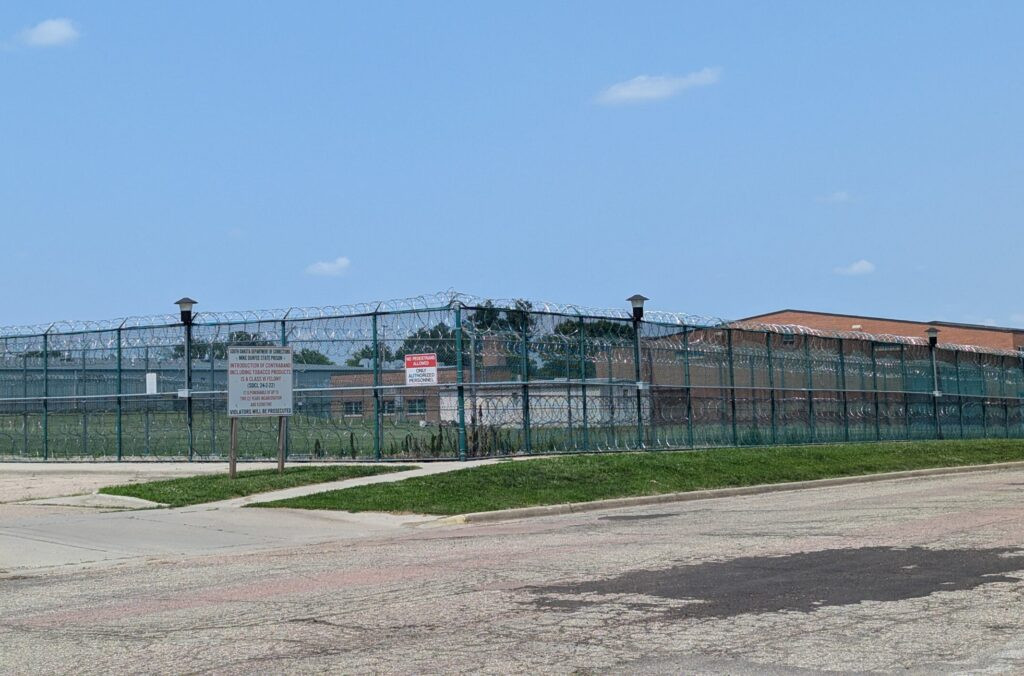
Mike Durfee State Prison in Springfield, South Dakota. (Photo by John Hult/South Dakota Searchlight)
The South Dakota Department of Corrections’ parole division notched a series of wins in 2025, its leaders said this week, even as public scrutiny of people on parole reached a crescendo late last month loud enough to spark immediate changes from Gov. Larry Rhoden.
Two top parole administrators delivered the message to the state Board of Pardons and Paroles on Wednesday. It was the board’s first full-group meeting since Rhoden announced plans to hire five new parole officers to do intensive supervision on high-risk inmates, requested faster decisions on parole violations and said the state would crack down on drug use and other misbehavior by people under state supervision.
The changes came a few days after a police officer in Sioux Falls was shot and injured, allegedly by a man on parole. The April 27 incident was the second time an officer was shot in Sioux Falls in the space of a year. The alleged shooter in a separate incident from April 2025 was on parole.
Earlier in April, Rhoden’s office issued a news release on what he branded a “Smarter Supervision Initiative,” which noted that the state had asked for an $890,000 Justice Department grant to improve data collection and parole officer training, and to “strengthen community partnerships.”
South Dakota governor pledges parole reform days after Sioux Falls officer is shot
The state’s struggling to get a handle on its 50% recidivism rate, Rhoden wrote in a letter supporting the grant, referencing a term for people who return to prison within three years of release.
Rhoden convened a Correctional Rehabilitation Task Force last year to address efforts to reform individuals inside the prison and address re-entry issues for people being released.
In response to repeated calls for parole reform from leaders in Sioux Falls and Rapid City, however, Rhoden, who is in the midst of a campaign to keep his job, has emphasized the public safety value of sending people back to prison.
“The stories I have heard about parolees receiving too many second chances are frustrating and wrong, so we have changed this process,” Rhoden wrote in an opinion column released on May 1. “I have directed the DOC to take a tougher stance on DUIs, drug use, simple assault, and weapons violations that are a danger to others.”
Extra work anticipated for board
Parole board Chairman Myron Rau said Wednesday that the group’s workload could grow considerably, because of “everything that’s happened recently in the Department of Corrections.”
Rhoden wants the parole board to process violations — which will now include more violations for drug use — more quickly, which Rau said could mean adding a day of work back onto the board’s monthly meeting schedule.
Rau leads a part-time, nine-person board with members appointed by the governor, attorney general and chief justice of the state Supreme Court. Parole officers supervise people and submit reports of parole violations, but members of the appointed board must sign off on those recommendations to send someone on parole back to prison.
The board holds in-person and virtual hearings during one week of each month, at which they hear requests for release from current inmates, as well as requests for clemency or early discharge from parole.
In recent years, the board added a one-day “special session” to the end of each month to make decisions on parole violations. During those sessions, two members consider the arguments of parolees who are accused of but deny violating the terms of their release. The two members also sign off on dozens of “paper violations” for people who admit to violating their parole terms.
The new system had worked so efficiently that the board meetings shrank from four days to three, but Rau told the board this week they should be prepared to add that day back onto their calendars in the coming months.
Division leaders see improvement
Leaders from the Department of Corrections’ parole division regularly report to the board on issues of open positions and parolees contacted in the previous month, but on Wednesday they offered a series of year-end statistics from 2025.
The division met or exceeded its goals, they said. Just 3% of the people on parole are now classified as “absconders,” said Brad Lewandowski, director of parole services, meaning they’ve lost contact with their parole officer on purpose.
“There’s no state in the country that’s done that,” Lewandowski said. “The average nationally is between 10 to 14% of your population as absconders. For our staff to get it there, they worked really, really hard.”
National averages for parole absconding are not readily available, as states have differing systems for defining the term and calculating rates.
In response to follow-up questions about where Lewandowski pulled those national averages, corrections spokesman Michael Winder said the parole director found the figures prior to the meeting “when searching other states who have similar systems and the available information.”
South Dakota Gov. Larry Rhoden issues 65 pardons, one commutation since taking office
The number of parolees ducking supervision now hovers at around 100 on any given day, Lewandowski said. Three years ago, when the state created an absconder apprehension unit, there were four times as many.
The state also has a status known as “attempt to locate,” which means parole officers have lost touch with a parolee but are unsure why. An attempt to locate sends notice to law enforcement statewide, signaling that any officer who makes contact with the parolee in question should hold them and reach out to their parole officer.
The man who allegedly shot the officer in Sioux Falls was not an absconder, but was on “attempt to locate” status. Per corrections policy, a person who remains out of contact with their parole officer can move into absconder status two weeks after the issuance of an attempt to locate bearing their name.
As of Thursday evening, there were 47 people on “attempt to locate” status in South Dakota, corrections spokesman Michael Winder said in an email sent after Wednesday’s meeting.
Kayla Stucky, associate director of parole field operations, pointed to a decrease in the number of people returning to prison on “technical parole violations,” a list of violations that includes absconding.
“Our goal was to decrease it by 3%, and we actually decreased it by 25%, so that’s pretty exciting for us,” Stucky said.
Stucky also pointed to two classes for people on parole, a “newer program” called “Thinking for Change” and another called “Moving On.” Seventy-two people on parole completed the latter; 40 completed the former.
In the coming year, Stucky said, the division hopes to work on helping more people on parole find jobs. About one in five parolees is unemployed, she said.
The division has assigned a staff member “to try and make sure our offenders are getting the right help that they need to get that employment,” Stucky said, and to find more businesses willing to hire people on parole.
Intensive supervision
The hiring of five new officers and the formation of an “enhanced compliance unit” was welcome and “probably needed,” Lewandowski said.
Unlike the typical parole officer, he said, the agents in the new unit will oversee 20 to 30 people, not 65 or more.
Five veteran parole officers volunteered to become part of that unit, he said.
GET THE MORNING HEADLINES.
“We’ll find the toughest cases for them to supervise,” Lewandowski said, and the agents will keep up the intensive monitoring for “about four months” after an inmate is released.
“They’ll be your aggravated assaults, your violent offenses, your high-risk sex offenders, and we’re going to throw in people that have been in prison for a long time,” Lewandowski said. “They generally need a little bit of supervision structure as they come out.”
Winder, the corrections spokesman, said the new positions will be funded with the existing corrections budget through the “internal reallocation of vacancies from other areas.”
Parole leader points to misconceptions
Recidivism rates are calculated on a three-year timeframe, Lewandowski reminded the parole board. The 50% rate that’s animated current discussions, he said, is tied to people the parole division began to interact with in 2023.
That can be frustrating for officers who’ve improved their methods, he said.
“We’re kind of being judged on what we were doing three to six years ago,” he said.

He also lamented what he called a lack of understanding from the public about the role of the parole board. Many use the words “presumptive parole” and “presumptive probation” interchangeably, he said, typically in reference to — and criticism of — the criminal justice reforms of 2013 that created the latter.
But probation doesn’t apply to prison. It’s the system of supervision for people who aren’t in prison, and a rebuttable presumption of probation was affixed to some nonviolent felonies in 2013.
The system sometimes referred to as “presumptive parole” came nearly two decades before that. Since 1995, inmates who complete assigned programming and avoid major rule violations are released without parole board review, on a date defined by a judge’s sentence. In practice, that’s meant that two-thirds of the people released from prison never see the parole board.
The current setup replaced a “good time” system. That former system automatically cut a third of an inmate’s sentence the day they arrived in prison, with no expectation they’d participate in educational or rehabilitation programming. That framework incentivized good behavior by threatening inmates with a loss of their “good time” for rule violations.
Board member John Brown said he and others on the board get questions about why they chose to release people they had no hand in letting out. The people who ask members questions like that, he said, are often surprised to hear that inmates usually earn their own release.
“I don’t think it really matters what we do,” Brown said. “People think somebody’s locked up and they ought to stay there. That’s about as far as they think about it.”
Jail numbers change
The recent supervision changes have already begun to ripple through the jail in Sioux Falls, South Dakota’s most populous city and home to the state penitentiary.
An undeveloped northeast corner of the city will soon play host to a new, $650 million prison, meant to replace the oldest penitentiary buildings.
Governor candidates clash over inmate rehabilitation as state builds new prisons
Public safety officials in Sioux Falls, as well as Mayor Paul TenHaken, have called for stricter parolee sanctions for years, often pointing to the high number of parolees arrested on new charges who fill the Minnehaha County Jail.
Penalties for parole violations can range from coursework and more contact with a parole officer to a return to prison. Parolees accused of violating the terms of their supervision may be held in jail until parole agents decide whether to send their recommendations to the board for approval.
Being charged with but not convicted of a new crime doesn’t necessarily result in a return to prison for someone on parole. People charged with new crimes typically either stay in jail or are released on bond and return to the community while their case is pending.
On the day the officer was shot, the jail in Sioux Falls held 112 people on parole holds, all but eight of whom had new criminal charges.
The number of parole-only holds increased to 40 in the days immediately following the shooting of the Sioux Falls officer, Minnehaha Sheriff Mike Milstead told South Dakota Searchlight late last month. He called the stricter guidelines for parolee detention a welcome change, although “I wish it would have happened earlier.”
As of Wednesday, there were 46 people at the jail on parole-only holds. Another 109 were being held on both parole holds and new criminal charges.
That’s led to a space crunch at the jail, but “the state has been responsive to our requests to transfer people out to other facilities,” said Mike Mattson, warden of the Minnehaha County Jail.
In the past two weeks, Mattson said in an email, the Department of Corrections took in 20 parolees, moved 27 more to Clay County and five to Union County.
YOU MAKE OUR WORK POSSIBLE.


