
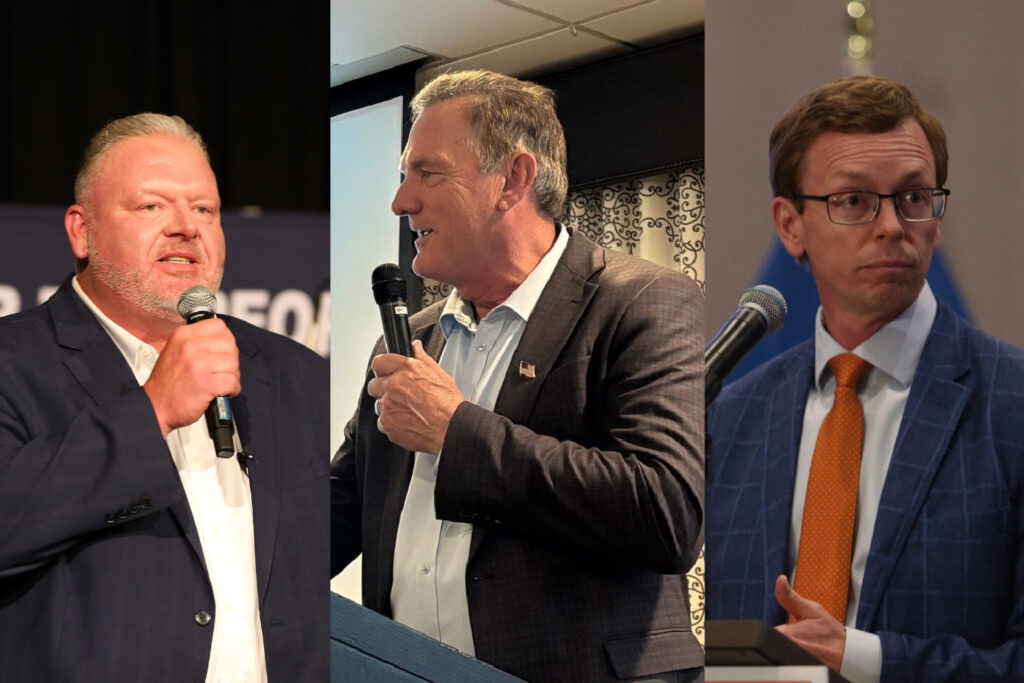
From left, businessman Toby Doeden, Gov. Larry Rhoden and U.S. Rep. Dusty Johnson speak at their respective watch parties on the night of the June 2, 2026, Republican governor primary election in South Dakota. (Photos by South Dakota Searchlight’s Joshua Haiar, Meghan O’Brien and Makenzie Huber)
Partial returns Tuesday night showed no candidate meeting the threshold to avoid a top-two runoff in the race for South Dakota’s Republican nomination for governor.
With 567 of 686 statewide precincts fully shortly after midnight, businessman Toby Doeden led with 30% of the votes, followed by Gov. Larry Rhoden, 26%, U.S. Rep. Dusty Johnson, 24% and state House Speaker Jon Hansen, 21%. All the votes are from registered Republicans, whose primary races are off-limits to independents and voters from other parties.
State law requires a runoff eight weeks later, on July 28, if nobody reaches 35% in a primary with three or more candidates for governor.
window.addEventListener(“message”, function(event) {
var message = JSON.parse(event.data);
if (message.sender == “Flourish” && message.context == “iframe.resize”) {
src = message.src.replace(/#.+$/, “”);
vizFrame = document.querySelector(‘iframe[src=”‘ + src + ‘”]’);
vizFrame.setAttribute(‘height’, message.height);
}
});
Doeden, Rhoden and Johnson each acknowledged late Tuesday night that a runoff is likely, and each of them expressed confidence about making it into the runoff.
Doeden, a political newcomer, said “the career politicians told me what we collectively have done across this state was impossible.”
“They said no outsider in South Dakota can break through three career, 20-year politicians,” Doeden said. “Well, guess what? You and I, we are doing it.”
Johnson said “we’re in pretty good shape to make this runoff.”
“Tonight is a night of celebration, but of course we have a long way to go yet,” Johnson said. “We have a rendezvous with July 28th. I’m really looking forward to that.”
Rhoden made similar comments.
“Well, it’s been a long night and the numbers aren’t all in, but we feel very confident that I am going to be in a runoff with Toby Doeden to be the next governor of the state of South Dakota, and so that is a victory,” Rhoden said.
Prior to Tuesday, no race had gone to a runoff since the passage of the runoff law in 1985. There were six occasions before 1985 when such races failed to produce a 35% winner, and in those instances, the nominees were decided by delegates to state party conventions.
The candidate who ultimately wins the Republican nomination for governor will advance to the Nov. 3 general election to face Dan Ahlers, who was uncontested for the Democratic nomination.
Noem’s resignation ignites race
Former Gov. Kristi Noem opened the door for a Republican primary race when she resigned in January 2025 to accept a job in President Donald Trump’s administration.
Noem’s departure elevated Rhoden from lieutenant governor to serve the remainder of Noem’s second term, which ends in January. During his time as governor, Since then, Rhoden has worked with legislators to sign several major bills into law.
Those include laws capturing revenue from sales tax increases to reduce homeowner property taxes, a law banning the use of a legal procedure known as eminent domain to gain land access for carbon capture pipelines, and a law funding construction of a $650 million replacement for the oldest parts of the state’s 145-year-old penitentiary.
‘The least bad option’: South Dakotans explain their primary election voting decisions
Rhoden built his campaign on those and other achievements.
“Good policy makes good politics,” he said while launching his campaign in November.
At Rhoden’s watch party Tuesday night in Rapid City, Jim Hunt, of Faith, who has known Rhoden since high school, said his support for the governor is grounded in his character.
“If it’s something that he doesn’t believe in, he’ll tell you why, because he’s honest and his integrity is number one,” Hunt said.
But Rhoden’s status as governor couldn’t prevent Johnson from entering the race last June as the presumptive frontrunner. Johnson had the highest profile due to his four terms in the U.S. House, his previous service on the state Public Utilities Commission, and his 20-plus years of involvement in statewide politics.
That long resume was an important factor for 55-year-old Republican voter Dan Harrell.
“I’m looking for experience, and so for me, the one who’s going to have the most experience for our state is going to be Dusty,” Harrell said in an interview with South Dakota Searchlight at a Sioux Falls polling place. “Just because he’s been representing us for longer than the other ones have.”
Johnson also began with more than $6 million in campaign funds he’d built up over prior election cycles.
“Ladies and gentlemen, President Trump talks about this as the golden age of America,” Johnson said in a campaign announcement speech. “South Dakota needs an energy and optimism to meet that moment.”
The Trump effect
Johnson’s opponents cited several examples from his congressional career to label him as insufficiently supportive of the Republican president.
Johnson was one of 13 House Republicans who voted with Democrats when they blocked Trump’s declaration of an emergency on the southern U.S. border in 2019. Johnson said at the time that he supported funding for border wall construction. But he opposed expanding presidential power at the expense of Congress, which he said would result from allowing the president to pay for the wall with money budgeted for other purposes.
Johnson also voted for the certification of the 2020 presidential election and the creation of an independent, bipartisan commission to investigate the rioters who attempted to stop the certification. The effort to create that commission failed, and Johnson voted against creating the Democratic-led House Select Committee that ultimately conducted the investigation. But he supported Rep. Liz Cheney when other Republicans stripped her of a House leadership position in retaliation for service on the committee.
GET THE MORNING HEADLINES.
Rhoden’s campaign published a website referencing those votes and describing them as indicative of “the real Dusty Johnson” — someone who’s “not with Trump.” A political action committee affiliated with Doeden sent a text message to Republican voters saying “if you hate President Trump and all that he stands for, Dusty Johnson is the candidate for you.”
Doeden, who spent at least $4 million of his own money in the race and ran on a pledge to phase out property taxes, also tried to position himself as the most pro-Trump candidate. He often mentioned Trump in his initial advertisements — although not as much in the waning weeks of the campaign, as Trump’s national approval rating fell below 40%.
Candidate platforms
Doeden also ran on a promise to phase out property taxes, although opponents criticized Doeden’s property plan as vague. He said the state would have enough money to eliminate property taxes after he reduces state spending, grows the economy and eliminates waste, inefficiencies and redundancies in state government.
Republican voter Brian O’Connor, of Rapid City, liked Doeden’s message and outsider status.
“I just think we need somebody different, and I’ve seen those other people too much, and he’s probably the one that is the least political right now,” O’Connor said in an interview at his polling place with South Dakota Searchlight.
2026 South Dakota primary election results in statewide and legislative races
Johnson largely ignored the critiques of his own record. His campaign was a mix of promises to strengthen schools, the economy and public safety, and criticism of tax laws approved by Rhoden and Hansen.
Rhoden signed three bills into law during this year’s legislative session that allow for higher sales taxes. Two of them devote the extra revenue — from a scheduled statewide sales tax increase in one instance, and a new, optional county sales tax in the other — toward reducing homeowner property taxes. Hansen supported those bills but not the third one, which creates an optional sales tax that cities can impose temporarily to pay for special projects.
Ads from Johnson and political action committees supporting him criticized Hansen and Rhoden for the sales tax increases, without mentioning the homeowner property tax reductions.
Hansen ran on a platform of “faith, family and freedom,” seeking to capitalize on his standing as co-chair of the anti-abortion Life Defense Fund, which led the successful fight against an abortion-rights ballot question two years ago. Another major facet of Hansen’s campaign was his criticism of the state’s approach to economic development, calling the use of state funds to give tax breaks and other incentives to large companies “a breeding ground of corruption.”
Total spending by all four campaigns in the race surpassed $10 million, according to campaign finance reports filed two weeks before the election, plus more than $1 million spent by political action committees. Final figures won’t be known until the next reporting deadline in October.
South Dakota Searchlight’s Joshua Haiar, Makenzie Huber and Meghan O’Brien contributed to this report.


