
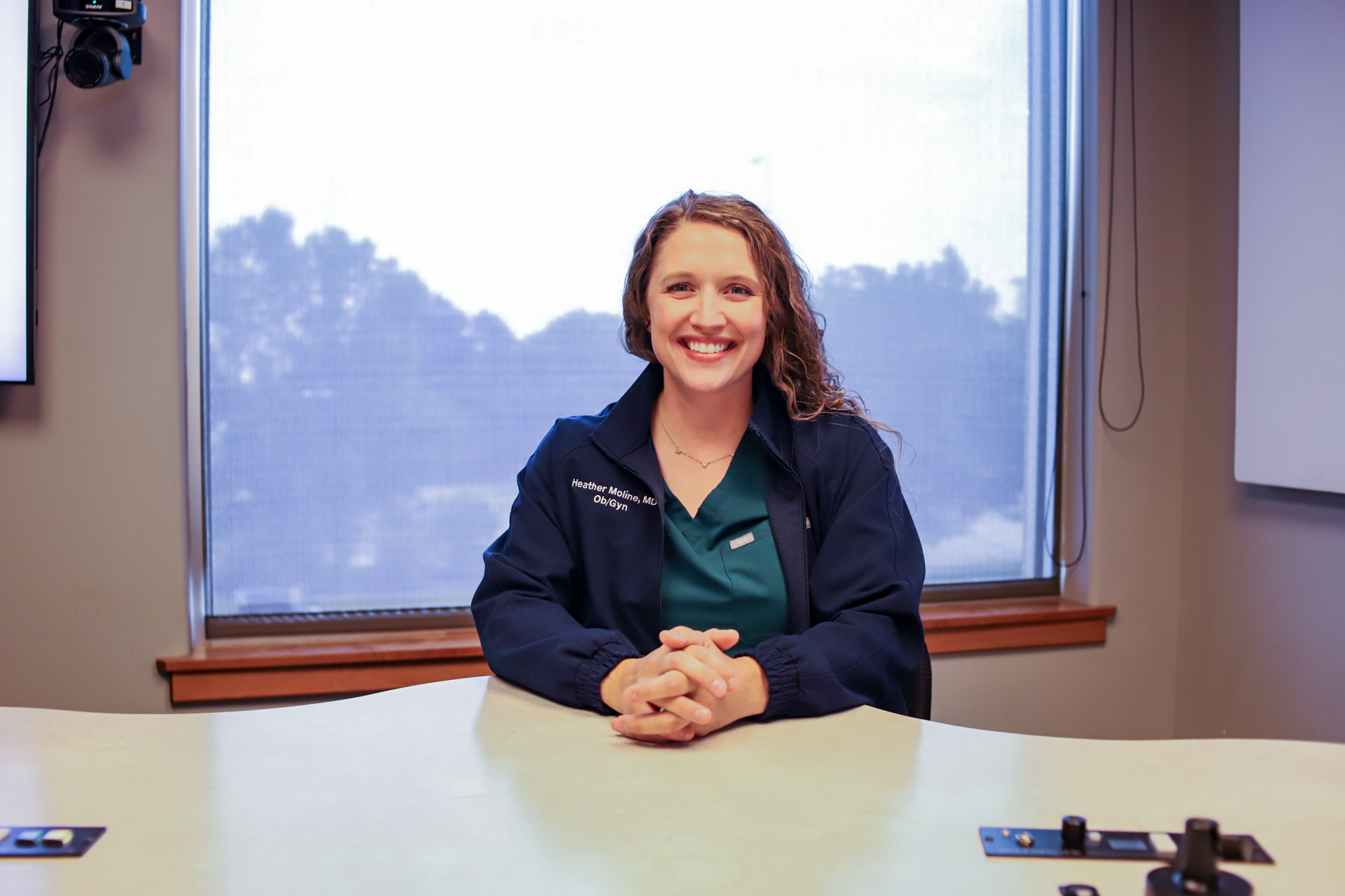
Dr. Heather Moline says the online perimenopause boom is pointing women toward care an entire generation was talked out of.
Scroll social media for ninety seconds and you’ll run into it. Hot flashes at 3 a.m. A patch somebody says changed her life. A comment section arguing about cortisol. The perimenopause conversation is louder than it’s ever been, and plenty of women in their forties are reading it while wondering if any of it applies to them.
Dr. Heather Moline, an OB-GYN with Rapid City Medical Center, sees those same posts. She doesn’t expect the interest to fade.
“This is the direction that we’re heading in health care for women,” she said on Monument Health’s Doc Talk podcast.
Later in the conversation, talking about the research finally catching up, she put it another way. “While it feels like it’s trending, it’s also trending in the right direction.”
How doctors define perimenopause and menopause
The two words get swapped online. In a clinic, each one means something specific.
Menopause has a clean definition: twelve consecutive months with no menstrual cycle. Average age is fifty-one, though Moline notes some women hit it seven years earlier or later.
Perimenopause is the gray zone before that. Cycles get unpredictable. Sleep falls apart. Mood swings show up out of nowhere. It can start in a woman’s mid-thirties and stretch on for years.
That messiness is the whole problem with testing. Draw labs on cycle day three, day ten, and day twenty-one, Moline says, and you may get wildly different numbers from the same woman.
“What happens in perimenopause is the instability of your hormones is what can make you feel quite abnormal,” she said. “It’s the instability of the levels.”
So a single blood draw is a snapshot, useful for a baseline and little more. She treats symptoms, and she watches how a woman responds.
“Sometimes it’s, let’s try some therapy and see if it helps you,” she said. “If it does, it’s probably perimenopause.”
The study that emptied the medicine cabinet
In the early 2000s, hormone replacement therapy was routine. A woman in her forties or fifties would talk to her doctor, go on estrogen and progesterone, and stay on it into her sixties.
Then the Women’s Health Initiative, a study that began in 1991, was halted early. Early data suggested higher rates of cardiovascular problems and breast cancer. Headlines went everywhere. Hormone therapy was dangerous, and nobody should be on it.
What followed, Moline says, was roughly twenty years of quiet. Few gynecologists offered HRT. Few new studies were done, because the field had watched what happened to the last one.
Later analysis, Moline says, showed the original numbers overstated the risk and harm to women while understating the benefits. That correction never got a headline of its own.
Moline says she understands why a woman in that stretch would be frustrated, told to grin and bear it and white-knuckle her way through.
“The other thing I’d be frustrated with now is knowing all of the benefits that you might have missed out on,” she said. “We have a reduction in dementia, reduction in all-cause cardiovascular problems, osteoporosis, all of the things that actually cause morbidity and mortality in women.”
She describes a narrow window, the years she puts at the forties through the sixties, when hormone therapy does its heaviest lifting on bone density and cardiovascular health. Start later and there’s still some benefit, though the big preventive payoff shrinks.
“It’s a question of what their eighties and nineties will look like now that we’ve known what their fifties and sixties are,” Moline said.
What treatment looks like now
For women who still have a uterus, oral micronized progesterone is standard. For estrogen, the preferred delivery is a transdermal patch, though Moline warns about a national shortage that has patients doing what she calls pharmacy chasing, trying one chain after another to fill a single prescription.
Vaginal estrogen cream is another option she wishes more women knew about. It helps with dryness and painful sex, and it cuts the rate of chronic urinary tract infections. She says there are almost no reasons a woman can’t use it, at any age.
Testosterone gets more caution. Moline prefers a low-dose topical cream over pellets or injections. Too much testosterone can bring changes that don’t reverse: facial hair growth, a deeper voice, a receding hairline. High levels can also hit liver function and cardiovascular health. Once a pellet is placed, she can’t lower the dose.
The first step is a sentence
Her advice for a woman who’s been reading these posts and recognizing herself: call your provider and say it out loud. “I think I might have perimenopause symptoms.”
You don’t have to want a prescription that day. Many of her patients show up wanting confirmation that they aren’t losing their minds.
And if the person across from you brushes it off? Push. “You probably do have anxiety, but you might have a hormone deficiency,” Moline said.
She says this one all the time: “We get the body we deserve in our sixties that we cultivate in our forties.”


