
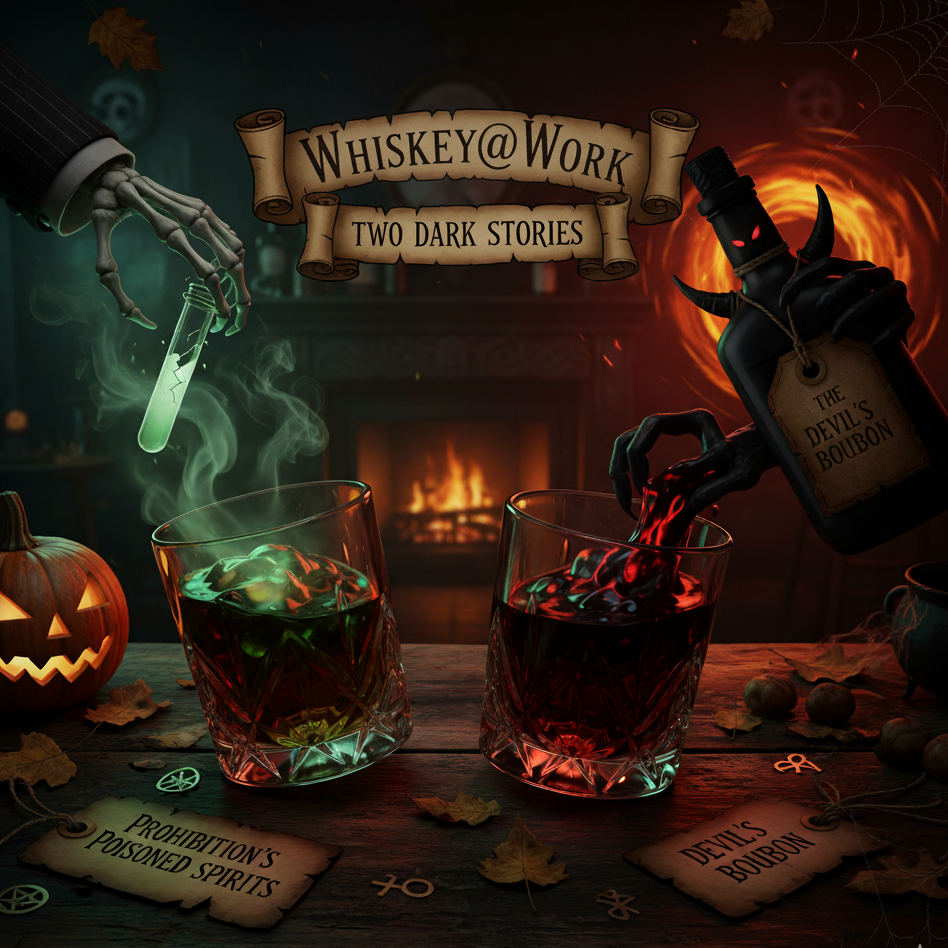
RAPID CITY, S.D. — As autumn settles across the Black Hills and whiskey season deepens, the hosts of Whiskey@Work are turning their attention to the darker side of the barrel. In a Halloween-themed episode, hosts Mark Houston and Rob Henry explore the real-life tragedies, folklore, and eerie science behind some of whiskey’s most haunting stories, from poisoned Prohibition booze to the mysterious “devil’s cut” still trapped inside aging barrels.
The episode begins with a look back at one of the most chilling chapters in American drinking history: Prohibition. When the 18th Amendment outlawed the production and sale of alcohol in 1920, bootleggers turned to stealing industrial alcohols from factories to keep their operations alive. In response, the U.S. government ordered those supplies “denatured,” contaminated with methanol, chloroform, and kerosene to render them undrinkable. The plan backfired. Thousands of Americans were poisoned after drinking what they believed to be safe whiskey, with estimates suggesting more than 10,000 deaths by the end of Prohibition. The hosts describe it as “the deadliest government experiment in drinking history.”
From there, Houston and Henry delve into another bootleg-era horror known as “Jake Leg.” Rural drinkers who couldn’t access real whiskey turned to Jamaican Ginger Extract, known as “Jake,” a patent medicine that contained about 70 percent alcohol. Bootleggers, looking to stretch profits, began cutting Jake with a chemical plasticizer called tri-ortho-cresyl phosphate. It gave the drink a smoother flavor but destroyed the spinal nerves that control movement. Victims developed a peculiar limp, dragging one leg behind the other, a tragic condition immortalized in early blues songs like Tommy Johnson’s “Jake Walk Blues.” By 1930, more than 50,000 Americans were crippled by the toxic tonic.
The conversation then shifts to the moonshiners of Appalachia, who built stills out of scavenged materials, including old car radiators sealed with lead solder. Each sip of their homemade spirits carried the risk of lead poisoning. Local newspapers in Tennessee and Kentucky reported men who went blind overnight and families plagued by birth defects. By the 1940s, health officials estimated that one in ten rural poisoning deaths came from contaminated moonshine.
In a nod to Appalachian folklore, the hosts recount the legend of “The Blind Barrel,” a cursed batch of Kentucky whiskey said to have killed every man who drank from it. Distilled in 1931 using radiator parts, the whiskey was so toxic that locals rolled the half-full barrel into a cave and sealed it forever. “They say you can still smell it, sweet corn and antifreeze, if you stand downwind on a humid night,” Henry says.
The second half of the episode focuses on the more mystical side of whiskey-making, the eternal tug-of-war between the angel’s share and the devil’s cut. The “angel’s share” refers to the portion of whiskey that evaporates each year from barrels stored in rickhouses, perfuming the air with ethanol vapor. At Jack Daniel’s in Lynchburg, Tennessee, that loss amounts to roughly a gallon per barrel per year. With more than two million barrels aging at any given time, that is millions of gallons disappearing into the Tennessee sky.
What remains inside the barrel, absorbed deep into the wood, is known as the “devil’s cut.” For centuries, distillers assumed that whiskey was lost forever. Then, in 2011, Jim Beam introduced a process to reclaim it. The company soaked, agitated, and pressed empty barrels to extract the trapped whiskey, blending it with extra-aged bourbon to create Jim Beam Devil’s Cut, a 90-proof release that sold out immediately despite its harsh, smoky taste.
But whiskey lore extends beyond chemistry. The hosts note that rickhouses in places like Lynchburg and Bardstown are often coated in a black film, a living fungus that feeds on ethanol vapors. Locals call it “angel’s soot.” Distilleries call it proof the angels are still getting their share.
Even the barrel itself carries superstition. Old-world coopers once believed that every cask held a spirit within its wood. Before refilling or burning an empty barrel, they would rap on it three times to thank the ghost inside. “Every creak, every scent of oak and vapor,” Houston says, “that’s the sound of a tug-of-war between heaven and hell.”
The episode closes on a poetic note: whiskey born in fire, aged in darkness, and forever divided between angels and demons. As Henry quips, “If you believe the old distillers, the best flavor, the soul of the whiskey itself, comes from the little bit the devil refused to give back.”


