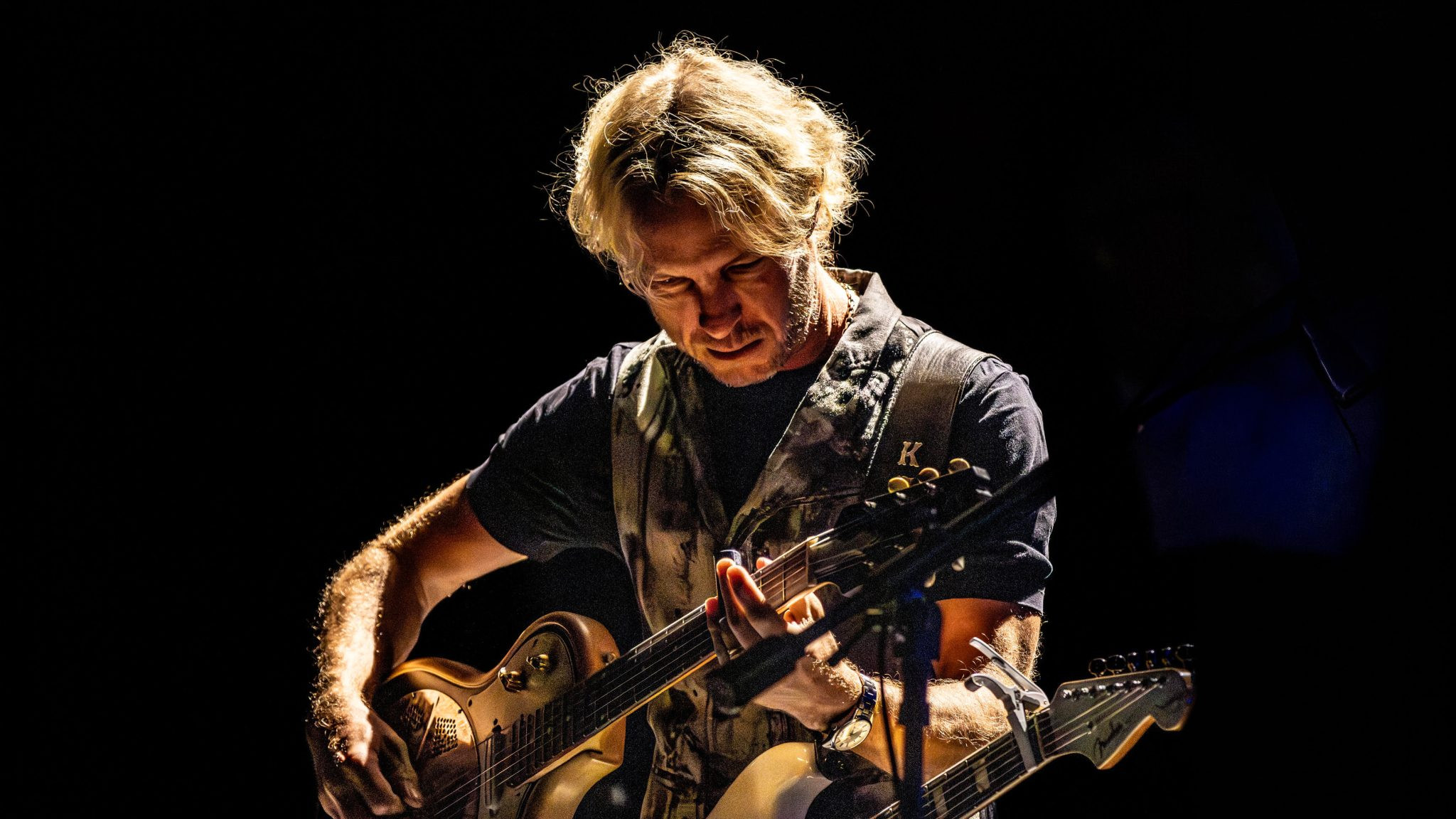
DEADWOOD, S.D. — Three decades after a teenage guitarist from Shreveport, Louisiana, burst onto the national scene with a Stratocaster in his hands and the blues at his fingertips, Kenny Wayne Shepherd is still doing what he believes he does best: playing live.
This September, the six-time GRAMMY-nominated blues-rock guitarist will bring that passion back to the Black Hills as he headlines the 36th Annual Deadwood Jam on Saturday, September 19, at Outlaw Square.
The free, two-day music festival returns to historic Deadwood September 18 and 19.
For Shepherd, the appearance will also mark a long-awaited return to an event he remembers playing nearly two decades ago.
“I’m excited about playing Deadwood,” Shepherd said during an interview with The Roadhouse. “I think it was like 18 years ago or something like that. It was the last time we played it, so we’re looking forward to it.”
Shepherd said Deadwood Jam audiences are a natural fit for the combination of blues and rock and roll that has defined his career.
“The people that show up for this event — that’s our audience,” Shepherd said. “What we have always done is a combination between blues and rock and roll, leaning a little more towards the rock and roll side of things.”
30 Years of Ledbetter Heights
The Deadwood appearance comes during a milestone year for Shepherd.
In May, he released Ledbetter Heights (The 30th Anniversary Sessions), a complete re-recording of his landmark 1995 debut album. Rather than simply remastering or reissuing the original, Shepherd returned to all 12 songs with three decades of additional experience behind him.
“This is a milestone anniversary for me,” Shepherd said. “It was my debut record. So it’s the album that put me on the map.”
That original album helped launch Shepherd from teenage guitar prodigy to an internationally recognized blues-rock artist. He recalled “Deja Voodoo” climbing to No. 5 on the rock charts and Ledbetter Heights eventually surpassing one million copies sold.
But the anniversary sessions aren’t intended to simply recreate 1995.
“We kind of walked the line between paying homage to the original version, but also taking some liberties here and there,” Shepherd said.
One of the biggest changes is longtime vocalist Noah Hunt. Hunt joined Shepherd’s band for his second album and has now been alongside him for nearly 30 years, but he wasn’t part of the original Ledbetter Heights recording.
The anniversary gave Hunt the opportunity to finally put his voice on the album.
“It gave the fans an opportunity to hear a record they’ve lived with now for 30 years in a different light,” Shepherd said. “It also gave Noah a chance to have a version of that record with his voice on it… It really kind of completes the catalog because he was on every other record except that one.”
Learning the Power of Restraint
Revisiting music created as a teenager also highlights just how much Shepherd himself has changed.
After decades on the road, one of the most important lessons he’s learned on guitar isn’t necessarily about playing more notes — it’s knowing when not to play them.
“When you’re young, you’re out there, you’re trying to take over the world, you’re trying to prove yourself to everybody,” Shepherd said.
As his musicianship developed, that approach changed.
“I’ve kind of learned the power of restraint,” he said. “Letting the music breathe and taking a moment and not actually playing anything can be a really powerful thing.”
It’s a perspective earned through a career that now spans more than 30 years of making records and performing around the world.
Despite being the namesake of the Kenny Wayne Shepherd Band, Shepherd didn’t initially serve as its primary singer. He sang just one song on Ledbetter Heights and didn’t begin taking on more lead vocals until his fourth album, The Place You’re In. Today, he and Hunt split much of the vocal work.
Shepherd believes succeeding with that unconventional arrangement has become one of the notable parts of his career.
“It’s even more challenging to find consistent success in the music industry when you don’t fit the perfect little mold,” he said. “I think that’s one of the more remarkable things about my career and the success that we’ve had.”
A Guitar That’s Traveled the World
Through all those years, one particular guitar has remained beside him.
Shepherd’s favorite electric guitar remains the Fender Stratocaster, and one instrument in particular holds a place above the rest: a 1961 Stratocaster he acquired when he was around 17 or 18 years old.
“It’s just been around the world with me multiple times,” Shepherd said. “It’s been on every record I’ve ever recorded since I got it.”
After decades of playing other instruments, he still hasn’t found one that can replace it.
“It’s just the one instrument that I haven’t really found another one that’s better than that one.”
That connection to the Stratocaster can be traced all the way back to childhood.
Shepherd was surrounded by music growing up. His father worked as a radio disc jockey and program director, giving a young Shepherd opportunities to attend concerts, go backstage and see the touring music world up close.
Then, at seven years old, he saw Stevie Ray Vaughan.
“Stevie Ray Vaughan was the guy that really lit the fire in me,” Shepherd said.
He met Vaughan backstage and watched the concert from the side of the stage.
“It was just mesmerizing to me,” Shepherd said. “I just walked away from that show begging for an electric guitar, because all I wanted to do was to try and learn how to play the guitar with some of that passion and that intensity that he played with.”
Still Chasing the Thrill of a Live Show
Decades later, that passion remains at the center of Shepherd’s career.
His catalog now stretches across 12 studio albums and a career that has earned six GRAMMY nominations and multiple Gold and Platinum records. Yet when asked what keeps him excited about getting back onstage night after night, Shepherd’s answer was simple: the audience.
“We feed off of their energy,” Shepherd said. “The more excited they are, the more excited we get.”
For Shepherd, recording music ultimately serves the thing he loves most.
“There’s really no thrill that I’ve experienced in my life that really compares with being on stage and performing live in front of people,” he said. “We make albums so that we can go out and play shows for people because that’s what we do best.”
That philosophy will come full circle when Shepherd returns to Deadwood in September.
And for anyone wondering what to expect when the Kenny Wayne Shepherd Band takes the stage, Shepherd offered a straightforward invitation.
“If you like American music, if you like rock and roll and you like a little blues… we got just what you’re looking for,” Shepherd said. “We’ve built a career now going over 30 years of making records and a reputation for being a great live band. That’s what we love to do. That’s what I feel we do best. And so we’re excited to bring it to you.”
The 36th Annual Deadwood Jam takes place Friday, September 18 and Saturday, September 19 at Outlaw Square in Deadwood. The 2026 festival is free to attend, with Kenny Wayne Shepherd performing Saturday.