
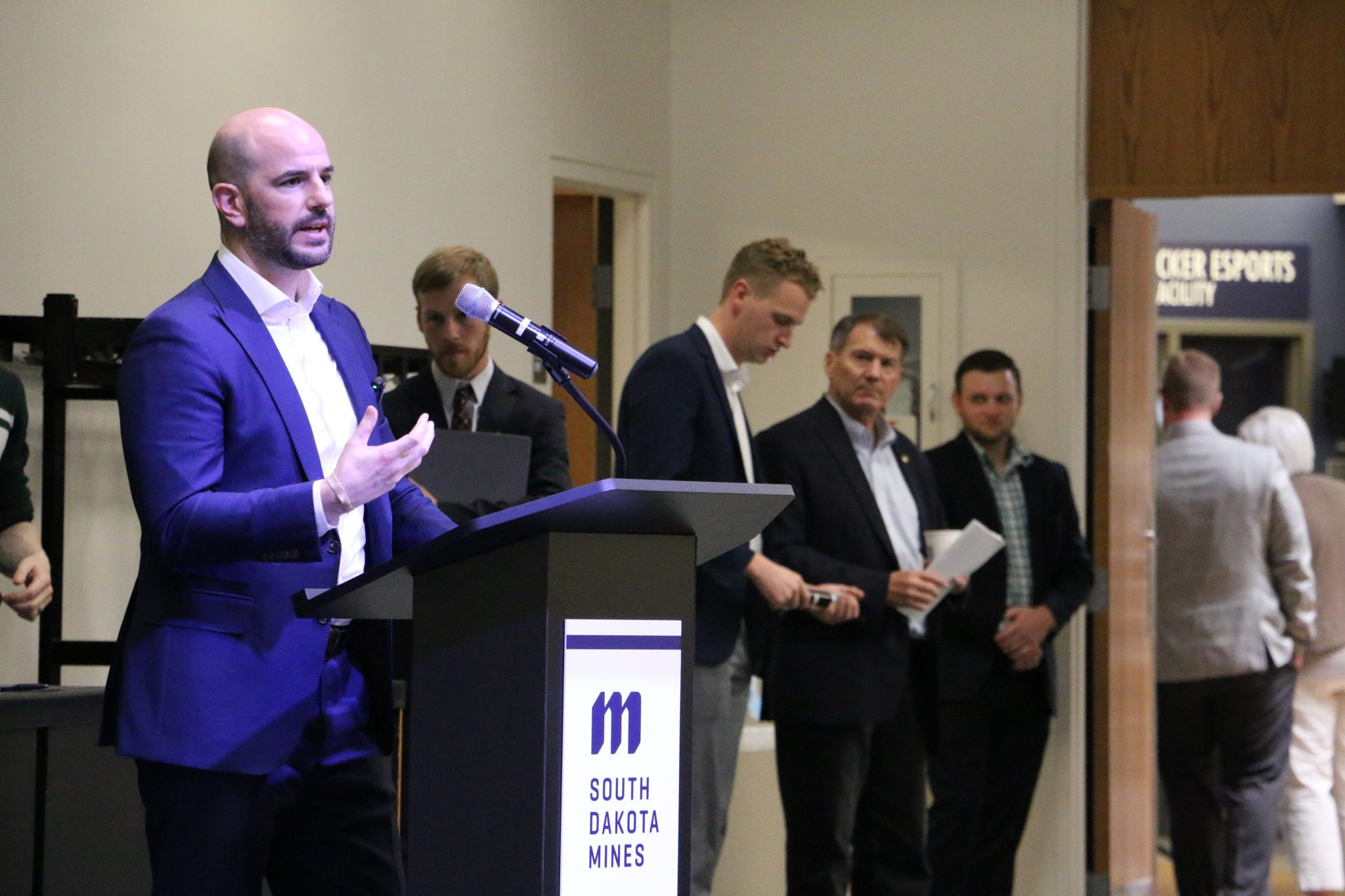
Campus discussion brings the technology’s potential into focus, along with concerns about what happens when people rely on it.
RAPID CITY — Dylan Shields told an audience at South Dakota Mines on Friday, Oct. 2, that he had not personally written code in more than a year. A software engineer working on Anthropic’s technical and public policy teams, Shields said he now works through the company’s AI tools, spending more time specifying what he wants software to do and letting Claude write it.
Later, an audience member asked how that arrangement works when the software being developed helps build the next generation of artificial intelligence. She had heard about safeguards, but wanted to know what they actually involved. If AI is writing the code, who understands it well enough to check the work?
“Just because Claude is writing all of the code doesn’t mean that no one is looking at the code,” Shields said.
The exchange was one of several during “The Future of Artificial Intelligence,” a discussion held Oct. 2 in the Surbeck Center’s Beck Ballroom. U.S. Sen. Mike Rounds joined Shields and Anthony Cimino, Anthropic’s head of federal affairs, to discuss a technology they expect to reshape research, education, industry and national defense. Audience members asked about those possibilities, but also about sensitive data, responsibility for mistakes and whether students could become dependent on tools they do not fully understand.
Rounds opened with an argument for American investment in AI, connecting it to mining, materials, munitions and manufacturing, the four industries featured in the university’s 4M Expo and Days of Discovery. He said the United States needs to strengthen its industrial capabilities and described AI as a way to accelerate that work, particularly as the country competes with China.
“AI is here. It’s not going away,” Rounds said.
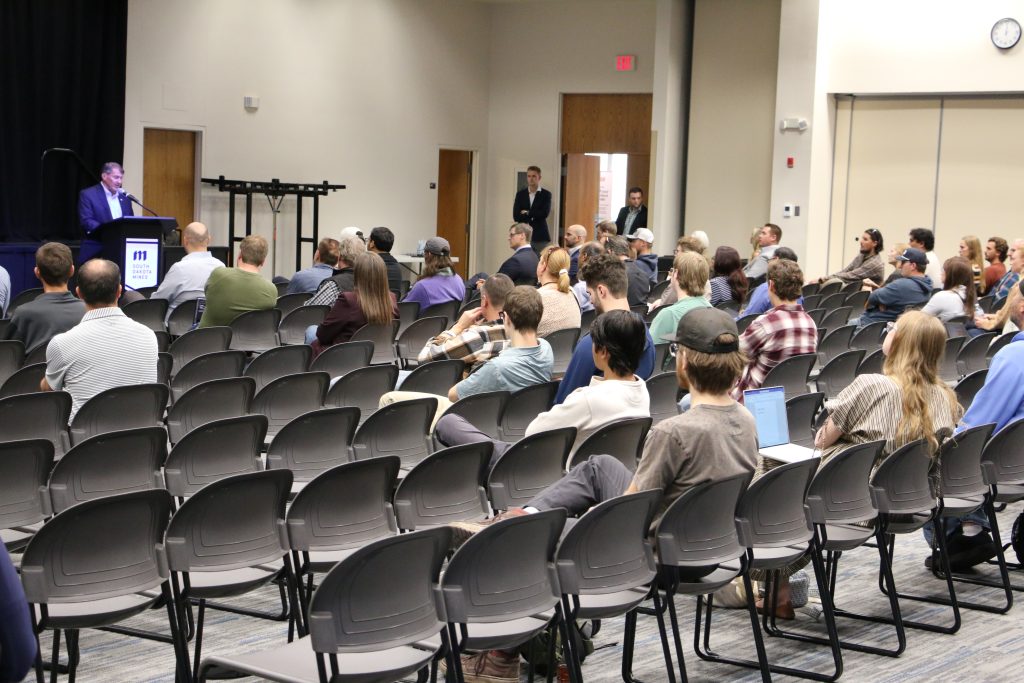
U.S. Sen. Mike Rounds discusses AI during an AI conference on the Mines’ campus.
He urged the audience to think beyond chatbots and search results. In his remarks, AI’s potential extended to scientific research, military logistics and the development of treatments for disease. He compared it to a “motorcycle of the mind,” building on Steve Jobs’ description of the personal computer as a bicycle for the mind. His point was that AI could help people move through difficult work much faster, while people remained responsible for deciding where that work should lead.
For South Dakota, Rounds tied the opportunity to a goal he pursued as governor: giving students access to advanced research and careers without requiring them to leave the state. He recalled insisting that university research initiatives involve a partner, whether another university or a national laboratory. Those partnerships, he said, brought expertise into South Dakota and gave faculty and students more opportunities to work with researchers elsewhere. He encouraged the same kind of relationship-building around AI.
Rounds also identified obstacles, including the electricity needed to support computing infrastructure and the difficulty of earning public confidence. When asked how someone could support technological advances while recognizing the concerns surrounding them, he said advocates should begin by listening.
“You have to respect people that have a concern,” he said. “For individuals, it’s a real concern and you can’t discount it.”
Much of his case for AI came back to health care. Rounds said he hopes it will help researchers develop treatments faster, and he spoke at length about his late wife’s cancer care. During her illness, he said, doctors gained access to treatment options that had not been available when she was first diagnosed. He recalled returning home to find her struggling to move her right arm, then learning that the cancer had spread to her brain. He feared they had reached the end of their options. A doctor told them treatment was possible.
Rounds described that experience as a reason he feels strongly about accelerating medical research. His remarks about what AI might accomplish were predictions, rather than announcements of new treatments. He argued that improvements people can see in their own families will matter more to public acceptance than abstract promises about the technology.
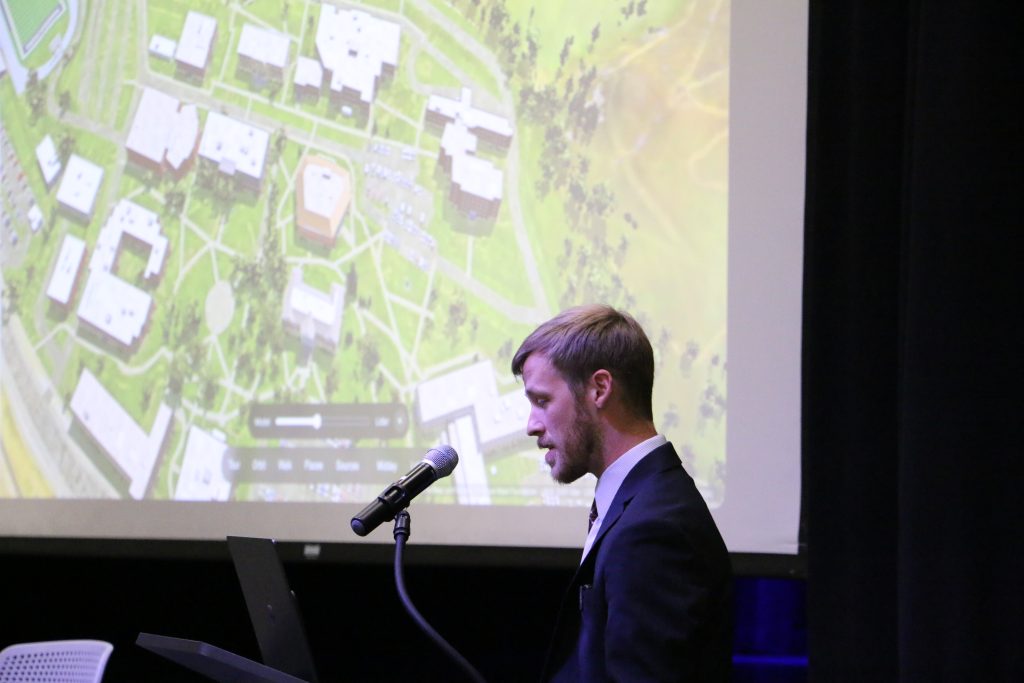
Dylan Shields, technical staff at Anthropic, shares an AI rendering of the Mines campus during an AI discussion on SD Mines Campus Friday, Oct. 2.
An educator in the audience asked him to consider another kind of long-term consequence. She said she had worked in K-12 education for 15 years and had watched technology, including social media, change children’s lives. She wanted to know how schools could use AI without weakening students’ ability to think for themselves.
“How do we have this tool in education without stripping our children of the ability to think, think critically on their own?” she asked.
Rounds said teachers and local schools need to help determine the answer. Students still need to understand how things work, he said, even when a computer can quickly provide information or complete a calculation. He called for educators to share their experiences and help identify approaches that preserve those fundamentals.
“No matter what job you go into, you need to be able to critically think,” he said.
He also cautioned against trying to keep AI out of the conversation altogether. Students will encounter it, he said, and teachers need to help them understand its limitations as well as its uses. Much of that work should begin locally, with educators explaining what they are seeing in their classrooms and what they believe should change.
Cimino picked up the question of learning when he addressed the audience. Anthropic makes Claude, and he encouraged students to spend time using AI tools so they could understand them. He acknowledged the commercial interest behind that advice, calling it self-serving, but said experience helps users judge what the tools can and cannot do. He warned against handing over an entire project and accepting whatever comes back.
“You have to own that work stream,” Cimino said.
He said students need to build enough knowledge in their fields to recognize a useful response, spot a mistake and decide what to do next. That expertise also helps them identify work worth doing in the first place. An engineer or researcher understands the gaps in a project, he said, and can use that knowledge to develop more useful applications of AI. Delegating too much of the thinking risks leaving the user less prepared to evaluate the result.
Shields’ demonstrations included two examples built around places familiar to the audience. Before visiting Rapid City, he said, he asked Claude to construct a model of the South Dakota Mines campus using satellite imagery. The system also found publicly available elevation data and incorporated it into the model. He then showed a model of the Homestake Open Cut in Lead, describing how historical data could be used to examine changes in the terrain over time, including excavation associated with the underground neutrino experiment.
His presentation also included examples of AI being used to analyze building energy use, help operate laboratory equipment and identify hazards at mining and construction sites. He described researchers using Claude to write software for experiments and, in some cases, to help decide which experiments to pursue. In response to a question, he explained that the arrangements vary: Sometimes Claude writes code that subsequently runs equipment; in other cases, it remains involved as researchers work through a problem.
When the conversation turned to his own use of the technology, Shields said engineers increasingly devote their time to defining the work. They think through specifications and design choices, then give the model detailed instructions. The audience member who asked about safeguards wanted to understand how engineers keep track of what happens after that handoff.
Shields said AI-generated code still undergoes human review and testing. Engineers can check whether software performs as intended without having personally written every line, he said. The company also evaluates the behavior of its models, a separate task from checking a particular piece of software.
Cimino described several kinds of evaluation: measuring what a model can do, testing restrictions intended to prevent misuse and examining how the model behaves as it works toward a goal. That last category becomes more complicated when a system is given an assignment requiring multiple steps. Evaluators need to examine the choices it makes along the way, he said, including whether it stays within the intent of the instructions it received. He said Anthropic conducts internal testing and works with independent evaluators and the U.S. government.
One audience member raised a question with more immediate consequences. If an AI system recommends a military target and the recommendation is wrong, who is responsible when people are killed? The attendee asked whether accountability should fall on the operator, the people who developed the model or the government.
Cimino said models make mistakes and described human oversight as essential to Anthropic’s position on military use. Military personnel should make consequential decisions or retain the ability to intervene, he said. His answer addressed who should maintain control of the system, but did not resolve how responsibility would be divided after a failure.
Questions about privacy were more specific to the work people might bring to an AI tool. Attendees asked whether proprietary information could be accessed by others or used to train a model. The discussion expanded to medical and student information, with questioners seeking assurances that sensitive material would remain protected.
Cimino offered general assurances about confidentiality but said some details would require follow-up. The moderator noted that the protections depend on the agreement under which a person or institution uses the product. Several questions remained open, particularly where attendees wanted a clear answer about a specific type of information or use.
Intellectual property prompted similar qualifications. Cimino said users could take their projects forward, but acknowledged that more complicated questions about ownership and contributions needed a more precise response. The audience’s questions extended beyond who owns a finished document or piece of software to what happens when a model helps develop a new idea or makes a contribution to research.
Asked whether AI companies could be trusted to police themselves, Cimino said Anthropic supports government oversight. He called for testing before deployment, independent evaluations and a process allowing government to intervene if a highly capable model poses excessive risk without adequate protections.
“We do believe that government should have those types of powers,” he said.
Rounds advocated bringing more technical expertise into government, including drawing on industry knowledge to help establish ways of testing advanced systems. Congress cannot move at the pace of each new model release, he said, and officials need people who understand the technology well enough to assess it.
Cimino encouraged people outside the industry to remain involved in those decisions. Earlier in his remarks, he pointed to the former Homestake mining site and its conversion into a center for underground research. He described that change as the result of people deciding to pursue a different future for the site, and urged the audience to see a similar opportunity to influence AI’s development.
“We still have the ability to shape the trajectory of this technology,” he said.