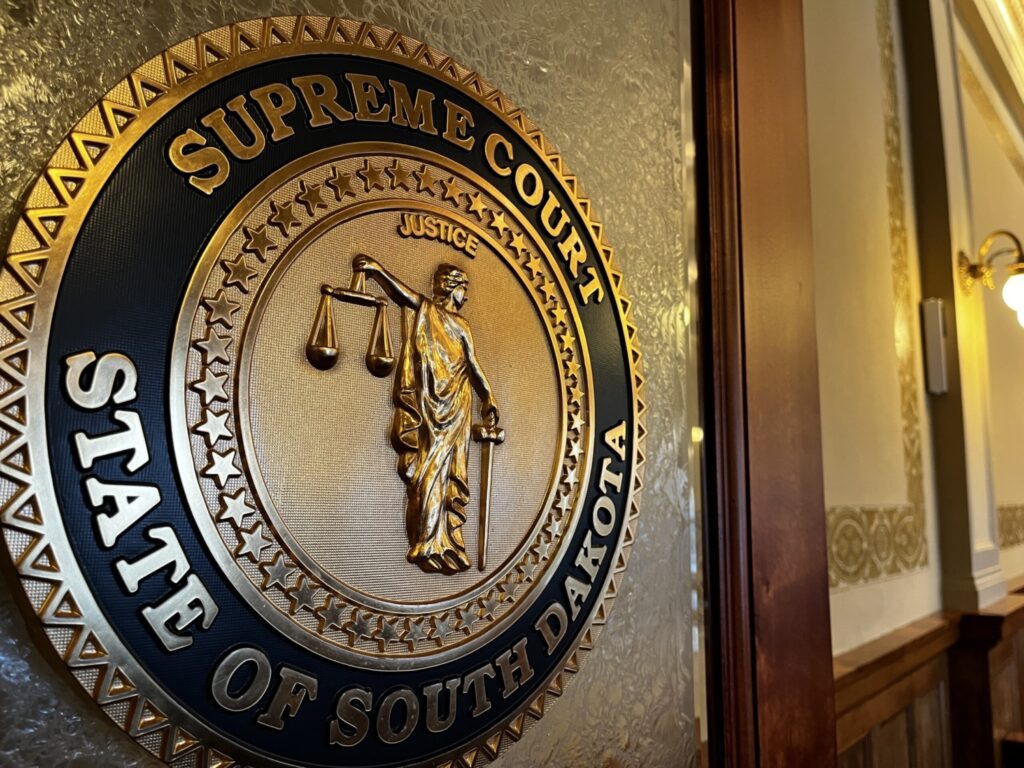
The entrance to the South Dakota Supreme Court at the state Capitol in Pierre. (Photo by Joshua Haiar/South Dakota Searchlight)
Lawyers for the recently created Office of Indigent Legal Services delivered their first oral arguments before the South Dakota Supreme Court on Tuesday in Pierre.
It was a watershed moment for the state’s public defense agency, a $1.5 million, five-attorney operation that the state court system’s leaders expect to deliver a net savings to taxpayers and improved legal services for South Dakotans who have the right to a lawyer but can’t afford one.
In South Dakota, counties are responsible for the cost of court-appointed attorneys. That typically means contracting with private defense lawyers, who are often paid mileage fees atop hourly rates to represent clients in cases that originate far from their local offices.
When lawmakers began pondering a state public defender’s office in 2023, county costs for indigent legal services had doubled in the space of a decade. The Legislature endorsed the office in 2024, and former Minnehaha County Public Defender Christopher Miles was hired to lead it that fall.
GET THE MORNING HEADLINES.
Miles and the appellate public defenders now employed by the office deal with criminal appeals, as well as appeals in abuse and neglect cases. Counties remain responsible for trial-level legal fees, but handing off appeals to the state is expected to save them $2.1 million a year.
Steven Jensen, chief justice of the South Dakota Supreme Court, signaled in January that the office may look to expand and take on “high-level felony cases” in some counties in the future, in hopes of preventing potential costly errors on the front end and improving efficiencies in the system as a whole.
Miles told lawmakers in January that his attorneys had taken more than 100 cases from all over the state, including four appeals in murder cases.
Questions on juror removal
Deputy Appellate Public Defender Beau Blouin presented a murder case appeal on Tuesday. Blouin represents David Shangreaux Jr., who wants a new trial following his conviction for second-degree murder in a 2023 stabbing death in Pierre.
Shangreaux is Native American, and Blouin argued that the prosecutor improperly dismissed a Native American juror — one of two empaneled for possible selection.
The U.S. Supreme Court barred the practice of striking jurors for race alone in 1986.
Chief justice says SD would benefit from expanding its new criminal public defense office
The potential juror in the Shangreaux case said he was harassed by police 20 years ago in Rapid City. But he also said he’d have no trouble fairly weighing police testimony in Pierre. When challenged by Shangreaux’s trial-level attorney over the decision to strike that juror, the prosecutor cited concerns about a prior criminal history, despite there being no record of the juror having one. The prosecutor later shifted the explanation and said he’d “assumed” the juror was referencing a criminal history while speaking of being handcuffed.
The judge expressed concerns about dismissing one of two Native American jurors, but allowed it.
On Tuesday, Justice Scott Myren asked Blouin why the high court shouldn’t defer to the discretion of the trial judge.
Blouin urged the justices to look at “the total picture” of the prosecutor’s shifting reasoning, and to ask if the reasons offered were “pretext for racial exclusion.” The race-based exclusion of jurors “has been and is a widespread issue and a reoccurring problem,” Blouin said.
Assistant Attorney General Erin Handke, however, told the justices that questions about negative interactions with and bias against police officers justified striking the juror, regardless of passing mentions of a potential criminal history.
The judge in Shangreaux’s case “evaluated the explanations and determined that a race neutral explanation was given,” Handke said.
Hearsay, competency
Deputy Appellate Public Defender Matthew Mirabella argued two cases Tuesday morning. In the first, he argued that prosecutors unfairly introduced new evidence on the second day of a child sexual abuse trial, and that the judge improperly allowed a detective to identify the victim to the jurors based on a pretrial police interview with a woman who wasn’t able to confidently identify the victim from the witness stand.
Mirabella also argued on behalf of a man who told police he’d considered hiking to the back of Mount Rushmore to shoot President Trump during the president’s July 3, 2020, visit to the national memorial. In 2019, the man called the FBI to say he’d been hearing voices telling him to kill Trump. Law enforcement found weapons and ammunition during a visit to the man’s home on June 30, 2020.
A jury failed to convict him in 2023 of making terroristic threats, but the man entered an Alford plea the following year. That plea allows defendants to maintain their innocence but admit that the government has the evidence to convict them. He was sentenced to two and a half years in prison.
Mirabella said his client should’ve been allowed to withdraw that plea, based on a severe mental illness that calls into question his ability to make a knowing and voluntary plea.
The state’s high court will issue rulings at a later date for the three cases argued Tuesday.