
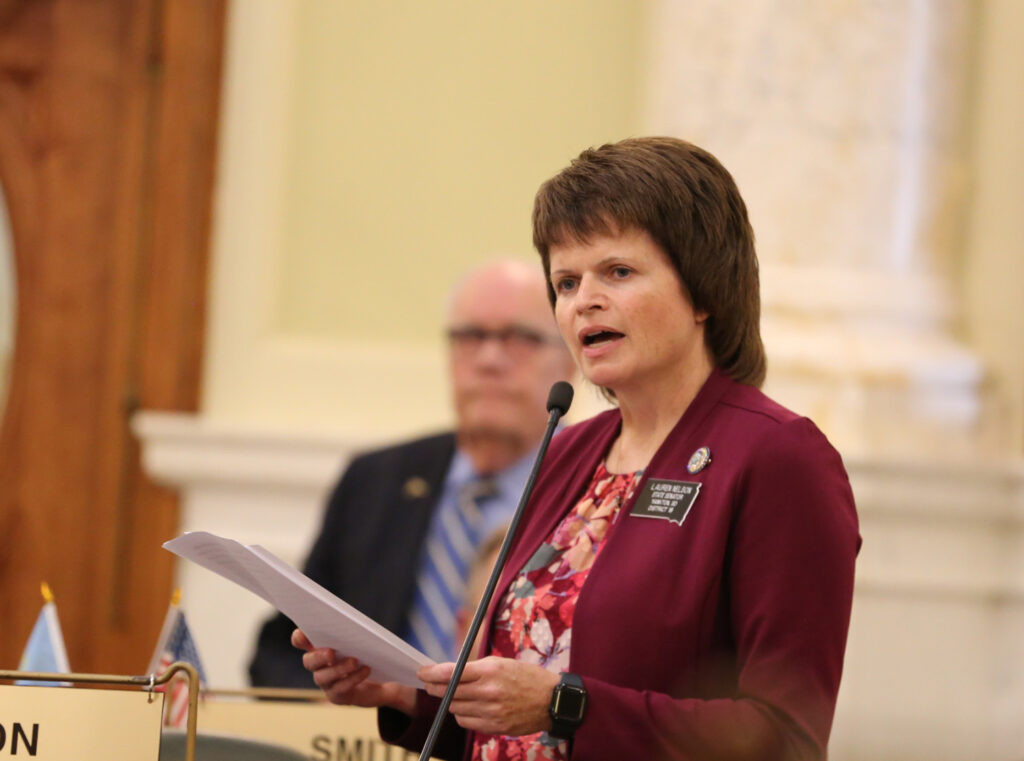
Sen. Lauren Nelson, R-Yankton, speaks in the South Dakota Senate on Sept. 23, 2025, at the Capitol in Pierre. She sponsored an unsuccessful bill this year to authorize charter schools. (Photo by John Hult/South Dakota Searchlight)
PIERRE — A proposal to allow charter schools in the state lost Thursday on a tie vote in the South Dakota Senate and failed on reconsideration Friday, after narrowly advancing out of a Senate committee.
A recent decision by the state Supreme Court confirmed Republican Lt. Gov. Tony Venhuizen’s authority to break Senate ties while he’s presiding over the chamber, but he sealed the bill’s fate Thursday by choosing not to cast a vote in favor of the legislation. The possibility of a tie has been ever-present this legislative session in the Senate because of the absence of Sen. Arch Beal, R-Sioux Falls, who’s been sidelined by a health problem.
“I think most of the time it makes sense to let the legislative process play out,” Venhuizen said Friday in an interview with South Dakota Searchlight. “Senators can move to reconsider and try to find a vote to flip their way and pass it if they want.”
Bill to allow publicly funded charter schools in South Dakota narrowly advances
Charter schools are privately run, tuition-free schools that run on public dollars. They’re funded on a per student basis, and run independently from local school districts. Forty-six states and Washington, D.C., Guam and Puerto Rico allow charter schools, according to the National Conference of State Legislatures.
Sen. Lauren Nelson, R-Yankton, introduced the bill. She told the Senate that charter schools would provide opportunities for students with more specialized needs.
“Public charter schools do not replace traditional public education,” she said. “Rather, they expand the range of options available to families.”
Sen. Jamie Smith, D-Sioux Falls, said charter schools could pull funding from the state’s “already underfunded public schools.”
“We’re already struggling to come up with our obligation, per law, of what we’re supposed to do to fund education in this state,” he said.
South Dakota law requires the state to increase funding annually for public schools by 3% or inflation, whichever is less, although lawmakers routinely reset the prior year’s baseline funding amount to get around that requirement. This year, the governor proposed no inflationary increase for public schools, but new revenue estimates since then have the governor and lawmakers talking about a potential bump in funding.
Other opponents worried that the board in charge of a charter school wouldn’t be elected or held accountable by the public and expressed concern about a provision in the bill allowing only 75% of teachers to be certified.
Meanwhile, Gov. Larry Rhoden recently opted South Dakota into a federal education program under President Donald Trump’s “One Big Beautiful Bill.” Under that program, South Dakotans who owe federal income taxes can send up to $1,700 to the federal government, or they can donate that $1,700 to a government-recognized, scholarship-granting organization benefiting public, private or homeschool entities in the state. The program starts next year.
South Dakota also has a program called Partners in Education that provides tax credits to insurance companies that fund scholarships for lower-income students to attend private school.


