
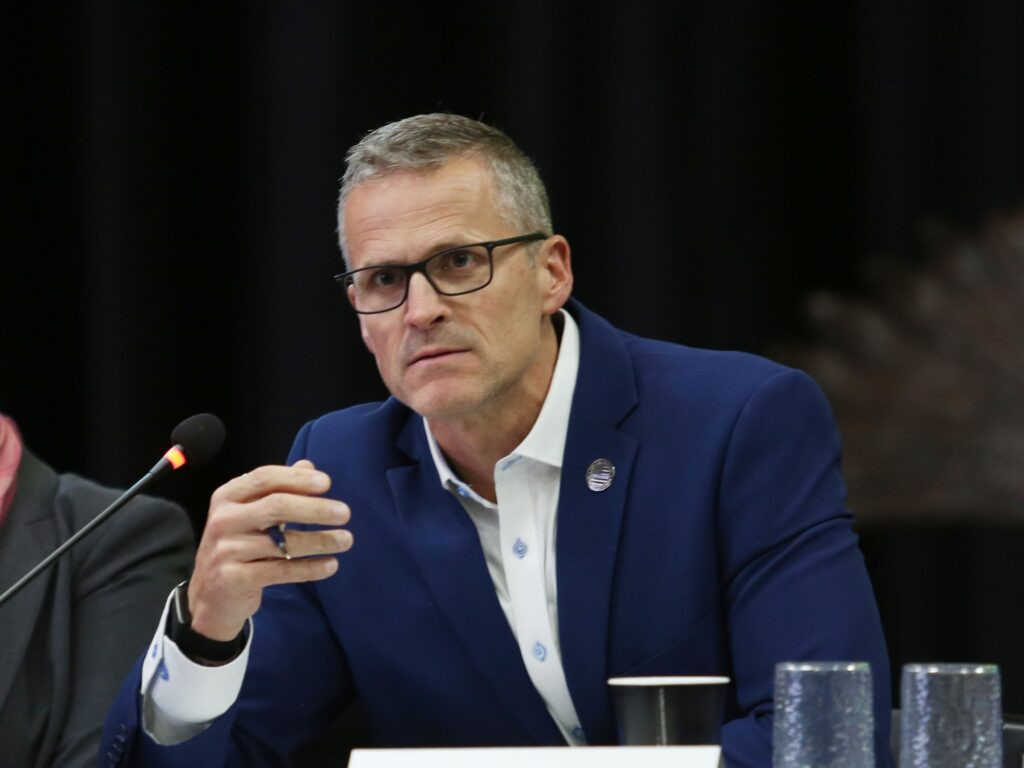
Sioux Falls Mayor Paul TenHaken asks a question at a Correctional Rehabilitation Task Force meeting in Sioux Falls on Oct. 29, 2025. (Photo by Makenzie Huber/South Dakota Searchlight)
Sioux Falls Mayor Paul TenHaken aired some of his frustrations Monday during a public Q&A with the Downtown Sioux Falls Rotary Club.
Asked to share advice for the next mayor of South Dakota’s largest city, TenHaken suggested building a competent staff rather than suggesting how to navigate divisive issues like data centers.
“The Legislature did not give a tax break for data centers. They ain’t coming here,” TenHaken said. “Let’s stop talking about them. Sioux Falls is not going to have a data center.”
Statewide partisan stakes surface in nonpartisan Sioux Falls mayor race
The Sioux Falls City Council, with TenHaken’s support, approved rezoning a 164-acre piece of land in northeastern Sioux Falls earlier this year to make way for a data center project, after hours of opposing testimony. State lawmakers then rejected new tax incentives for large data centers during the legislative session.
After a runoff election June 23, Sioux Falls’ next mayor will be sworn in on July 17, giving TenHaken about a month left in office after eight years of service. Term limits prevented him from seeking reelection again this year.
TenHaken became emotional Monday while reflecting on positive relationships with city leaders and his staff’s accomplishments. He lamented the decline of civil discourse and described how threats against him for his decisions during the COVID-19 pandemic — serious enough that he considered resigning and bought his first handgun — took a personal toll.
The 48-year-old TenHaken, a Republican serving in an office that’s officially nonpartisan, spoke to South Dakota Searchlight later Monday about his relationship with the Legislature, his future role in politics and how he views the Sioux Falls mayor’s role in statewide issues.
This interview has been edited for length and clarity.
You’ve shared that your next move is to go back to the private sector. Why not a statewide political run or something else in that vein?
I’ve always been a firm believer that politics and public service is a chapter and not a career. For the past eight years it’s been a chapter for me and I’ve been honored to do it, but when you run hard and give it your all, you should be kind of tired at the end and ready for a break — that’s where I’m at.
In addition, the landscape right now in the Republican Party, of which I am a member, is pretty fractured. Someone like me, someone with my style of leadership, wouldn’t play well right now in Republican politics because I’m a collaborator — I’m not an attacker, I’m not a divider. That, unfortunately, is a style that seems to be successful right now. Politics is cyclical and it has different peaks and valleys, and that’s where we’re at right now.
You have taken a role in politics this year by funding legislative candidates with your South Dakotans for Common Sense political action committee. Is that background role — in funding and influence — more what you’re gravitating toward?
I’ll always love South Dakota and always love Sioux Falls, and so I’ll still be politically adjacent. Just because you’re not in elected office doesn’t mean you can’t use your influence in different ways to make sure the state stays strong and your city stays strong. Whether that’s through consulting work or staying active through PACs or helping the right candidates get into the right offices, I still want to see South Dakota as a very welcoming, very business-friendly, very accommodating state to new ideas. So I’m not going anywhere.
Sioux Falls has a history of influential mayors who have not climbed the political ladder, so to say. They’ve either stepped back from politics or they were unsuccessful in their larger political ambitions, though Gary Hanson is a state public utilities commissioner. How might that history influence your decision and next steps?
There certainly is a Sioux Falls versus the rest of the state conflict that seems to always exist. You see it during the legislative session. It’s unfortunate, and I hope we could overcome that if there’s ever a strong Sioux Falls candidate that would emerge for public office again, since we have John Thune in Sioux Falls who’s been a great leader for the past 20 years or so.
GET THE MORNING HEADLINES.
I think it would be harder for someone today from Sioux Falls to win a statewide office because of some of that “Sioux Falls splatter” that we have — good, bad or otherwise. I think that’s something that everybody who is from Sioux Falls and thinks about public office always has to consider.
There has been plenty of pushback against “Sioux Falls priorities” during recent legislative sessions. Both mayoral candidates have served in the Legislature. What is your advice for them about legislative relationships and accomplishing goals in Pierre?
Trying to be as collaborative as possible with non-Sioux Falls legislators is really important. It’s really hard. Quite honestly, I didn’t do as good of a job with that as I would have liked. I have really great relationships with our Sioux Falls area legislators, but I didn’t go as deep as I wish I would have with lawmakers outside of Sioux Falls.
I think that’s going to be important for the next mayor: making sure they keep those good relationships in Pierre — not just lawmakers from the Sioux Falls metropolitan area but with the entire state. It’s making sure that lawmakers truly understand that a third of the state’s sales tax revenue is generated in this metro. So, when bills come before the House or the Senate that can really bolster this local economy, it really does help Pukwana and Murdo and Buffalo, because we will help generate income and revenue that will help the state as a whole.
Were you expecting those relationships with lawmakers and the decisions they made to impact your time as mayor and Sioux Falls so much when you were first elected?
I think it was less about legislative relationships and more about the fracturing we’ve seen in the Republican Party that had such an impact. Our primary for governor even showed it was almost a four-way split across the board, which shows you that there are four different philosophies on what it means to be a Republican in this state. We have a supermajority in our Legislature, so you have those four different philosophies play out in the Legislature.
I have a certain philosophy of Republicanism that I bring to the table, which doesn’t always mesh with some of the other Republicans in the Legislature. That sometimes comes into conflict when bills are introduced or when I take a position on a bill that a lawmaker disagrees on. Even though this is a nonpartisan office, and we try to keep it nonpartisan, we still have to get involved in those partisan issues.
Given the results of the legislative primary races, with many candidates you financially backed moving on to the general election in November, how do you foresee that potential shift in the Legislature impact Sioux Falls legislative priorities?
I have a lot of optimism. It seems to me that we did see a more pro-business group of legislators that got through the primaries that will also be more friendly to Sioux Falls and maybe see the value that Sioux Falls brings to the state.
What does being Sioux Falls mayor mean from a statewide lens?
This office, outside of the governor, is probably the most visible elected official serving in the state, so it comes with the responsibility to make sure that you’re using your bully pulpit well and that you’re representing Sioux Falls the way it needs to be represented.
You also have to be cognizant of the fact that the Legislature has a lot of priorities that aren’t just Sioux Falls-related. They have a lot of counties and school districts and cities that are all hungry for funding and attention. Even though I obviously represent Sioux Falls, I also in some ways want to help sister cities and communities be successful as well. It’s a unique balance as the mayor of Sioux Falls.


