
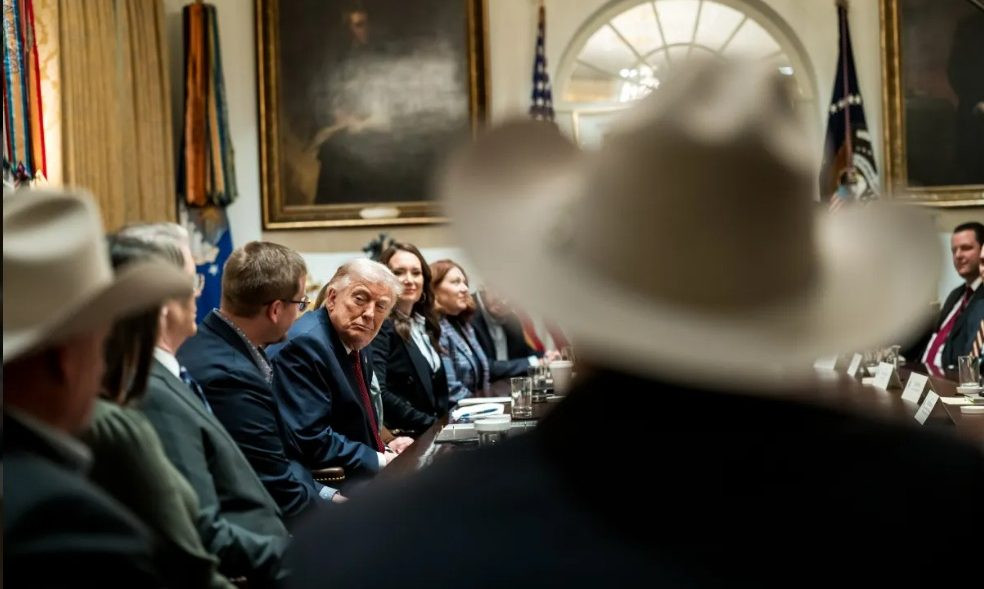
WASHINGTON, D.C. – Some of the nation’s farmers and ranchers were in Washington, D.C. this week to join President Donald Trump in the launch a broad federal push to expand research into regenerative agriculture and develop alternatives to conventional crop protection active ingredients under his Make America Healthy Again (MAHA) initiative.
Trump issued an executive order directing agencies to develop and use new methodologies to improve scientific understanding of the human health and environmental risks of chemical contaminants in the food supply.
The White House order was issued simultaneously with Agriculture Secretary Brooke Rollins releasing the final Regenerative Feedstock Rule, which will link regenerative practices to the 45Z tax credit and biofuel low-carbon fuel standards. USDA also released its updated Feedstock Carbon Intensity Calculator to quantify the carbon sequestration benefits of cover crops, tillage and nutrient management practices.
“Today’s USDA’s Regenerative Feedstock Rule puts farmers, not Washington bureaucrats, in the driver’s seat. Instead of mandates, we’re creating market opportunities. Farmers and ranchers who choose to implement regenerative practices will have new opportunities to earn premium prices, lower their input costs, improve soil health, and strengthen the long-term profitability of their operations,” Rollins said.
The White House executive order directs USDA to maximize funding for the current $700 million regenerative agriculture pilot program “and evaluate ways to expand the reach of the program.” These steps include using existing authorities for partnerships with businesses that can help more farmers and ranchers adopt such practices.
In April 2026, Trump asked for another 20% cut in USDA’s budget. For USDA, the budget cut request is $20.8 billion in discretionary budget authority for FY 2027, a $4.9 billion or 19% decline from 2026. That compares to a $3.1 billion cut in 2025 for both discretionary and mandatory funding.
Under this week’s order, EPA and Health and Human Services will create a “grand prize challenge” for researchers to identify solutions for evaluating cumulative chemical exposure, pre-harvest desiccation and “methods of production less harmful to human health.”
The order calls on Health and Human Services to “also prioritize research to identify new, innovative, and cost-effective technologies that reduce reliance on conventional chemical crop protection tools in order to reduce risks to human health.”
The regenerative agriculture and crop protection research announcement came the same day that the U.S. Supreme Court issued a 7-2 ruling blocking state lawsuits over Roundup cancer warnings in Monsanto Co. v. Durnell. The decision marked a victory for the crop protection industry and a setback for advocates seeking additional state warning requirements.
Present at the event was Health and Human Services Secretary Robert F. Kennedy Jr., who previously fought against glyphosate in private legal practice and won multimillion-dollar verdicts. The Trump administration backed Bayer in the case, and Kennedy’s position has since shifted.
The order also states that agencies should not take regulatory action beyond existing statutory requirements, a provision likely to reassure farm organizations that support crop protection tools often opposed by Make America Healthy Again (MAHA) advocates.
One agriculture lobbyist who spoke with DTN described the executive order as “a copy and paste of the MAHA Commission report.”
The White House event capped a significant week in agricultural policy, following Tuesday’s release of the Senate Agriculture Committee’s farm bill draft, Wednesday’s request for $11.1 billion in agricultural disaster assistance as part of emergency funding legislation, and Thursday’s Supreme Court decision.
SUPPLEMENTAL AID, E15
After reiterating his request that Congress approve year-round sales of E15, Trump told farmers, “We saved it. We saved it.”
The provision was included in the administration’s supplemental aid request from Trump, announced on Wednesday.
“I made it clear that I will sign a bill allowing E15 all year round,” he said.
Trump also reaffirmed his request for $11.1 billion in assistance for row-crop and specialty-crop producers, contingent on congressional approval. He said the funding is intended to help “our great agricultural producers rebound from the losses that they had.”
TRADE CLAIMS
Trump reiterated his claim that the United States had an agricultural trade surplus during his first term before “Biden took that surplus and turned it into a $50 billion agricultural trade deficit.”
He also pointed to China’s commitment to buy $17 billion in agricultural commodity purchases, saying they consisted of “mostly soybeans and different things, but mostly soybeans.”
Referencing negotiations involving Vice President JD Vance in Switzerland, Trump said Iran could become a future trading partner. “They’re having a hard time with food, and we’re going to be taking some of their money, and we’ll spend it, and we’re going to be buying wheat, soybeans, and corn, a lot of it. And that process is going to be starting pretty soon.”
The U.S. has had few agricultural sales to Iran in the recent past. Over at least the past quarter-century, the U.S. has sold little in terms of agricultural products to Iran.


