
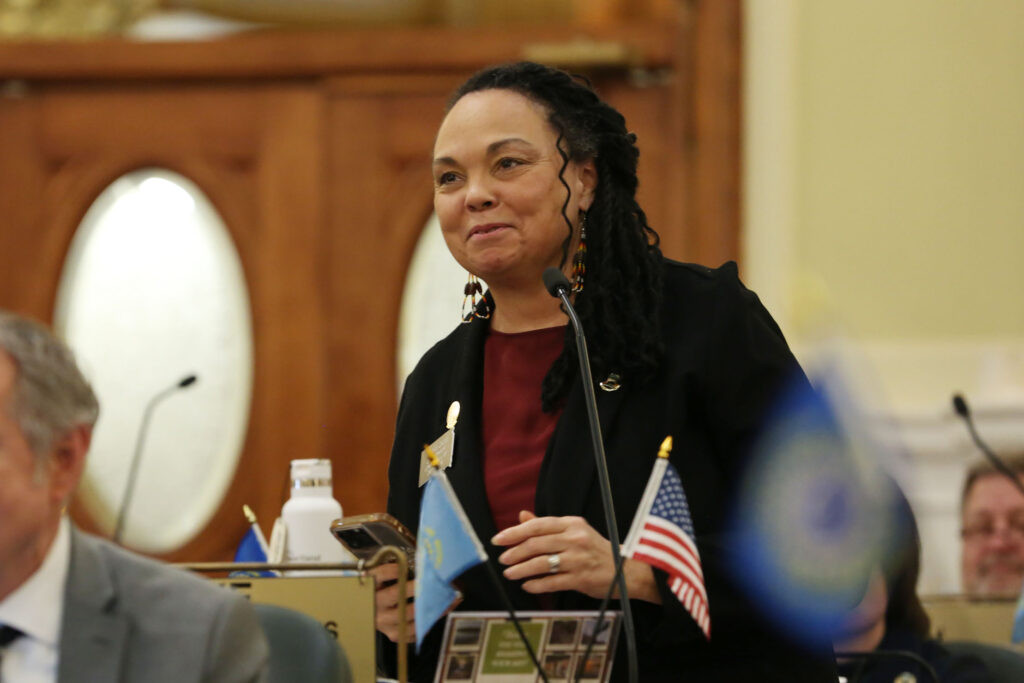
State Sen. Tamara Grove, R-Lower Brule, speaks on the South Dakota Senate floor at the Capitol in Pierre on Feb. 11, 2026. (Photo by Makenzie Huber/South Dakota Searchlight)
South Dakota state senators revived and approved a bill Tuesday that was described by its sponsor as strengthening parental rights, but was criticized by opponents for its potential to undercut protections against abuse and neglect, delay urgent health care decisions and encourage lawsuits.
The bill had failed last week in the Senate on a vote of 17-16, which was one vote short of a majority with two senators absent. After a reconsideration vote Tuesday, senators voted 19-15 to approve it. The bill now goes to a House committee.
South Dakota is currently “aligned with some of the most liberal states” in the country, Sen. Tamara Grove, R-Lower Brule, told a Senate committee Feb. 10. She is the bill’s sponsor.
“Parents know and love their children the best,” she said. “They have the right and responsibility to make decisions that are in the child’s best interest without undue interference from government.”
More legislative news
See all of Searchlight’s coverage of the 2026 legislative session.
The legislation states that a parent has the right to “direct the upbringing” of their child, including the “moral and religious training.” It would give parents a stronger hand in their child’s medical decisions and education, Grove said. It would also authorize parents to file a lawsuit if its provisions are violated.
The bill says parents could not use the legislation to “abuse or neglect” their child, but some senators worried about a parents’ rights overriding concerns voiced by a mandatory reporter — a person in a profession such as teaching who is required by law to report abuse.
“That sounds fine in theory, but in practice, I don’t feel that can possibly work,” said Sen. Glen Vilhauer, R-Watertown. “You’ve got somebody that knows what is going on at home, and yet we have to assume that the parents have the best interest of the child at heart when that is definitely not the case.”
The bill doesn’t affect who, under state law, is a mandatory reporter.
Medical care
Under Grove’s proposal, parents would have to give consent for their child to receive a surgical procedure, medical or mental health exam and mental health treatment.
Physicians could administer emergency care without parental consent if “exercising competent medical judgment,” or if the child is accompanied by a person who either has written consent from a parent or that the physician believes “in good faith on the representation of an individual, that the individual has been granted authority by the minor child’s parent to make decisions regarding the minor child’s health.”
Some lawmakers said those clauses may cause health care providers to hold off on performing needed services for children. Sen. Sydney Davis, R-Burbank, said in instances when a teenager comes into an emergency room without blatantly life-threatening injuries, health care providers might exercise undue caution.
Davis said the bill’s authorization of lawsuits by parents could send up red flags for providers.
“We need to get some CT scans, we need to do an MRI, we need to know if this is a life-threatening situation,” she said. “Or would you like us to pause and wait until things are so bad that now we can intervene?”
Sen. Tim Reed, R-Brookings, expressed concern for children who may be facing sexual abuse at home. He said the legislation could prevent a child from getting an exam if a parent does not consent to it, concealing the abuse.
“Unless you’re 18, no medical examination can happen,” he said on the Senate floor. “We’re losing the protection we have on our children because of this bill.”
Education
Grove’s proposal would also prevent a school employee from withholding or concealing information from a parent about their child’s “curricular or extracurricular projects, assignments, or activities,” and “physical, emotional, or mental health.”
It would require that school boards work collaboratively with parents and teachers to set a plan for parent participation in the school and establish a process for parents to review their child’s curriculum and participation in extracurricular activities.
Parents also would have to be made aware of and consent to having their child “receive any instruction in or presentation on human sexuality, human sexual behavior, gender identity disconnected from or inconsistent with the biological reality of an individual’s sex, or the idea that an individual is able to identify with a gender that corresponds to an individual’s internal and subjective sense of self, disconnected from the biological reality of the minor’s sex.”
Parents would also have to consent before their child could go by a name or nickname other than their legal name or a name derived from their legal name.
Heath Larson, executive director of the Associated School Boards of South Dakota, said during committee testimony against the bill that schools already share information with parents.
“Every school I’ve ever been familiar with, every teacher I’ve been familiar with, is very open, transparent about what they’re teaching, the homework they’re giving,” he said. Parents are often “involved in their child’s education, they’re watching, and they’re doing homework with their children.”


