
Billionaire philanthropist T. Denny Sanford to help move pork plant from Falls Park area, into Interstate 90, 29 nexus
SIOUX FALLS, S.D. – Smithfield Foods will vacate the site of its pork processing plant near downtown Sioux Falls and build a new slaughterhouse, following a $50 million donation from banker and philanthropist T. Denny Sanford.
Smithfield, which purchased John Morrell and Co. in 1995, will build a new modern processing plant in northeast Sioux Falls, clearing the way for the current site next to the city’s iconic Falls Park to be redeveloped. The Smithfield plant occupies more than 80 acres of land, according to city records.
The announcement by Smithfield CEO Shane Smith marks one of the most monumental moves in Sioux Falls history. Smithfield is the city’s fourth-largest employer, with more than 3,100 employees.
The new facility will open in Foundation Park near Interstates 90 and 29. Smith said the announcement was a major development for agriculture in South Dakota and the United States.
“It’s a once in a lifetime opportunity,” for Sioux Falls, Smithfield employees and agriculture, he said.
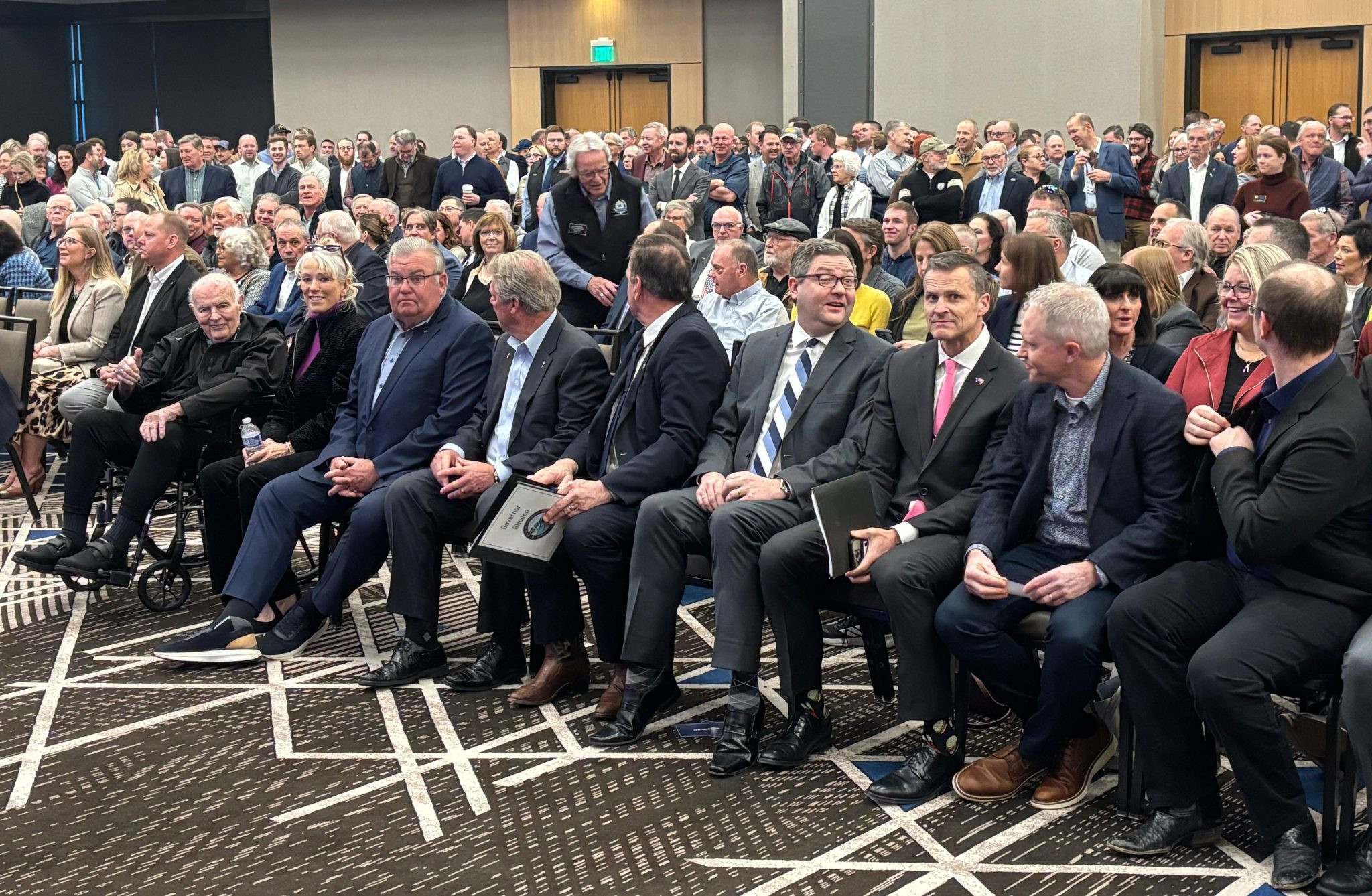
Hundreds turned out for the announcement including Gov. Larry Rhoden and Mayor Paul TenHaken, as well as Sanford. The deal had been under negotiation for more than a year.
“What a turnout,” TenHaken said.
Sanford’s $50 million will be used by the Sioux Falls Development Foundation to purchase land at the current site, TenHaken said.
The current facility northeast of downtown Sioux Falls has been the site of a slaughterhouse since 1909, when the Iowa-based John Morrell & Co. first opened its plant. Morrell sought to service the area’s growing cattle market near the city’s railyards. A few years later, the Sioux Falls Stockyards opened across the street. Besides shipping cattle and hogs around the country, the stockyard provided a steady supply to Morrell.
The first plant could process 500 cattle, 6,000 hogs and 1,000 sheep each day, according to the South Dakota Agricultural Heritage Museum.
English origins
The company was founded in Bradford, England by George Morrell, who used a small inheritance to purchase a load of oranges in 1827, which he sold at a market. The profits allowed the company to expand its produce offerings. Eventually it moved into cured hams and bacon. The company advertised its hickory-smoked curing process that infused meats with a “nut-like mellowness.”
John Morrell, George’s son and the company’s namesake, expanded operations to Ireland and then to the United States in 1864, with plants in Chicago and by 1888 Ottumwa, Iowa that became the hub of the company’s U.S. operations.
Morrell moved into Sioux Falls 1909, lured by strong rail traffic and plentiful cattle and hog operations. The company went public in 1928.
In a 1922 article on the importance and growth of the packing industry in Sioux Falls, the Argus Leader noted the Morrell plant “has been one the most important factors in the developing of the market in Sioux Falls. It has also been the means of giving publicity to the city as a packaging center and by the routing of cars of meat out of here each week as far west as Spokane and Seattle, Wash., and east to Detroit and Cleveland. The equipment at the plant is extensive and up to the minute for the packing industry.”
In 1953, the company elected its first president in its 126-year history who was not a direct descendant of founder John Morrell. At the time of his election to the presidency, William McCallum was a vice president of Oscar Mayer & Co.
By 1967, Morrell was the nation’s fourth-largest packing company with its headquarters in Chicago and plants operating around the country. The company merged that year with AMK, an industrial machinery manufacturer for plastics, tires and industrial fasteners and coasters. Morrell’s stock was delisted from the New York Stock Exchange and its stock rolled into AMK’s.
AMK merged with United Fruit Co. in 1969 and in 1970 the two companies formed United Brands, with Morrell operating as a subsidiary of United Brands, which was later renamed Chiquita Brands International based in Cincinnati.
Labor strife
In the late 1970s, the meat processing industry was undergoing major changes, and Morrell was struggling. By 1982, the company had shuttered plants around the country, and Morrell management was ready for a showdown with its Sioux Falls workforce. The company demanded wage and benefit cuts. The United Food and Commercial Workers International Union offered a three-year wage freeze, which the company rejected.
At the time, the base salary and benefit was $18 an hour.
Morrell hadn’t been immune from labor strife before. In 1935, workers staged a sit-down strike that caused Gov. Tom Berry to order the mobilization of the National Guard. But the strikes in the 1980s marked a decade in which the company remade its workforce. What had been a steady pipeline to the middle class for area workers became lower paying jobs that attracted immigrant labor.
After breaking the union in the 1980s, the company sued it in 1991 to get out of its commitment to pay the health benefits of its retirees. The company won the case at the Eighth Circuit Court of Appeals in 1994, allowing it to end the negotiated benefit in 1995.
In 1992, the company ended its beef processing division, laying off 400 employees. The Federal Reserve Bank in Minneapolis noted at the time the decision would have a big impact on local producers.
“Although Morrell slaughtered only 1,150 cattle daily, a small number compared to newer, larger slaughter operations elsewhere, the company bought about 100,000 cattle annually from the Sioux Falls stockyards, about one-fourth of the cattle sold there,” the bank noted.
The company was at the center of the biggest tragedy in the state’s political history in 1993 when Gov. George Mickelson and seven others died in a plane crash outside Dubuque, Iowa on April 19. Mickelson and leaders of the state’s business community had flown to Cincinnati to visit with Chiquita leaders amid rumors the company would close or sell the Sioux Falls plant. At the time, Morrell was the city’s largest employer.
Becoming Smithfield
By the mid-1990s, it was obvious that Chiquita was trying to get out of the meatpacking industry. Months after its victory in the retiree benefits legal case in 1995, Chiquita announced the sale of Morrell to Virginia-based Smithfield Foods, also a pork producer.
In 2005, the company announced a $100 million expansion at the Sioux Falls plant. But the expansion didn’t materialize. Instead, Smithfield acquired other producers, including number two hog producer Premium Standard Farms in Missouri. Doubts again began to seep into the city’s business community about the viability of the plant in Sioux Falls.
But those doubts were soothed some when Smithfield announced the closing of its Sioux City plant in 2010, with some of that production being shifted to Sioux Falls. While the Sioux City plant had been built in 1959, it was obsolete compared to the Sioux Falls facility, which had better refrigerating.
Three years later, Smithfield was purchased by Shuanghui Group for $4.7 billion. The company, now known as WH Group, operates Smithfield as a wholly owned subsidiary and part of the largest pork company in the world.
The acquisition of Smithfield was not without criticism. WH Group has ties to the Chinese Communist government, and China’s role in U.S. agricultural markets has been under scrutiny by national and state lawmakers. According to the Department of Agriculture, WH Holdings owns 43,091 acres of land through Smithfield.
Smithfield continues to sell products with the John Morrell label, including bacon, hams, lunch meat and hotdogs


