
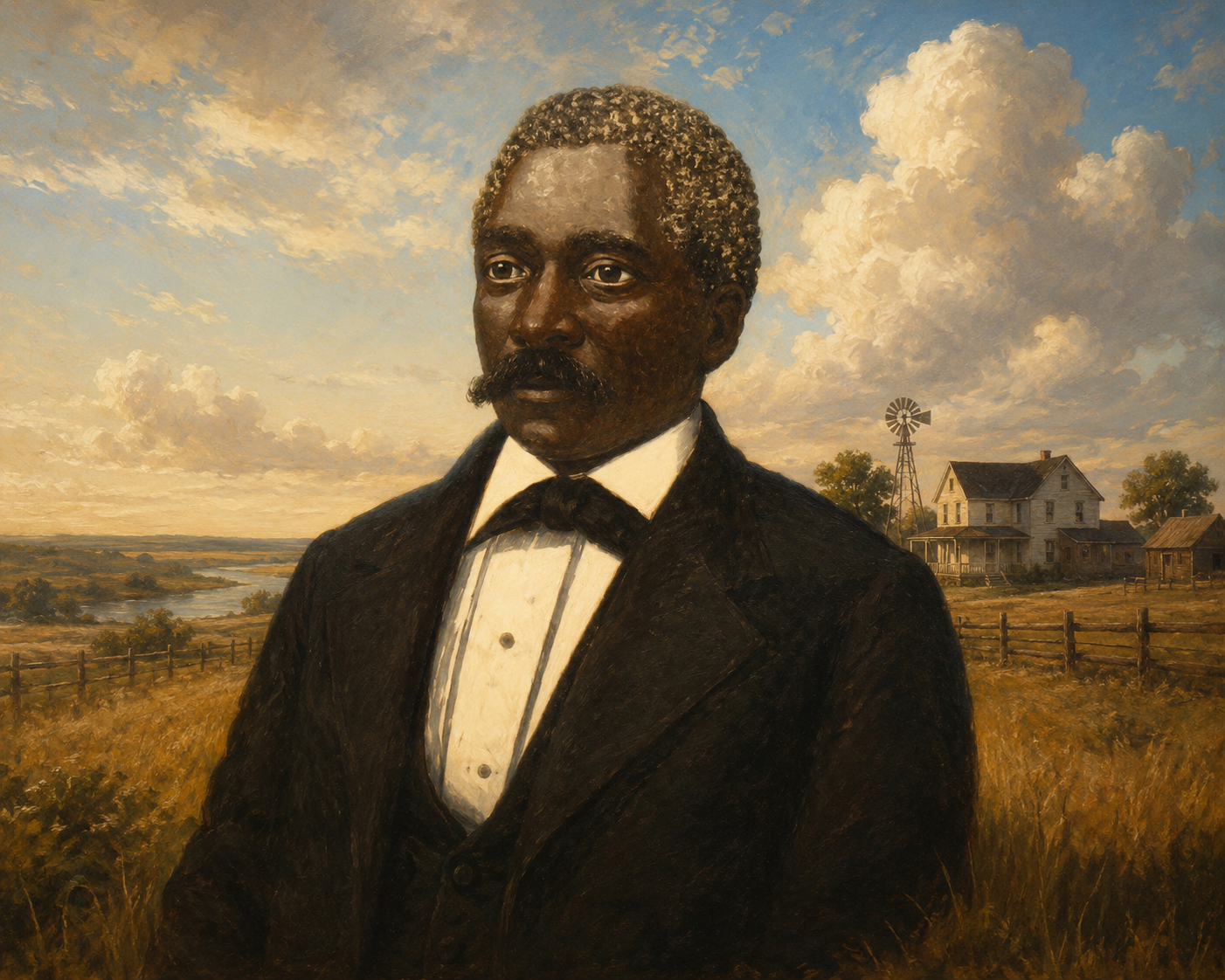
For three years, from 1907 to 1909, the fastest horse in South Dakota was a racer named Johnny Bee. The man who bred him had a philosophy about the sport. “Racing horses is a fine sport for any man, as it teaches him how to be a good winner and good loser,” he said, “and if you can’t be both, you should never race horses.”
That man was Norvel Blair. He was born enslaved in Montgomery County, Tennessee, around 1825. By the time Johnny Bee was outrunning everything in the state, Blair was in his eighties, farming land he owned in Sully County.
Juneteenth marks the day in 1865 when word of emancipation finally reached Galveston, Texas. South Dakota holds a piece of what came after. The Blair family story is the closest thing to a homegrown Juneteenth South Dakota has, and it sits on a stretch of prairie called Fairbank Township, about 40 miles north of Pierre.
From Tennessee to Fairbank Township
Blair gained his freedom in 1863. After the Civil War, he reunited with his wife, Mary, and their seven children, and the family built a prosperous farm in Illinois. Then came 1880. A mob burglarized their home and riddled it with bullets. Around the same time, a white lawyer cheated Blair out of land. He responded by publishing a memoir and political tract with a title that wasted no ink on subtlety: Book for the People! To Be Read by All Voters, Black and White.
Then he looked west. In 1882, Blair sent two of his sons, Benjamin and Patrick, to scout homesteading prospects in Dakota Territory. They returned with a favorable report, so when Sully County opened for claims in 1883, the brothers filed in Fairbank Township. The rest of the family followed the next year, and seven Blairs eventually claimed land there. They also bought up properties abandoned by settlers who drifted away after the Black Hills gold rush fizzled.
Norvel was pushing sixty by then, and he farmed like a man half his age. He broke ten acres his first year, then added ten more every year after until he proved up his claim.
The Colony Grows
The Blairs wanted company. Norvel’s daughter Betty worked as a land agent, traveling east to recruit Black families out of the South and sell them farms along the Missouri River. A schoolteacher who worked in the area years later remembered that Betty “got them to believe there weren’t any flies in South Dakota.”
It worked. John and Ellen McGruder came up from Missouri and bought 1,200 acres through her. Other families followed, and the settlement became known as the Sully County Colored Colony. Estimates of its peak population range from 100 to 200 people, depending on the source, with roughly 7,000 to 8,000 acres under Black ownership. Historians at the University of Nebraska’s Center for Great Plains Studies now count it among the six most successful Black homesteading colonies in the country, alongside places like Nicodemus, Kansas.
The family kept busy beyond the fields. Betty and her sister Winnie ran a restaurant and bakery. Benjamin and Patrick operated a livery. In 1896, Benjamin became the first Black person in South Dakota to serve on a school board, and he went on to chair the Fairbank district for a decade. By 1906, he had helped found the Northwestern Homestead Movement in Yankton, a group that aimed to move Black families from the South onto farms across the Upper Midwest. The Blairs pledged 1,700 acres toward an agricultural college. The college never got built.
What’s Left
Norvel stayed on his land until his death on October 7, 1916. He’s buried in Blair Cemetery, in Fairbank Township, surrounded by the acres his family claimed. The colony faded over the following decades as younger generations moved toward cities and steadier wages. Plenty of homesteads across the state emptied the same way.
In 2020, the National Park Service and the Center for Great Plains Studies dedicated a historical marker in Onida honoring the Blair and McGruder families. Descendants came for the ceremony. Onida sits about three hours east of Rapid City, an easy detour if you’re already headed toward Pierre, and the marker is worth the stop.
Juneteenth commemorates a freedom that arrived late and unevenly. Norvel Blair got his in 1863. He spent the next fifty years building on it: a farm, a fortune, a school district, a colony, and for three years, the fastest horse in South Dakota.
Sources: National Park Service (Homestead National Historical Park), South Dakota Magazine, BlackPast.org, Dakota News Now


