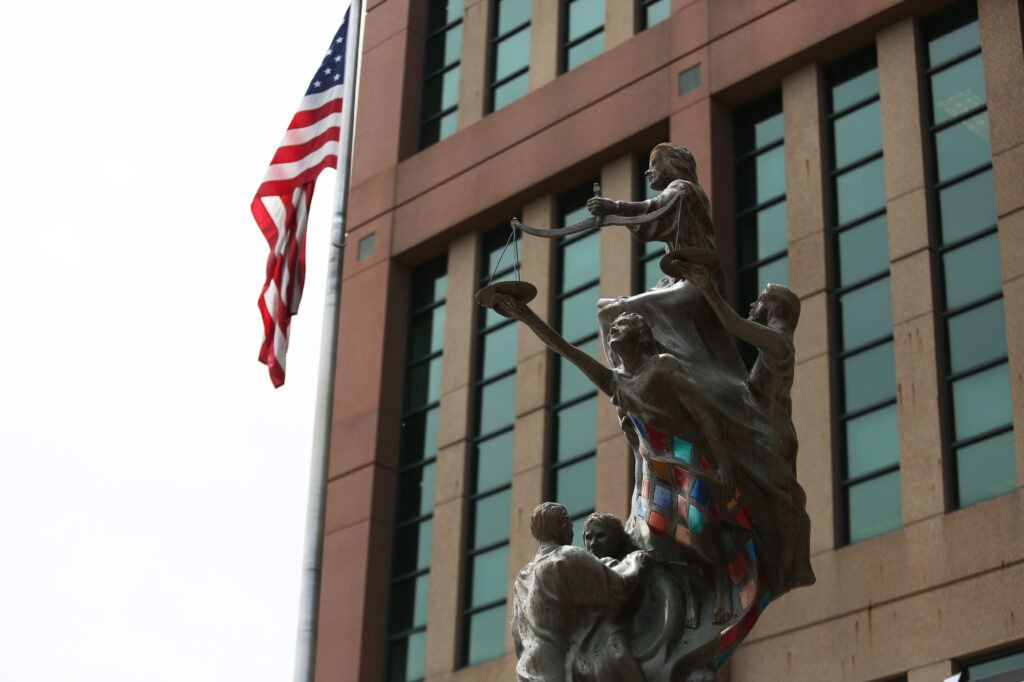
An equal justice statue stands outside the doors of the Minnehaha County Courthouse in Sioux Falls. (Photo by Makenzie Huber/South Dakota Searchlight)
South Dakota specialty courts are saving taxpayers money on prison costs, according to an annual report presented to the state’s Drug Court Advisory Council.
The council oversees the state’s 17 specialty courts, which include drug courts, mental health courts and DUI courts.
Each court is an intensive program with weekly check-ins that take place in courtrooms but function more like mental health group therapy sessions led by a judge, who checks in with participants one by one to ask about their jobs, families, addiction treatment sessions and other life stressors. The judge can issue sanctions for poor behavior, like failing a drug test or quitting a job, or rewards for good behavior, like finishing outpatient drug treatment.
Pretrial monitoring could reduce missed court appearances and improve outcomes, court officials say
Each participant pleads guilty to a felony charge up front, avoiding prison time through a promise to stay sober and move through the program, which typically lasts around 18 months. Those who leave or fail typically go to prison.
The Drug Court Advisory Council includes judges, prosecutors, defense lawyers and treatment providers. The council oversees the specialty courts and makes recommendations on policy adjustments for the courts.
The group met virtually on Tuesday and discussed the South Dakota Treatment Courts Annual Report for fiscal year 2026, which ended June 30.
The courts had 707 participants in that timeframe, said Noreen Plumage, the treatment court director for the state’s Unified Judicial System. That’s a drop from the 759 people participating in the previous fiscal year, she said, but “our new admissions are on the rise,” Plumage said, with 304 people starting in treatment court.
There were 167 graduations, Plumage said. The price to the state to move each of those graduates through the program is $8,137. The average annual price of a year in prison in South Dakota is $34,000, the report said.
The courts had a 60% graduation rate last year, and 71% of graduates did not commit any new crimes within five years of their graduation.
Terry Dosch is a member of the advisory council, and is director of the South Dakota Council of Mental Health Centers. Dosch asked Plumage to make sure the report is shared “with our legislative friends.”
“I think the data are very compelling, especially the cost contrast between drug court and incarceration,” Dosch said