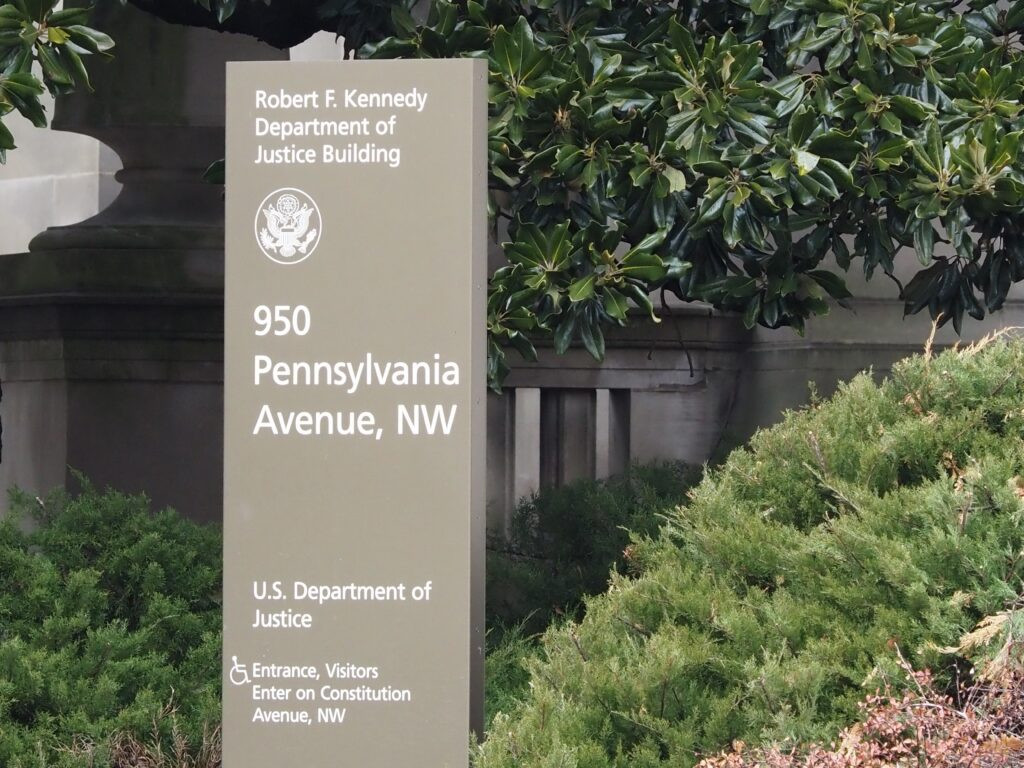
The U.S. Department of Justice on Feb. 20, 2026. (Photo by Shauneen Miranda/States Newsroom)
After the U.S. Department of Justice sued California over its refusal to remove voters the federal government alleges are noncitizens, voting rights advocates fear the Trump administration is violating a court order blocking it from rooting out noncitizens with states’ voter data.
U.S. District Judge Sparkle Sooknanan on Oct. 9 ruled against the Justice Department’s year-long project to obtain state’s unredacted voter rolls, which include sensitive personal data, and share them with the Department of Homeland Security to identify possible noncitizens. The DOJ on Friday said it plans to appeal the decision.
In letters sent on Oct. 13, the Justice Department gave California officials 48 hours to review and remove a list of some 20,000 registered voters that the Trump administration believes are noncitizens.
Many are concentrated in the Los Angeles area, and state and local elections officials both refused to act on the list. The DOJ immediately sued after its deadline passed on Thursday.
The Justice Department’s lawsuit, coming less than three weeks before Election Day and with voting underway in California, amounts to the latest development in President Donald Trump’s efforts to assert authority over elections, which under the U.S. Constitution are administered by the states. Trump faces a deluge of investigations and pushback if Democrats retake one or both chambers of Congress in November.
Democrats and voting rights groups have previously raised alarms about the possibility of the Trump administration attempting to interfere with voting. For some, the legal action against California only exacerbates their concerns.
Letter sent, hearing requested
On Thursday, several Democratic senators wrote to U.S. Attorney General Todd Blanche to demand that the DOJ confirm it won’t seize ballots or other election materials.
The watchdog groups Common Cause and Citizens for Responsibility and Ethics in Washington, or CREW, which represents voters who sued to block the DOJ’s voter data sharing, have asked Sooknanan to hold a hearing to look into whether the Trump administration’s actions violate her order. They said the DOJ has adopted an “exceedingly narrow view” of her decision.
“By attempting to superintend voter roll list maintenance and prohibit registered voters from exercising the franchise without adequate consideration of the reliability of the underlying data, DOJ’s October 13 letters and the actions described in the California (lawsuit) appear to implicate — and perhaps outright violate” Sooknanan’s order, lawyers for the groups wrote in a court filing.
On Friday, Sooknanan ordered the Justice Department to respond to the request for a hearing in District of Columbia federal court by Monday.
Email exchange
Common Cause and CREW filed in court a late Thursday email exchange with Christian Dibblee, a Justice Department trial attorney, in which Dibblee writes that Homeland Security obtained a publicly available voter roll of California voters — as opposed to the full, unredacted roll that DOJ has sued states over — and that DHS didn’t use the SAVE system to identify possible noncitizens.
SAVE, a computer system operated by DHS, combs through government databases to verify citizenship, but critics point to examples of the program falsely flagging U.S. citizens. The U.S. Supreme Court in September ruled that states could continue accessing SAVE ahead of the midterm elections, but most states are currently prohibited from conducting mass purges of voters because it’s too close to the election.
Sooknanan’s order “does not extend to using other methods, nor does it prohibit taking enforcement actions based on those other methods,” Dibblee wrote, adding that Homeland Security also wasn’t a party to the lawsuit challenging the DOJ’s voter roll effort.
The Justice Department’s lawsuit against California offers a broad overview, but few specifics, of how Homeland Security compiled its list of suspected noncitizens. It says that Immigration and Customs Enforcement, or ICE, compares “information about voter rolls” with “its internal data” to identify possible noncitizens. Additional investigative steps, not described, are used to assign a confidence level — low, medium or high — to each match.
ICE then connects high confidence matches with an “alien number” and those individuals are compared against internal records regarding naturalization and parental citizenship. Records from the State Department and Social Security Administration are also reviewed, the DOJ says in its lawsuit.
Individuals that ICE still believes to be noncitizens are then sent to Homeland Security Investigations, a sub-agency of ICE, according to the Justice Department. HSI conducts an “analytical data enrichment process” before sending data to HSI criminal investigators in the field.
In a statement Friday, DHS said it uses multiple data sources, from both government and commercial third-party sources, to supplement public information.
Mullin slams ‘unlawful voting’
In a Thursday statement, Homeland Security Secretary Markwayne Mullin called the number of alleged noncitizens registered to vote in California “completely unacceptable.” He said even one noncitizen vote cancels out the ballot of a U.S. citizen and undermines elections.
“DHS is committed to identifying unlawful voting, protecting the integrity of federal elections, and ensuring that only eligible American citizens elect America’s leaders,” Mullin said.
Democrats and voting rights experts have questioned the Justice Department’s decision to file the lawsuit with the election underway. The DOJ previously lost a lawsuit seeking to force California to turn over its unredacted voter roll — one of 23 similar lawsuits over state voter data that the Trump administration has lost.
The Trump administration’s efforts to identify large numbers of noncitizen voters have, up to this point, also fallen short of its own standards. Over the summer, the federal government claimed that California had upwards of 190,000 noncitizens on its voter roll.
By contrast, Thursday’s lawsuit alleges only roughly 20,000 noncitizen voters — about 0.08% of the nearly 23.2 million registered voters in California.
DHS said Friday that 190,000 remains the number of potential noncitizen voters but that 20,000 represents a subset who have gone through a manual verification process so far.
“Every count, recount, hand count, lawsuit, and audit has found that there’s no widespread voter fraud in the U.S.,” California Attorney General Rob Bonta, a Democrat, wrote on social media. “The Trump Admin’s last-minute demands are meritless, and we look forward to making our case in court.”