

A January 2025 view of the South Dakota State Capitol in Pierre. (Photo by Makenzie Huber/South Dakota Searchlight)
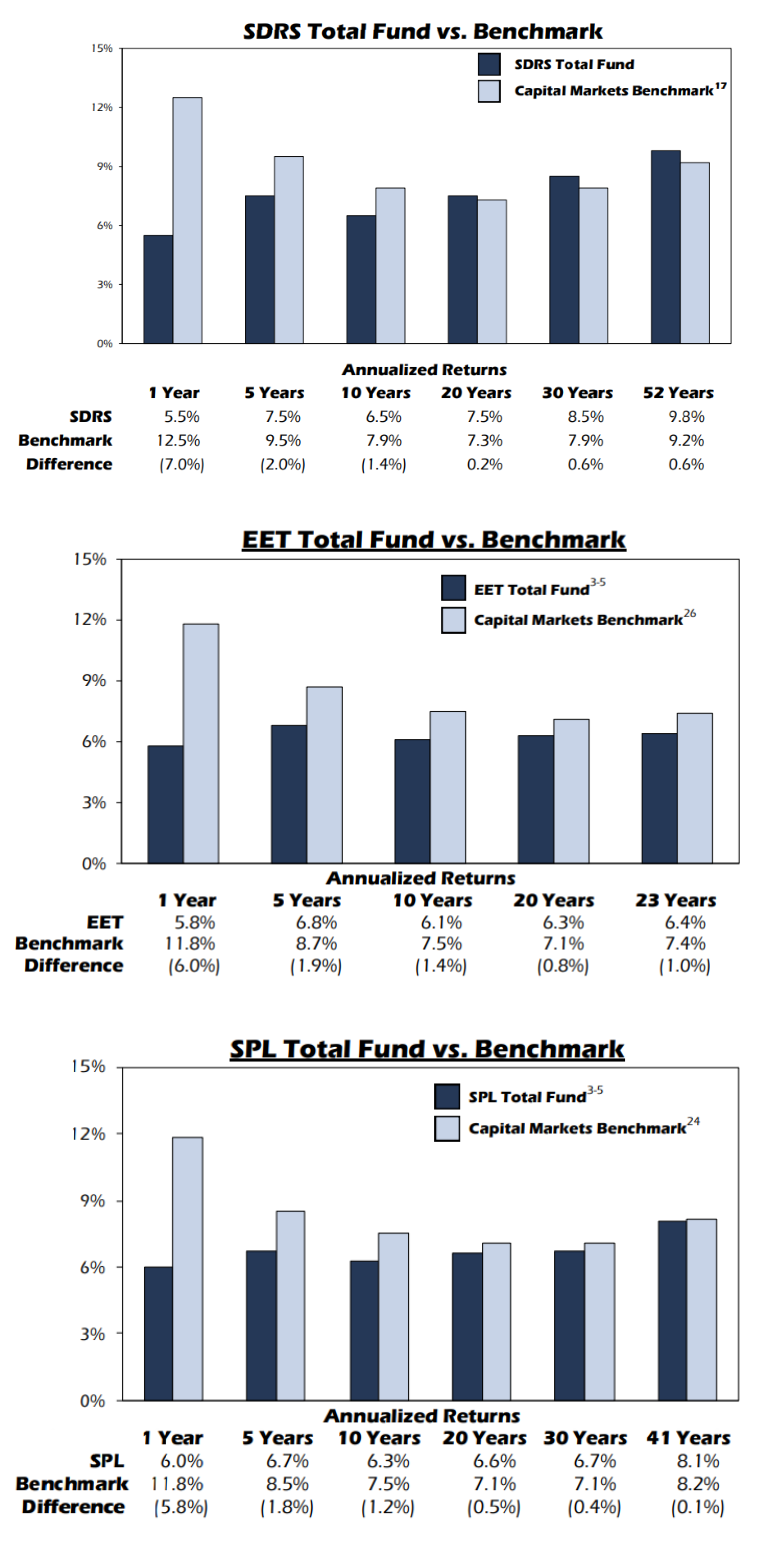
The people who manage the investments for the state of South Dakota’s retirement system have underperformed for the third year in a row, contributing to a 1.4 percentage-point gap — or a $2.75 billion shortfall — between their 10-year performance and the benchmark they try to meet over the long term.
The state Investment Council manages nearly $21 billion worth of total assets that fund the retirement system for public employees and also support the state budget, including health care and education trust funds. The council has eight voting members and a staff of 28.
The recent underperformance is by design, State Investment Officer Matt Clark told the legislative budget committee this session in Pierre.
“We’re fine. Just muddling along and being cautious for an extended period if we have to,” Clark said.
window.addEventListener(“message”, function(event) {
var message = JSON.parse(event.data);
if (message.sender == “Flourish” && message.context == “iframe.resize”) {
src = message.src.replace(/#.+$/, “”);
vizFrame = document.querySelector(‘iframe[src=”‘ + src + ‘”]’);
vizFrame.setAttribute(‘height’, message.height);
}
});
The council weighs its performance against a Capital Markets Benchmark, which is an index that can be used as a comparison to measure an investment portfolio’s results.
The state has been “significantly below” its benchmark as stock prices rose in recent years, largely inflated by artificial intelligence-led investments, Clark said. His “contrarian” approach pulls risk back when markets are high to protect against anticipated market downturns and outperform by buying stocks when they’re cheaper.
The state’s stock investments are currently set to the “minimum risk position,” Clark said. Some other investments in real estate and private equity have not yielded the best results, but are key to a more stable and diverse portfolio, Clark told lawmakers.
Eric Ollila, executive director of the South Dakota State Employees Organization, represents and advocates for current and retired state government employees. He isn’t concerned about the investments’ performance yet. The council is still beating its benchmark over the longer term of 20 years and beyond.
“You have to look at the long-term trends,” Ollila said. “How it has operated has proven itself over the years and deserves the benefit of the doubt.”
Ollila added that South Dakotans “vest our faith in our elected officials” and appointed members of the South Dakota Investment Council and the South Dakota Retirement System board.
“We put them in a place to get things done,” Ollila said. “If we are unhappy with how they’re performing, we can replace them.”
Market downturn will follow inflated AI investment, state investment officer says
Clark, who has been with the Investment Council since the 1980s, said South Dakota is “underweight” in the artificial intelligence boom.
Clark compared the current AI-driven stock market to the “dot-com bubble” of the late 1990s. The investment council started pulling back from the market in 1996 and waited until the bubble burst. The stock market has been in a similar position recently with some of the most expensive prices since the 20th century ended, Clark told lawmakers.
Clark told South Dakota Searchlight that investors historically get “overexcited” about technological innovations, including railroads, telephones, automobiles and airplanes.
“In each of those instances, they were overdone in terms of stock market investor enthusiasm,” Clark told Searchlight. “You end up overdoing it, at least in the short term.”
Many companies struggled or went bankrupt after those bubbles popped, such as fiber optic companies after the dot-com bubble. He expects the same for artificial intelligence.
By minimizing risk ahead of a downturn, that means South Dakota’s investors can “sidestep most of the damage” and buy cheap stocks while other investors are recovering from their losses.
“Maybe we’ll set a new record and we’ll have to suffer another two to three years, but we still believe strongly that staying the course with a long-term oriented, disciplined approach makes sense,” Clark told lawmakers. “It has to matter when markets are extremely expensive.”
‘Mediocre’ returns sustain system in the long term, officials say
South Dakota has been on the defensive since 2019, when Clark’s team anticipated an economic downturn. The pandemic and subsequent federal involvement prolonged South Dakota’s risk-averse approach.
That approach has consequences for members of the state retirement system.
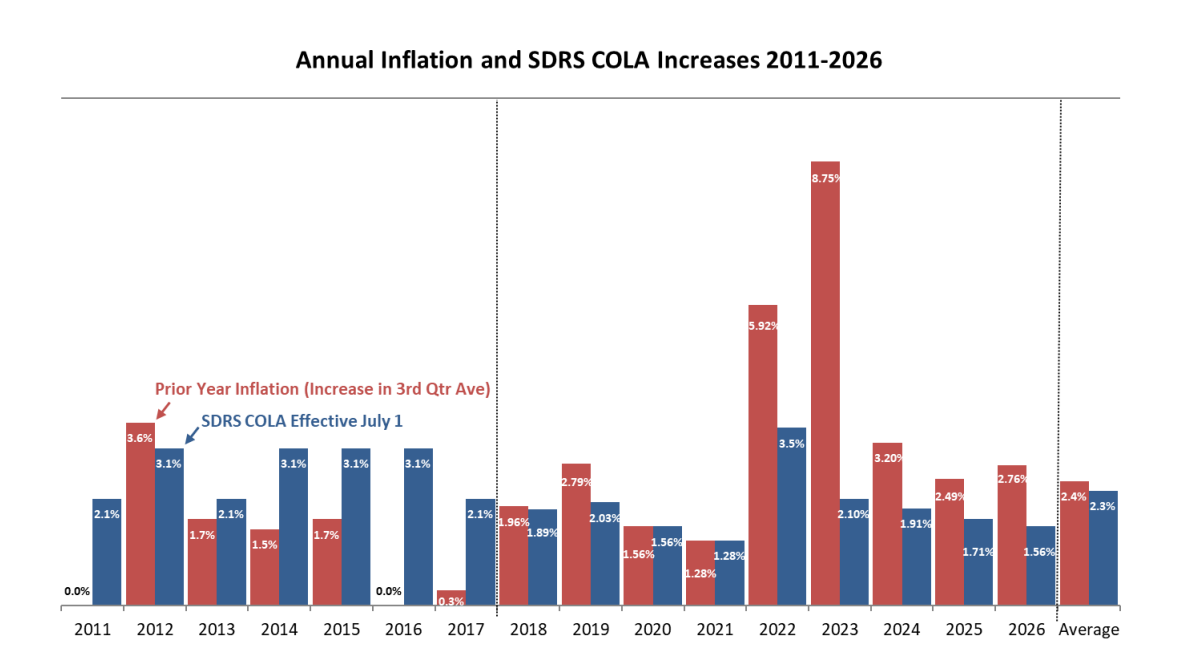
Retirees’ cost-of-living adjustment is supposed to equal inflation, up to 3.5%. The annual adjustments are typically decreased to “what we can afford” for all members if retirement investments underperform, the South Dakota Retirement System’s senior actuary, Doug Fiddler, said during a December meeting. That annual adjustment depends in part on the system’s investments meeting a long-term return assumption of 6.5%. The system’s investment return last year was 5.44%.
The adjustment is the main piece of the formula the state can toy with, since the system must use fixed contribution rates, according to state law. The adjustment is also dependent on member demographics, salary trends, retirements, disabilities and mortality, which “often have an equal or greater impact on liabilities” and the annual adjustment, state retirement system Executive Director Travis Almond said in an emailed statement.
Due to less-than-expected investment returns, high inflation, and other factors, the retirement system’s annual adjustments fell short of inflation each of the last five years.
Sioux Falls School Board member Marc Murren taught in South Dakota for 42 years before retiring in 2017. His wife taught for 33 years in Canton before retiring a few years later. They’re both receiving benefits from the state retirement system.
Murren is familiar with annual benefit and salary increases that don’t meet inflation. South Dakota sometimes does not increase state education funding to match inflation.
“It’s like I got beat up when I was a teacher and now I’m getting beat up again because the retirement system isn’t doing its job,” Murren said.
Murren coached wrestling and football during his time at Washington High School, taught summer school and painted homes during the summers to earn more cash. He said he and his wife are “doing fine” in retirement, but he wants the retirement system to be more transparent in its communications about why benefit adjustments are lagging inflation.

Almond said the system is “highly transparent” about how the adjustment is determined and when it falls below inflation. He said members of the public can attend board meetings in person or virtually and that information on the adjustment is sent to benefit recipients in the December newsletter, posted on the system’s website, and included in annual reports to the Legislature and governor.
The balance between cost of living adjustments, investment performance and other factors sustains the fund in the long term, Almond said. Without the “flexibility” to change the adjustment amount each year “it would be incredibly difficult to provide adequate retirement income.”
“The current structure ensures that retirees receive the largest COLA SDRS can sustainably afford year after year,” Almond said. “It prevents sudden funding shortfalls, protects the system’s long-term health, and helps ensure retirees receive their earned benefits for life.”
Clark prefers “disappointing but moderate” returns around 5-6% compared to risky investments that could lead to “challenging underfunding” of the state’s retirement system if the bubble pops.
“It’s no fun saying that the markets are high and bad times are coming and you have to be cautious,” Clark told South Dakota Searchlight. “We’re either going to get mediocre returns or worse, and we’re hoping for mediocre. But if there is a crash, hopefully we can take advantage of the volatility like we have in the past.”
Clark believes the state could “remain patient for an extended amount of time” until more attractive investment opportunities come along.
“We understand we’re investing people’s retirement money,” Clark said. “We have to be mindful that we invest in assets that are prudent and help us pay benefits people can depend on.”
GET THE MORNING HEADLINES.


