
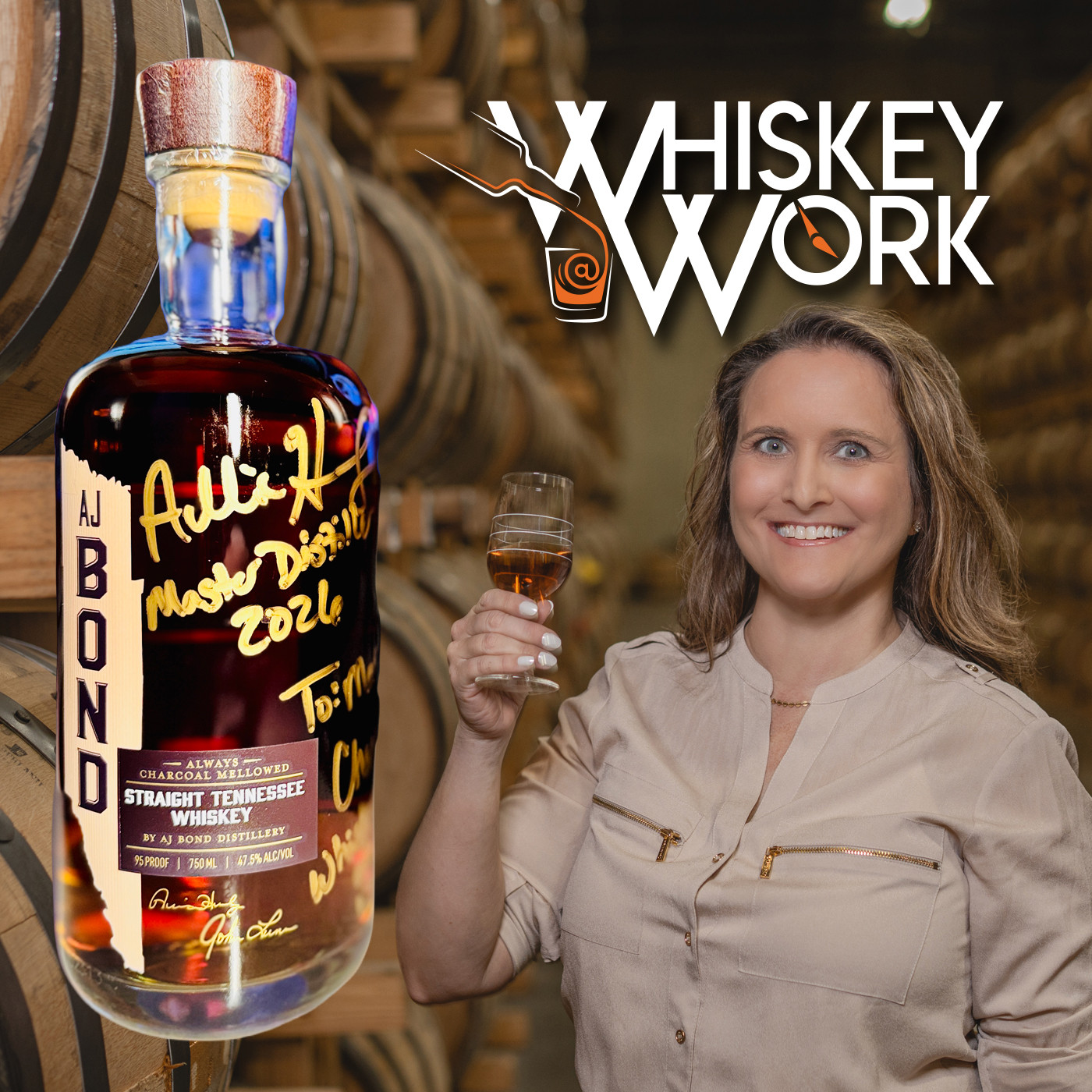
Here’s a thing that happens more than you’d think in the whiskey world. Coincidence. A guy who knows nothing about whiskey walks into a tiny Tennessee liquor store holding a photo of a bottle on his phone. He’s looking for it because his team back at the office is dying to try it. He shows the clerk the picture. The clerk points to the back of the store and says, oh, she’s right here doing a tasting.
The “she” was Allisa Henley. The master distiller. The woman whose name is on the bottle he was hunting for.
A distiller who started by writing a tour script
Allisa Henley didn’t grow up around whiskey. She grew up in middle Tennessee, in the Bible Belt, in a house with no alcohol in it. When she took a job at a distillery, her family wasn’t sure what to make of it. “My mom said she was going to call the Sunday school class and activate the prayer chain,” Henley says. “She’s like, oh my gosh, what are we going to do? I’m like, it’s okay. I can use some more prayers.”
She didn’t start as a distiller. She had an MBA and no distilling experience, and George Dickel hired her to design the visitor experience. The place had been closed to the public for years. Her first real assignment was to hire a staff and write a tour script for a distillery she knew nothing about.
So she figured it out the only way that made sense to her. “I just went over there and rolled up my sleeves and got dirty,” she says. Shoveling spent grain. Cleaning fermenters. Learning from people who’d been doing it for thirty years. She calls it the old school of distilling, and she’ll tell you flat out, “I learned better doing it by my hands.” After about ten years, the people around her started saying she knew the stuff, she had a good palate, she could talk to people. Did she want to be their distiller?
She wasn’t going to say no.
The bond in AJ Bond
At Dickel, Henley met John Lunn. He was the master distiller, the chemical engineer, the introvert who’d rather sit with the numbers than work a crowd. She was out front, teaching people, shaking hands. “It was like I had just met my long lost brother or something,” she says. The two of them fit together that fast.
“We talked every day, every day for twenty years,” Henley says. They came up in the industry the same way, both from families without booze in the house, both learning the craft on the job. When Sazerac decided it wanted a real Tennessee whiskey to go with all that famous Kentucky bourbon, the company came looking for the two of them and asked a simple question. If you could make anything you wanted, what would it be?
The name AJ Bond comes from that friendship. “A” for Allisa. “J” for John. And the word bond, for what the two of them had.
John Lunn passed away in 2023, before any of this reached a bottle. He knew the name. He never saw the design. “It’s a big hole when they’re gone,” Henley says. “I definitely feel it. Our guys at the distillery feel it.” She took on finishing a thing that was supposed to be the two of them, and the way she frames it, the work is a way of keeping him around. “It is like my chance to help carry on his legacy with this brand,” she says.
The chairman of Sazerac’s board, Mark Brown, pushed for the name. The team had been throwing around all kinds of options, and Brown’s point was that the only reason Sazerac had a Tennessee whiskey at all was because the company found these two people. Name it after them.
Two stills, one bottle, and a couple of hidden faces
The whiskey comes from a single mashbill run through two different stills. Same recipe, same cook, same fermentation. One batch goes through a pot still, the other through a column still, and they age separately in Tennessee oak before Henley blends them back together. The column distillate comes out cleaner and a little fruitier. The pot side runs grungier. “They have a lot more character,” Henley says. “There’s just a lot of earthiness that’ll come through on those pots.” Bonding the two of them was another nod to John.
There’s also a detail on the bottle worth turning over in your hands. The design looks like a torn piece of paper, and flipped the right way the shape is the state of Tennessee. Look in the top left corner of that shape and you’ll find two silhouettes. Allisa’s face and John’s face.
The charcoal mellowing, that Lincoln County process every Tennessee whiskey has to go through, they handle with sugar maple charcoal they make themselves on site, so they know exactly what wood is touching every drop. Henley says that control is part of the point. It’s a step they’re proud of, and it’ll touch everything that carries the AJ Bond name down the road.
Liquid to lips
AJ Bond Tennessee Whiskey came out in June 2026, first in the Nashville and Knoxville areas, bottled at 95 proof and running about $39.99 for a 750ml. A wider push into more of Tennessee comes this fall and winter, with a few other states getting small allocations after that.
Henley has a phrase she uses for people who think they already know what Tennessee whiskey tastes like. “Liquid to lips is the proof,” she says, “because as soon as somebody tastes it, they’re just like, oh my gosh, we didn’t know Tennessee whiskey could be like this.” Her hope is that AJ Bond raises what people expect from the category. “Tennessee can be like Kentucky,” she says. “There’s room for everybody.”
For those of us up here in South Dakota who tend to get everything last, the wait will take a while. When you finally pour it, you’re drinking twenty years of a friendship between two people who built it together.
To hear the full story, listen to the “Liquid to Lips” episode on the Whiskey@Work podcast.


