
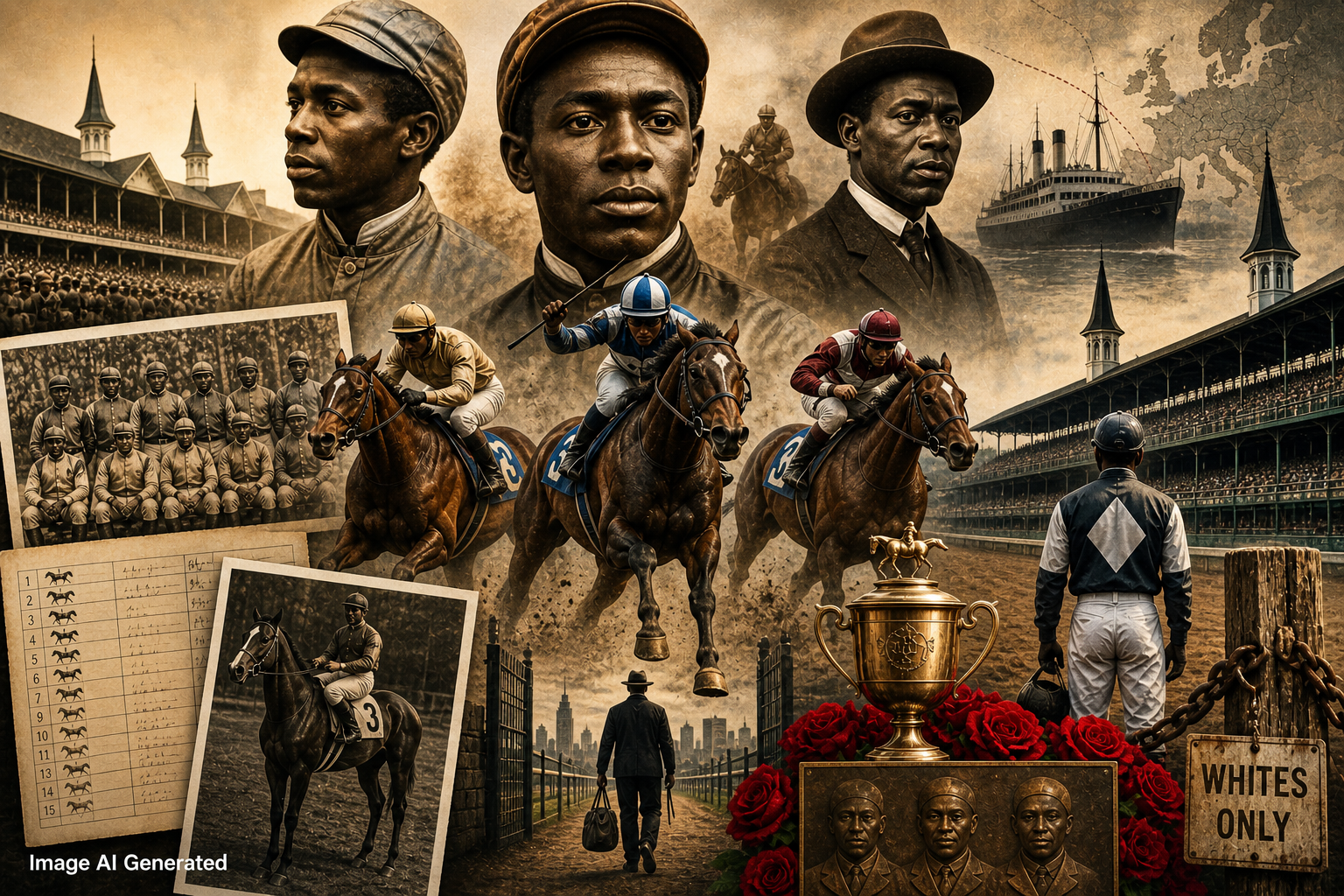
Every first Saturday in May, somewhere around 150,000 people pack into Churchill Downs wearing hats that probably cost more than a car payment. They’re sipping mint juleps out of commemorative cups, betting on horses they’ve never heard of, and singing “My Old Kentucky Home” with their hands over their hearts.
Most of them couldn’t name the jockey who won the first Kentucky Derby.
Thirteen Out of Fifteen
When the first Kentucky Derby ran on May 17, 1875, a crowd of 10,000 showed up to watch 15 horses go around the track. Thirteen of the fifteen jockeys were Black men.
The winner was a 19-year-old named Oliver Lewis, riding a chestnut colt called Aristides. Lewis had been formerly enslaved in Kentucky. The horse’s owner, H. Price McGrath, intended for Aristides to play rabbit, running hard early to tire out the field before pulling back so McGrath’s other horse, Chesapeake, could take the win. When Chesapeake fell back in the pack, Lewis improvised. He pushed Aristides forward and never looked back.
The man who made that call was 19, riding on instinct, and most people today couldn’t tell you his name.
Black jockeys won 15 of the first 28 Kentucky Derbies. They built the race into something worth watching.
The Greatest Athlete You’ve Never Heard Of
Isaac Murphy was born into slavery in 1861 in Frankfort, Kentucky. His father joined the United States Colored Troops and died of camp fever three years later. His mother got sick. By the time Murphy was ten, family friends had taken him in and put him to work at a horse stable.
He won three Kentucky Derbies, in 1884, 1890, and 1891, and was the first jockey to win back-to-back titles. By his own count, he won 44 percent of all the races he ever rode in, a winning percentage no jockey has matched since. At his peak, he was earning $20,000 a year, somewhere around $700,000 in today’s money. He owned property. He owned racehorses. He reportedly turned down a bribe mid-career, on principle, when gamblers approached him before a race in 1879.
By any reasonable measure, he was the greatest jockey in American history and one of the first Black superstar athletes in any sport.
He died at 35 and was buried in an unmarked grave.
In 1955, the National Museum of Racing and Hall of Fame opened and inducted its first jockey. It was Murphy, nearly sixty years after his death.
The Squeeze
Starting in the late 1890s, Jim Crow laws reached into horse racing. White jockeys began riding directly into Black jockeys during races, boxing them against the rail, forcing them out of contention while officials looked away. Horse owners quietly stopped booking Black riders. The money dried up fast.
By 1904, it was nearly impossible to find a Black jockey at a major racetrack.
In 1921, Henry King rode in the Kentucky Derby and finished tenth. No Black jockey competed in the race again for 79 years. In 2000, Marlon St. Julien rode in the Derby and finished seventh. In 2013, Kevin Krigger rode and finished seventeenth.
The 2025 Derby ran without a single Black jockey.
The Most Cinematic Life in American Sports
Jimmy Winkfield was born in Chilesburg, Kentucky in 1880, the seventeenth child of a sharecropping family. He worked as a carriage driver before catching on at a racetrack. A horseman named Col. Phil Chinn once described him by saying he “just sat up there like a piece of gold.” By the time he was 22, Winkfield had won the Kentucky Derby back-to-back, in 1901 and 1902, one of only five people in history to ever do that.
With his rides dwindling due to rampant racism at American tracks, and KKK threats following him around, Winkfield bought a steamship ticket and a Russian/English dictionary in 1903 and crossed the Atlantic. He landed in Eastern Europe and never stopped winning. He became a celebrity in Czarist Russia, riding for the aristocracy and earning over $100,000 a year. The Russian sports press called him the “Black Maestro.” He ate caviar for breakfast and stayed in Moscow’s finest hotels.
In 1919, with the Bolsheviks advancing on Odessa, Winkfield and a group of horsemen led over 250 thoroughbreds on a three-month, 1,100-mile overland march to Poland. They survived partly on horse meat. Winkfield later said, “I got to thinking this ain’t no longer a fit place for a small colored man from Chilesburg.”
He settled in France, built a stable, and rebuilt his career. When Germany occupied France during World War II, the Nazis seized his property, his horses, everything. He was 60. He picked up a pitchfork to defend a horse being abused by a Wehrmacht soldier and had to leave.
Back in America, nobody in racing knew him or cared. The only work he found was as a groom. He ran a jackhammer on the sidewalks of Queens for the WPA.
He returned to France in 1953, rebuilt his stable a third time, and was running a successful operation into his seventies.
The Dinner at the Brown Hotel
In 1961, Winkfield returned to Louisville for the Kentucky Derby, his first time back in nearly sixty years. Sports Illustrated hosted a dinner at the Brown Hotel in his honor, celebrating his two Derby wins.
He was denied entry at the door.
A two-time Derby champion, invited guest, turned away from his own dinner in Louisville in 1961.
He died in Paris in 1974, homesick for Kentucky until the end. The Hall of Fame inducted him in 2004, thirty years after his death.
What the Race Is Built On
Oliver Lewis improvised his way to the first Derby win on a horse that wasn’t supposed to finish first. Isaac Murphy refused a bribe and rode with a 44 percent win rate nobody’s touched in over a century. Jimmy Winkfield won back-to-back Derbies, escaped the Bolshevik Revolution, survived the Nazi occupation of France, worked a jackhammer in Queens, rebuilt his career in his seventies, and got turned away from his own dinner in Louisville.
The Twin Spires, the roses, the mint juleps. None of it exists without those men.


