
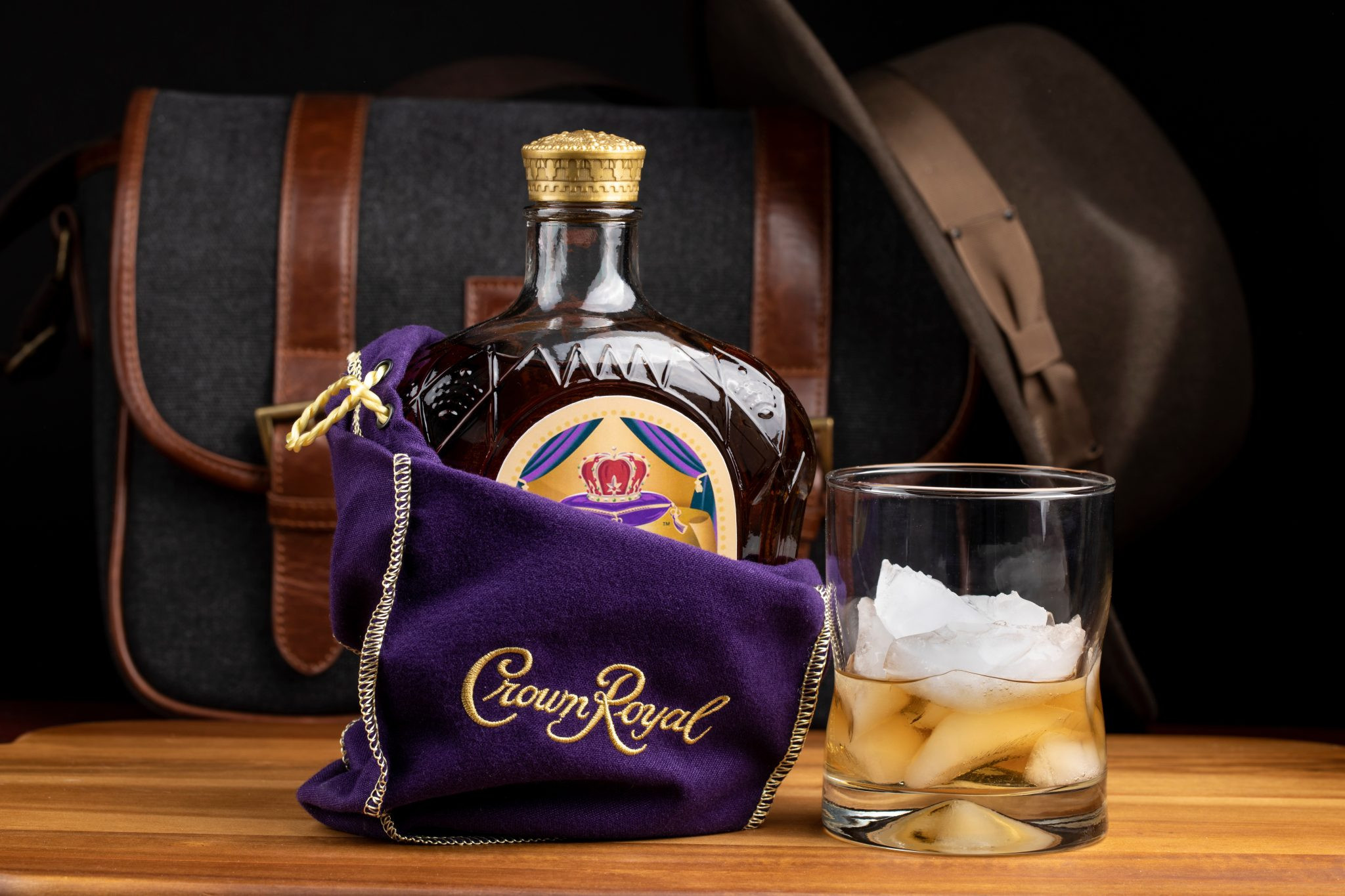
You probably know someone who keeps loose change in one. Maybe your dad used his for spare keys. Maybe you’ve seen one in a tool shed next to the wrenches. The whisky’s long gone. The bag stuck around.
That’s the strange, underreported story of the Crown Royal purple bag. It started as packaging. It became something else entirely.
A Bag Fit for a King
In 1939, Seagram’s president Samuel Bronfman learned that King George VI and Queen Elizabeth would be the first reigning British monarchs to visit Canada. He reportedly worked through hundreds of blends before landing on a recipe, presented in a crown-shaped bottle wrapped in a purple bag with a gold tasseled drawstring. Purple, of course, for royalty.
It stayed exclusive to Canada for 25 years, and it’s still made in one place, the Gimli distillery on Lake Winnipeg in Manitoba. Once Crown Royal hit American markets in 1964, something happened no marketing team could have engineered. People started keeping the bags. Not as novelties. As containers for whatever mattered most to them.
The velvet holds up. These aren’t flimsy paper sleeves, and once the bottle’s empty, the bag has another life waiting.
When Packaging Becomes the Point
Crown Royal drinkers store property titles, tarot cards, watches, and anything else too important to leave loose in a drawer. Others have sewn the bags into quilts, hoodies, kilts, Christmas stockings, and dog scarves. Designer Jhoanna Alba built a limited-edition blazer out of them. At a Tales of the Cocktail gathering in New Orleans, one attendee turned up in a full suit made of Crown Royal bags.
Bobby Henline, a soldier from San Antonio, was on his fourth tour in Iraq when a roadside bomb left him badly burned and cost him his left hand. He asked his prosthetist to cover the arm in a Crown Royal bag. Barbara Jo Bagby Enterline got a bottle as a gift, passed the whisky along, and kept her anniversary pearls in the bag, because it was soft and purple was her favorite color.
The Etsy Economy
There’s a secondary market here that has nothing to do with whisky. On Etsy, sellers list empty bags by the dozen for crafts and quilts. People are buying bags they never got from a bottle.
Sizes run from roughly 6 by 7.5 inches up to 9 by 13 on the 1.75 liter. Quilters know which size they need before they think about which expression to buy.
Around 50 million bags get stitched for Crown Royal every year. Nine colors exist now, and the classic purple still outsells the rest. The brand has known about the repurposing for years. It published a book of fan creations and donates a dollar per returned bag to charity. But the brand didn’t start any of this.
A Cultural Touchstone
Nobody knows exactly when the purple bag became so embedded in Black culture. There was no ad blitz, no targeted campaign. It was in the house, in the closet, on the shelf, across generations, before the brand noticed.
Bar historian Tiffanie Barriere traces the appeal to something elemental. “Purple stands for royalty,” she’s said. “It’s got a crown on top of it.” Wine journalist Chasity Cooper remembers the bag from childhood, long before she was old enough to touch the bottle. The logo was simply there, tied to the adults she looked up to.
Artist Amanda Williams recognized that same weight when she chose Crown Royal purple for “Color(ed) Theory,” her 2014 to 2016 project painting condemned Englewood houses in colors drawn from products marketed to Black communities. The Art Institute of Chicago and the Smithsonian both hold that work now.
The Bag That Ships Out
In Arizona, Kathleen Lewis started sending care packages to her son Christian after he deployed to Iraq. When she learned he was the only soldier in his unit getting mail, she founded a nonprofit called Packages From Home. Crown Royal partnered with it around 2010 to launch the Purple Bag Project, filling donated bags with food, toiletries, and handwritten notes. More than a million have gone out since, with a goal of two million by 2030.
Most whisky packaging hits a recycling bin inside a week. The Crown Royal bag ends up in a junk drawer, a golf bag, or a kid’s toy chest, holding whatever the person who kept it decided was worth keeping.
Samuel Bronfman designed it for a king. Turns out everyone else wanted one too.


