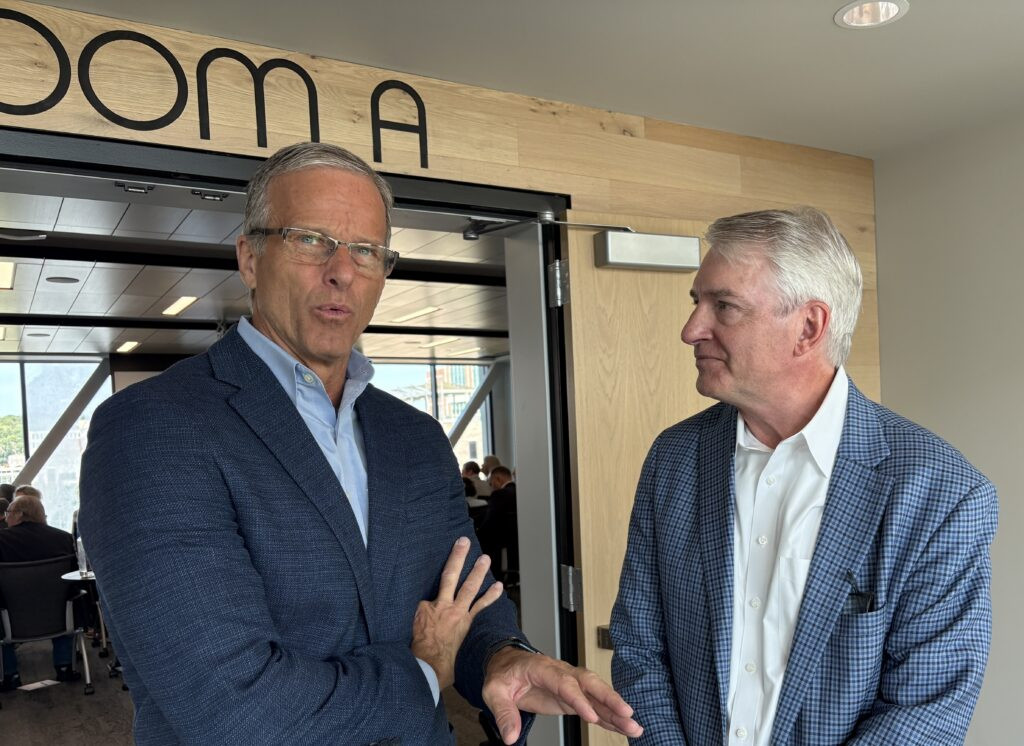
U.S. Senate Majority Leader John Thune, R-South Dakota, speaks with Northwestern Energy President and CEO Brian Bird in Sioux Falls on Aug. 18, 2026. (Photo by Joshua Haiar/South Dakota Searchlight)
SIOUX FALLS — U.S. Senate Majority Leader John Thune, R-South Dakota, said this week that permitting reform could offer a rare opportunity for bipartisan action in Congress.
Thune discussed the issue on Tuesday during a summit hosted by Northwestern Energy, which has about 65,000 customers in the state and plans to merge with Black Hills Energy to become Bright Horizon Energy Corporation.
Thune told attendees lawmakers are considering shorter federal reviews for energy projects and time limits on legal challenges from project opponents.
“As soon as they’re ready to go, we’ll put it on the floor” of the Senate for a vote, Thune said.
The politics around the issue, Thune said, have shifted because developers of coal, natural gas, wind, solar and nuclear projects have run into similar obstacles, and have brought those concerns to their elected officials. Democrats have watched renewable energy projects encounter those hurdles, which he said has created momentum for reform.
Support from Democrats matters in the Senate, he said, where major legislation requires 60 votes to overcome a filibuster. Republican senators need some Democratic support.
The Senate Environment and Public Works Committee and Energy and Natural Resources Committee are hashing out potential permitting reform, he said.
South Dakota inches toward studying nuclear power as data center energy demands loom
Ranking Democratic members of the two committees said in March they want a bipartisan bill to speed up development, lower energy costs, and create jobs. The Democrats warned, however, that progress depended in part on the Trump administration backing off its opposition to renewable energy projects.
Among other policy shifts, the administration has argued that offshore wind is a national security threat, tightened eligibility requirements for wind and solar tax credits and moved to pull back Biden-era “Solar for All” grants. Last October, the Bureau of Land Management cancelled what would have been the nation’s largest solar energy project last October.
Thune said the negotiations come at a time when Congress is more partisan and polarized than he has ever seen. That makes bipartisan policymaking difficult, but energy permitting reform may be an exception.
“I’m a realist,” Thune said. “But I feel good about where things stand.”
Permitting reform
Northwestern and other utilities anticipate rapidly growing demand, including that associated with data centers. Thune said faster and more predictable permitting could unlock more private investment at a time when the nation needs additional electricity generation and transmission.
Congress should put permitting reform into federal law rather than rely on regulations that can change from one presidential administration to another, Thune said. He said different administrations will continue to treat fossil fuels and renewables differently. Thune, for his part, said he favors an “all of the above” energy strategy.
A permitting “shot clock” to establish deadlines for the review process is one possibility, he said. He also wants Congress to address litigation after permits are issued, including how quickly courts deal with litigation and who can file legal challenges.
Nuclear power
Nuclear power could also draw bipartisan support, he said, particularly small modular reactors. The reactors are designed to be smaller than traditional nuclear plants, looking more like a warehouse than a large power plant. They produce up to 550 megawatts of electricity, according to information shared by Northwestern Energy.
“Nuclear is, you know, it’s kind of back in vogue, especially the smaller modular reactors,” Thune told Searchlight. “We want to, as much as we can, create conditions that are favorable for investment there.”
Northwestern Energy has spent more than $800,000 studying small modular nuclear reactors in South Dakota. The company is evaluating potential sites and is helping establish a nonprofit to educate the public about nuclear power, dubbed the “South Dakota Nuclear Collective” in documents filed by the company with the state Public Utilities Commission.